The Minister of Lands and Natural Resources, Hon. Emmanuel Armah-Kofi Buah, has issued a compelling call to global investors, declaring Ghana’s leadership as the continent’s premier gold producer and positioning the nation as a gateway for sustainable mineral investments.
Speaking at the China Mining 2026 conference in the People’s Republic of China, the Minister delivered a high-level address to distinguished ministers, heads of delegation, and international leaders across the mining, finance, and technological sectors.
He emphasized that Ghana’s decades-long diplomatic and economic partnership with China provides a solid foundation for entering a new chapter of value creation. By highlighting the nation’s historical standing as Africa’s Gold Coast alongside its rich endowment of critical minerals, Hon. Buah framed Ghana as an ideal destination for green and intelligent resource development.
“How do resource-rich countries and their partners create prosperity that lasts beyond the life of a mine? Ghana comes to this conversation, and Africa comes to this conversation with experience, ambition, and a clear sense of direction. We are Africa’s Gold Coast, leading gold producers. We hold significant reserves of bauxite, manganese, iron ore, diamonds, and many more, alongside an emerging endowment of critical minerals required by the changing global economy.”
Hon. Emmanuel Armah-Kofi Buah,
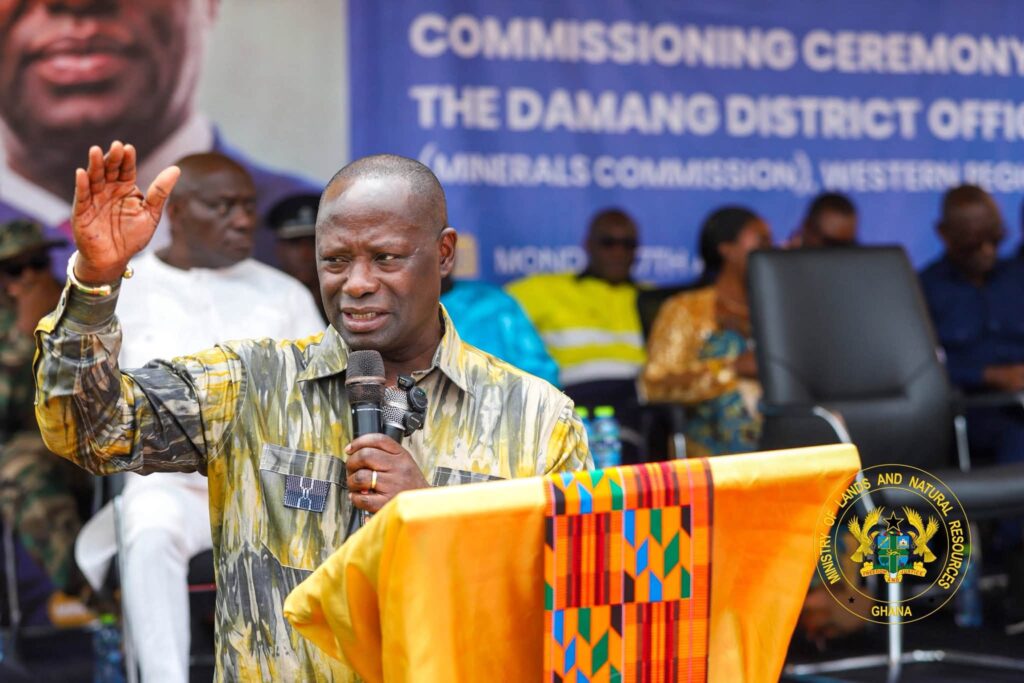
Hon. Buah outlined the extensive breadth of Ghana’s natural resource base, which extends far beyond traditional bullion deposits. Ghana holds significant reserves of bauxite, manganese, iron ore, and diamonds, coupled with a rapidly growing endowment of critical minerals necessary to power the global green energy transition.
The Minister stressed that the modern era of natural resource exploitation requires moving beyond mere raw extraction toward long-term economic capacity.
To achieve this vision, he urged international financial and technology partners to align with Africa’s ambition for green mining, environmental reclamation, and lawful small-scale operations.
He noted that lessons drawn from China’s successful land restoration initiatives can directly inform and strengthen ongoing mining reforms across the African continent.
A Paradigm Shift: Moving Beyond Raw Material Extraction
Ghana’s pitch at China Mining 2026 reflects a crucial shift in how resource-rich African nations approach global partnerships and mineral extraction.
Historically, the extractive sector across Sub-Saharan Africa operated under a traditional export model, where raw ores were extracted and shipped abroad with minimal local processing.
This economic framework frequently left mining communities exposed to environmental degradation while missing out on the broader benefits of industrial value addition.
Hon. Buah’s address underscores a deliberate effort to pivot toward local content development, technological transfers, and downstream processing.
By insisting that success be measured by “what we have above” the ground, the Ministry of Lands and Natural Resources is aligning national mining strategies with long-term industrialization goals.
Assertions made by the Minister highlight that modern resource management requires building resilient industries and developing domestic technical skills. “Win-Win Cooperation, Green and Intelligent Mining” is no longer just a diplomatic conference theme; it represents an essential investment requirement.
Investors are expected to integrate environmental management, tailing containment, and post-mining land restoration into their operational budgets.
For Ghana, securing commitments to local capacity building ensures that mineral wealth translates into durable infrastructure and sustainable livelihoods long after reserves are exhausted.
Leveraging Critical Minerals for the Global Energy Transition
The urgency behind Ghana’s investor charm offensive is further driven by the rapid global pivot toward renewable technologies and electric mobility.
As international markets demand increasing volumes of lithium, cobalt, manganese, and rare earth elements, resource-endowed nations hold significant strategic leverage.
Hon. Buah noted during his presentation that Ghana’s emerging critical mineral endowment positions the country at the center of the changing global economy.
By courting established industrial giants like China, Ghana seeks to secure high-tech partnerships that combine capital investment with state-of-the-art ecological management techniques.
Furthermore, the emphasis on “lawful small-scale mining” addresses a pressing socio-economic challenge facing Ghana’s extractive industry. Regulating artisanal and small-scale mining while encouraging eco-friendly technology adoption remains critical to protecting water bodies and agricultural lands.
Drawing on practical models of mined-out area restoration observed during ministerial visits to China, government regulators aim to enforce stricter reclamation standards without suppressing local entrepreneurial participation in the sector.
Building Lasting Prosperity Through Bilateral Partnerships
Ghana and China share a historic diplomatic and trade partnership spanning over six decades. Hon. Buah referenced these historical ties to assure prospective investors of Ghana’s political stability, institutional transparency, and welcoming investment climate.
As bilateral trade continues to expand across infrastructure, trade, and education, the mining sector stands out as a vital pillar for future economic cooperation.
By advocating for green and intelligent mining frameworks, Ghana aims to set a benchmark for responsible resource governance across West Africa.
The Minister’s address serves as both an open invitation to responsible global capital and a firm declaration of policy direction: future mineral exploration in Ghana must yield mutual prosperity, ecological restoration, and tangible growth for local host communities.
READ ALSO: DR Congo Detects Ebola Case in Northwestern Province Far From Epicentre