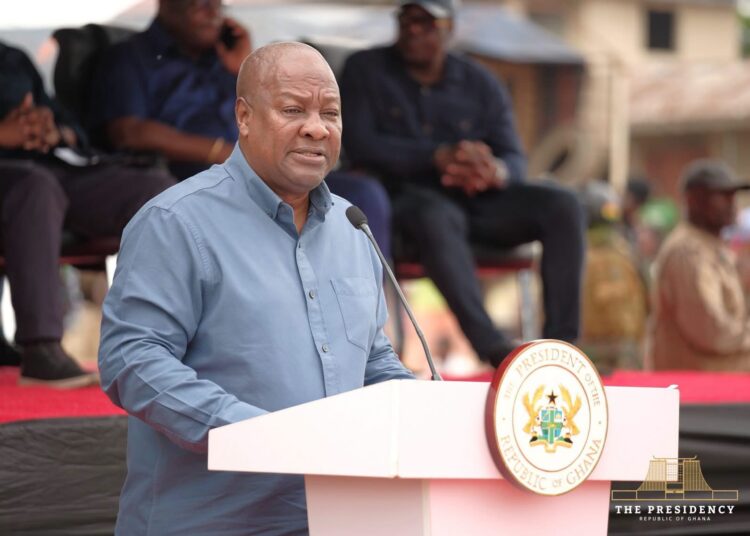
President John Dramani Mahama has unveiled plans by the government to establish a major maize processing plant in the Sissala enclave of the Upper West Region, a move aimed at permanently resolving the annual maize glut that has left farmers in distress.
The President said the factory will serve as a guaranteed off-taker for maize produced in the area, while adding value to the crop for local use and for the export market.
He made the announcement during a citizens’ engagement held at the University of Business and Integrated Development Studies [UBIDS] in Wa, as part of his tour of the Upper West Region.
According to President Mahama, the Sissala area, which comprises Sissala East and Sissala West, is one of Ghana’s biggest maize production zones, contributing a significant portion of the country’s total maize output.
However, that productivity has become a double-edged sword, as farmers in the area consistently face a lack of ready market during bumper harvests, leading to post harvest losses and price crashes.
The President noted that the establishment of the processing plant will change that narrative by creating a sustainable market linkage.
“We are going to set up a maize processing plant in the Sissala area. The plant will not only buy the maize, but it will also process the maize for the market and for export, and so I believe that this glut will become a thing of the past.”
President Mahama
The planned factory, he explained, will process maize into various value-added products including maize grits, flour, and animal feed, which are in high demand both domestically and across the West African sub region.
This industrial approach, he said, is part of a broader strategy to move Ghana’s agriculture from mere primary production to agro-industrialization, where farmers earn more because their produce is processed.
The Lack of Storage Forces Low Prices
For years, maize farmers in Sissala, Tumu, Gwollu and surrounding communities have complained about being forced to sell their produce at giveaway prices to middlemen due to the absence of storage and processing infrastructure.
During the 2024 and 2025 crop seasons, reports of farmers leaving maize to rot on farms or selling a 100kg bag for as low as GH¢150 were common, far below production cost.
President Mahama acknowledged the frustration of the farmers and said the new plant is designed to restore confidence and incentivize expanded production.
“The whole idea is to encourage our farmers to produce more because they know when they produce, there is a ready market. When you have a processing plant that is ready to buy and process, the farmer is motivated to go into increased production.”
President Mahama
Beyond the processing plant, the President also announced a major intervention to strengthen the National Food Buffer Stock Company [NAFCO], which is mandated to mop up surplus produce and ensure food security.
He admitted that NAFCO’s capacity to absorb the excess maize from the market has been severely limited by inadequate funding and lack of modern storage facilities.
To address this, President Mahama disclosed that government will significantly increase the financial allocation to Buffer Stock to enable it to purchase more maize from farmers during the peak season.
“Aside from that, we are increasing the amount of money that we are giving to Buffer Stock to off-take the excess maize.’’ In addition, he announced that government will construct large scale silos at NAFCO’s storage centres across the country to expand storage capacity and reduce post-harvest losses.
New Silos to Improve Storage and Stabilize Prices
The silos, according to the President, will allow NAFCO to store maize for longer periods under better conditions, preserve quality, and release stock onto the market in a regulated manner during the lean season to stabilize prices.
The dual approach building a processing plant and empowering Buffer Stock – is expected to create a comprehensive solution to the glut problem. While the factory provides a permanent industrial market, Buffer Stock will serve as a price stabilization mechanism and strategic reserve.
The Sissala area alone produces over 100,000 metric tonnes per season, and stakeholders have consistently called for an industrial enclave to be sited there. The presence of a processing plant would not only create jobs for the youth in processing, packaging and transport, but also cut the cost of transporting maize to southern markets.
President Mahama reiterated that his administration’s agricultural policy is focused on making farming profitable, attractive to the youth, and resilient. He assured farmers that the Sissala maize processing plant will be prioritized and executed in collaboration with the private sector to ensure efficiency and sustainability.
READ ALSO:IEA Warns Of Tighter Oil Market, Ghana Faces Fuel Pressure