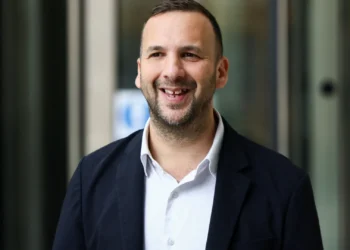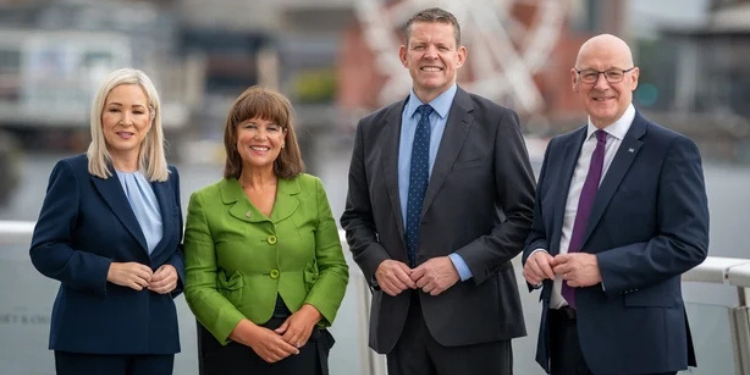
The leaders of Scotland, Wales and Northern Ireland have joined forces to push for independence and constitutional change, declaring that Westminster’s time is coming to an end as they seek to increase pressure on the British Government to facilitate referendums on the future of the three nations.
The agreement was signed by SNP leader and Scotland’s First Minister John Swinney, Plaid Cymru leader Rhun ap Iorwerth and Sinn Féin Vice President and Northern Ireland First Minister Michelle O’Neill in Cardiff, setting out plans for greater cooperation on independence, economic growth, energy and international relations.
Sinn Féin President Mary Lou McDonald also participated in the meeting.
Although the leaders met in their capacity as party leaders rather than as representatives acting on behalf of their respective governments, the agreement marks a coordinated attempt to strengthen cooperation among political movements seeking to loosen or end constitutional ties with Westminster.
The parties argued that the political landscape across United Kingdom and Ireland is changing and that growing support for independence and Irish reunification could reshape relationships between the nations.
“For the first time ever, people across these islands have first ministers in Scotland, in Wales and in the North of Ireland who are all committed to independence from the United Kingdom.
“For people watching across these islands, for people watching around the world there could be no clearer sign that Westminster’s time is coming to an end.”
The leaders of Scotland, Wales and Northern Ireland
The declaration reflects a broader political argument from the three parties that Scotland, Wales and Northern Ireland should have greater authority to determine their own constitutional futures rather than having such decisions ultimately controlled by Westminster.
According to the leaders, they wanted to establish a model based on cooperation between nations as equals, rather than continued political dependence on the UK Government.
“We believe there is a better way: nations working together as equals, sharing ideas and expertise, and building relationships based on mutual respect and common interests.”
The leaders of Scotland, Wales and Northern Ireland
They also argued that the momentum behind their respective constitutional movements was increasing and that political cooperation could help prepare for future changes.
The agreement commits the parties to strengthening cooperation and identifying areas where they can work together, including economic growth, energy and international cooperation.
Parties Challenge Westminster Over Constitutional Future
The joint declaration places self-determination at the centre of the three parties’ political agenda.
The leaders stated that their nations had a right to determine their own futures and rejected the idea that Westminster should have the authority to prevent constitutional change.
“Our nations have the right to self-determination. No Westminster government has the right to block democracy or undermine the principle that our people will decide their own future.”
The leaders of Scotland, Wales and Northern Ireland
However, the parties also acknowledged that their constitutional ambitions are not identical.
Scotland’s independence campaign seeks to establish an independent Scottish state, while Plaid Cymru advocates Welsh independence. Sinn Féin, meanwhile, supports the reunification of Ireland, bringing Northern Ireland into a united Irish state.
The agreement therefore recognises that each nation will pursue its constitutional future according to its own political circumstances.
Despite those differences, they called on the British Government to begin preparing for potential constitutional change.
The parties also sought to broaden their cooperation beyond constitutional questions.
The agreement includes proposals to challenge “whitehall’s broken economic model,” while encouraging the sharing of ideas on economic growth and cooperation in energy.
The leaders further stated that “the future of our nations belongs in the European Union,” linking their constitutional ambitions with a broader desire for closer European cooperation.
The declaration therefore presents independence not simply as a constitutional objective but as part of a wider political and economic vision based on cooperation among neighbouring nations.
Speaking at the signing event, Michelle O’Neill pointed to recent comments by US President Donald Trump in support of Irish unity as evidence that the debate was attracting increasing international attention.
“I think the comments from the president of the United States very much reflect the fact that the unity debate is very much alive, and people are engaged in it, not just at home, but obviously now internationally as well.”
Michelle O’Neill
She described Irish unity as the “big prize” for those supporting reunification.
“I think that tells us where we’re at with where the thinking is around what is the big prize here for our people, and the big prize here is unification. It is the end of partition and it is that new beginning in a new Ireland.”
Michelle O’Neill
Ms O’Neill added that recent developments demonstrated that the debate was attracting a wider group of participants.
At the same time, Scotland remains at the centre of the UK’s wider constitutional debate.
Scotland’s Deputy First Minister Jenny Gilruth has claimed that the trigger point for another independence referendum has already been reached.
She has also indicated that she does not believe UK Prime Minister Andy Burnham is an “ardent unionist,” following previous comments by the Prime Minister about the future of the Union.
However, the Scottish Government continues to face the fundamental question of whether Westminster would agree to another legally recognised referendum.
Successive UK governments have maintained that another Scottish independence vote should not take place after the 2014 referendum, in which voters rejected independence.
That position was again tested after Mr Burnham indicated in the House of Commons that another referendum could take place if there were a “clear consensus” for one in Scotland.
However, a subsequent letter sent to Mr Swinney clarified the government’s position, making clear that a further independence referendum remained “off limits.”
The Cardiff agreement therefore represents an attempt by the three parties to increase political pressure through collective action.
READ ALSO: Iran Condemns Visa Denial For Nuclear Chief