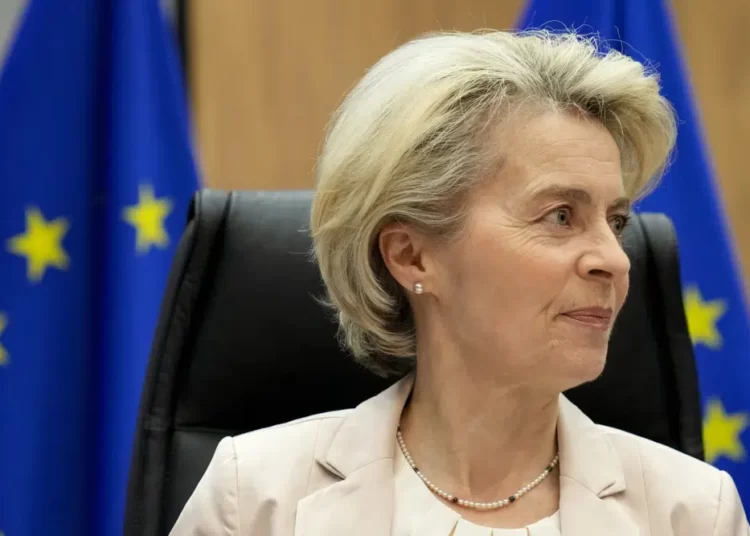
European Commission President, Ursula von der Leyen has proposed making Canada the European Union’s first associate member, signalling a significant effort to deepen economic and security ties between Ottawa and Brussels as U.S. trade policies push Canada closer to Europe.
Von der Leyen made the proposal during her annual State of the European Union address at the European Parliament in Strasbourg, where Canadian Prime Minister Mark Carney was seated in the front row.
She welcomed Carney, saying that his presence “is a symbol of the enduring friendship between our people.”
“Mark, Europe and Canada believe in democracy. That power does not belong to the strongest, richest and loudest, but to all of us. That democracies have the freedom to choose with whom to work. So we are joining forces voluntarily.”
Ursula von der Leyen
She stated that the EU wants to “move the partnership with Canada to the highest level possible.” “I would like to work with you on opening the door for Canada being the first associate member of the EU,” von der Leyen told Carney. “This is not a partnership against anyone else but for our common strength,” she added.
She said that the proposed partnership would seek to establish “a common prosperity and economic security space” between Canada and the European Union, extending cooperation well beyond traditional trade relations.
The overture comes as U.S. President Donald Trump’s tariffs and repeated comments about Canada becoming the 51st U.S. state have prompted Ottawa to pursue stronger economic and security relationships with other international partners.
The United States remains Canada’s dominant trading partner, with roughly 70% of Canadian exports going to the country. Carney has therefore called for a “unique alliance” with the EU as Ottawa seeks to reduce its economic dependence on the United States.
Von der Leyen framed the proposed relationship as being based not only on economic interests but also on shared democratic principles.
Under the proposed expanded partnership, cooperation could cover a broad range of strategic sectors, including advanced manufacturing, technology, defence production, the Arctic, energy, critical minerals, batteries, artificial intelligence, quantum computing, cybersecurity and economic security. “In short, we want to bring the relationship with Canada to the highest level possible,” von der Leyen said.
The proposal nevertheless comes without detailed arrangements for how associate membership would operate. Von der Leyen did not explain how such a status would fit within the EU’s existing framework, including the countries currently negotiating full membership of the bloc.
Canada has already taken steps toward closer cooperation with the EU on defence. Earlier this year, it became the first non-European country to join the EU’s €150 billion ($173 billion) SAFE defence programme, providing Canadian companies with access to joint procurement opportunities.
The proposal has also received support from some European lawmakers.
Iratxe García Pérez, President of the Socialists & Democrats group in the European Parliament, praised Carney for showing “great courage confronting Donald Trump” and argued that allies were needed to defend “sovereignty, solidarity and international law.”
Canada has responded to U.S. tariffs with retaliatory measures while rejecting trade arrangements that Carney has said could undermine the country’s sovereignty.
Barry Andrews, Chair of the European Parliament’s Development Committee, described Canada as “a perfect ally for Europe” and pointed to potential benefits for Ireland, noting that more than 10% of Canadians claim Irish ancestry.
The proposed relationship would mark a significant expansion of Canada-EU ties, building on the existing Comprehensive Economic and Trade Agreement, or CETA.
Carney’s Office Welcomes EU Proposal
Carney’s office welcomed von der Leyen’s proposal, describing Canada’s closer engagement with the European Union as part of efforts “to strengthen our sovereignty.”
The office also backed moving beyond the existing CETA framework toward what it described as an “Alliance for the Future.”
The response indicates that Ottawa is receptive to the EU’s proposal as Canada seeks to broaden its economic and strategic partnerships.
Von der Leyen’s offer aligns with what Canadian Prime Minister Mark Carney called the “middle powers” in his Davos speech in January.
In a closely watched speech at the World Economic Forum in Davos in January, he urged middle powers to work together to increase their leverage in an era of great-power rivalry.
“When we only negotiate bilaterally with a hegemon, we negotiate from weakness. We accept what is offered. This is not sovereignty. It is the performance of sovereignty while accepting subordination.”
Mark Carney
Carney’s Davos speech on middle powers in January drew a personal rebuke from Trump, and von der Leyen’s overture to America’s neighbor could raise the temperature again.
For the EU, the proposal represents an effort to take its relationship with Canada to a new level, with cooperation potentially extending across trade, defence, technology, energy and other strategic sectors.
While the details of associate membership remain to be established, the proposal signals a willingness on both sides to explore a deeper institutional relationship at a time of shifting trade and geopolitical dynamics.
READ ALSO: Sánchez Rules Out Moroccan Role In Ceuta Migrant Surge