Ghana Revenue Authority estimates that six in ten businesses are not meeting their tax obligations, shifting the revenue debate from tax rates to whether uneven compliance is distorting competition and limiting formal-sector growth.
Ghana’s economic recovery is confronting a structural weakness inside the business environment after the Ghana Revenue Authority said about six out of every ten businesses are not complying with their tax obligations.
Commissioner-General Anthony Kwasi Sarpong made the disclosure at the 2026 AGI Industrial Summit and Exhibition in Accra on Tuesday, warning that uneven compliance is creating an unfair competitive environment. “For every 10 businesses in Ghana, about six are not complying,” he said.
The concern extends beyond revenue losses. A firm that records sales, remits VAT, files returns and bears the administrative cost of compliance can face a higher effective cost base than a competitor operating partly outside the tax system.
In markets with thin margins, that difference can affect prices and reinvestment, allowing non-compliance rather than productivity to become a source of competitive advantage.

The disclosure comes as Ghana’s economy expands strongly but public revenue still trails programme. Real GDP grew by 6.0% year on year in the second quarter of 2026, while government revenue and grants remained below target in the first half. Tax compliance therefore sits at the intersection of two challenges: converting stronger activity into sustainable public revenue and ensuring formal firms are not penalised for obeying the rules.
Non-Compliance Distorts Business Competition
In a well-functioning tax system, firms should compete mainly on productivity, quality, innovation and service. Uneven compliance changes that calculation. A non-compliant operator can potentially undercut a tax-paying rival without being more efficient, simply because part of its statutory cost is absent from the final price.
That can also weaken incentives to formalise. Businesses deciding whether to maintain proper accounts, issue tax invoices and invest in compliance systems will compare those costs with the benefits of operating formally.
If firms outside parts of the tax net continue competing for the same customers, formalisation can begin to look like a commercial penalty rather than a route to scale, finance and larger markets.
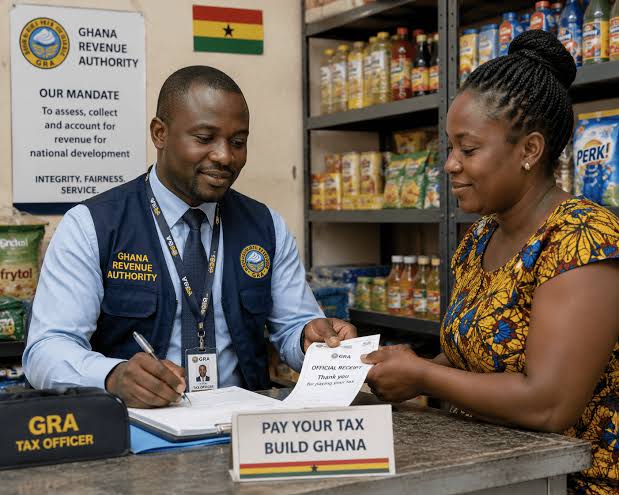
The distortion can ultimately affect consumers too, because market share may shift towards firms with lower tax compliance rather than those producing at lower real economic cost.
Formalisation Needs More Than Enforcement
GRA’s six-in-ten estimate is striking, but the Authority did not publish the underlying dataset or methodology alongside the disclosure. It should therefore be treated as GRA’s administrative assessment rather than a statistically representative estimate of every business operating in Ghana.
The policy response must also recognise that persistent non-compliance can reflect more than deliberate avoidance. Weak record-keeping, limited tax knowledge and administrative complexity can all make compliance harder, particularly for smaller firms.
Stronger enforcement is necessary, but it needs to be paired with simpler processes, predictable rules and consistent treatment so that compliant businesses do not carry an increasingly disproportionate burden.
Digitisation Can Broaden the Tax Base
GRA is relying increasingly on technology to close these gaps. The Authority has launched its Integrated Tax Administration System, or ITAS, as part of a wider move away from manual and semi-manual processes.

Mr Sarpong also said Fiscal and Accounting Devices will be implemented in the final quarter of 2026 to strengthen transaction monitoring and VAT compliance. The economic value of digitisation lies in reducing information gaps between businesses and the tax authority.
Better transaction records can make under-reporting harder, reduce discretionary treatment and lower the time firms spend dealing with tax administration. But the test is whether technology brings previously under-monitored activity into the tax net, rather than simply intensifying scrutiny of businesses already visible to GRA.
Revenue Growth Must Follow Business Growth
Sarpong framed GRA’s approach as growth-led revenue mobilisation rather than repeated tax-rate increases. “When your business grows, the nation can collect more without raising a single rate,” he said. GRA reported collections of GH¢182 billion in 2025 and is targeting GH¢225 billion in 2026.
That strategy is more durable if higher collections come from a wider effective tax base, stronger profitability and improved compliance. Repeatedly raising the burden on existing taxpayers can weaken investment incentives while leaving the underlying compliance gap unresolved.
A broader base would also give government more room to finance public services and productive investment without relying as heavily on new tax measures aimed at the formal sector.

For Ghana’s economy, the next test is therefore not simply whether GRA collects more, but how it does so. Businesses will be watching the Q4 rollout of the new monitoring devices, the operation of ITAS and whether enforcement increasingly reaches firms outside the effective tax net.
If broader compliance is matched by simpler administration and predictable rules, Ghana could strengthen public revenue while improving competitive fairness across the private sector.
READ ALSO: Gov’t Positions Economic Zones as Drivers of Jobs and Exports