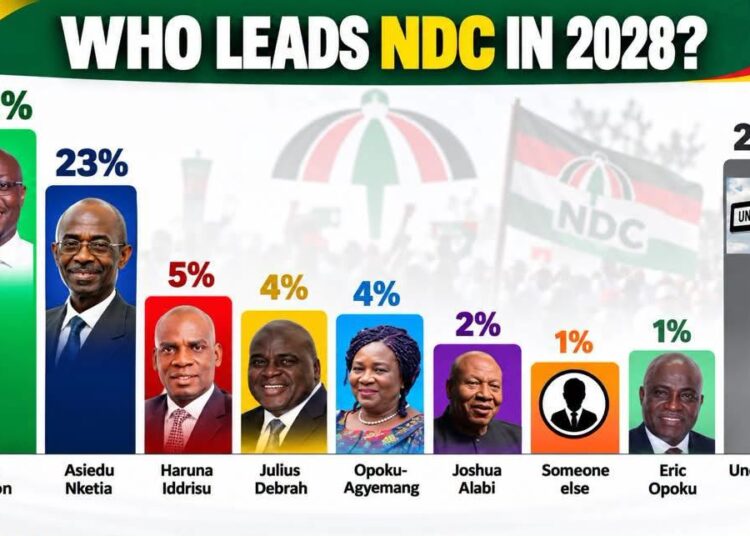
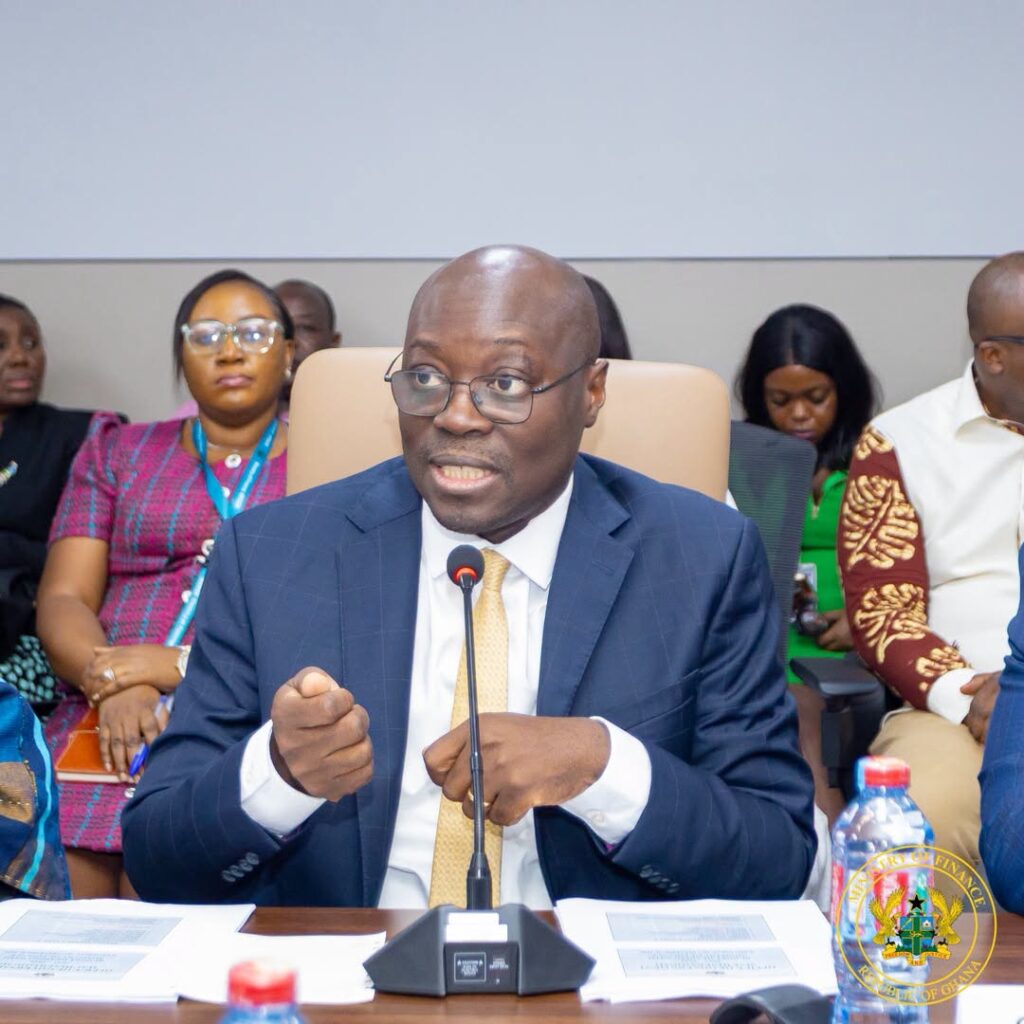
Finance Minister Dr Cassiel Ato Forson has moved to the front of the contest to lead the National Democratic Congress into the 2028 general election, polling 32 percent among party delegates in Global InfoAnalytics’ September survey.
The firm’s executive director, Mussa Dankwah, published the figures on Monday, September 14, 2026, and walked through the details in a televised breakdown from Accra. The shift matters because of its size and direction.
Dr Ato Forson climbed from 22 percent in July to 32 percent, a ten-point gain that Mr Dankwah described as unprecedented in the tracking series, where no contender had previously moved more than five points between polls. National Chairman Johnson Asiedu Nketia, who led the July survey, fell four points to 23 percent.
Ato Forson’s ten-point jump reorders the NDC 2028 race
The rest of the field either stalled or slipped. Education Minister Haruna Iddrisu polled 5 percent, down from 6. Chief of Staff Julius Debrah dropped a point to 4 percent. Vice President Jane Naana Opoku-Agyemang took the heaviest loss in proportional terms, sliding from 7 percent to 4.
Joshua Alabi, chairman of the GCB Bank PLC board and campaign manager for President John Mahama’s 2024 bid, edged up from 1 percent to 2 percent. Agriculture Minister Eric Opoku held at 1 percent, with another 1 percent naming other aspirants.
Undecided delegates fell from 30 percent to 28 percent. Mr Dankwah traced almost all of that movement into Ato Forson’s column, with a single point going to Alabi. On his reading, Alabi was the only other contender in the field to register net momentum, and every other named aspirant lost ground or stood still.
Head-to-head numbers give the Finance Minister a cushion
The survey also tested a straight contest between the two leading candidates, and that is where the gap widens. Ato Forson took 41 percent against Asiedu Nketia’s 30 percent, with 29 percent undecided. In July, the same question produced a statistical tie, Asiedu Nketia on 34 percent and Ato Forson on 33, with a third of delegates unwilling to choose.
Both leaders retain their own voters almost completely. Ato Forson keeps 96 percent of his first-round support in a run-off, losing 3 percent to the chairman. Asiedu Nketia keeps 95 percent, losing 3 percent to the Finance Minister.
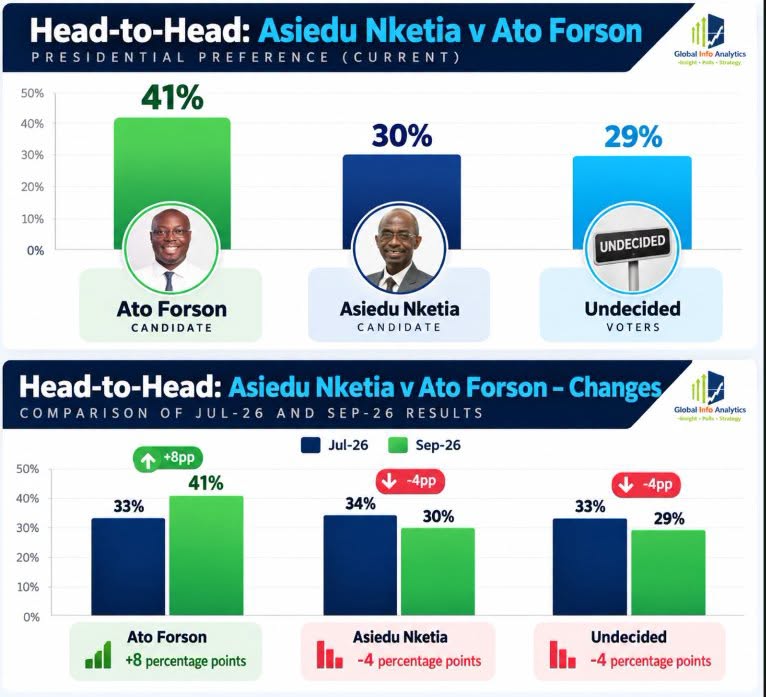
The contest therefore turns on delegates who have not yet committed, and there the flow runs one way. Mr Dankwah put the current split at roughly three undecided delegates moving to Ato Forson for every one moving to Asiedu Nketia.
Delegates still want an economist leading the party
Underneath the horse race sits a question Global InfoAnalytics has been asking for several cycles, on whether delegates agree that an economist should lead the NDC against the New Patriotic Party, which Mahamudu Bawumia currently fronts. Agreement dipped from 58 percent to 56 percent, while disagreement fell from 23 percent to 20 percent.
Mr Dankwah treated that pattern as a triangulation check rather than a headline. Had the drop in agreement moved into the disagree column, it would have signalled softening appetite for a technocratic ticket and improved the chairman’s position.
Instead both sides shed support to the no-opinion category, leaving the underlying preference intact while the named ballot moved decisively toward the Finance Minister. He also addressed the apparent mismatch between 56 percent endorsing an economist and Ato Forson taking only 32 percent.
The larger figure captures a general disposition, he argued, while the ballot question splits that disposition across four candidates with economics credentials. His position is that the poll now shows delegates settling on Ato Forson as the strongest of those options.
Timing keeps the race open
The survey covered 3,615 NDC delegates between September 11 and 13, 2026, at a 99 percent confidence level with a margin of error of 2.17 percentage points.
It lands as the party works through its internal reorganisation, with constituency executive elections set for October 24 and 25 across 276 constituencies, followed by regional and national contests before the flagbearer conference.
That sequence leaves considerable room for the picture to change. The party is not expected to elect its 2028 candidate until late 2027 or the opening months of 2028, and Mr Dankwah was careful to frame the September findings as a snapshot rather than a forecast, promising further updates as the internal calendar unfolds.