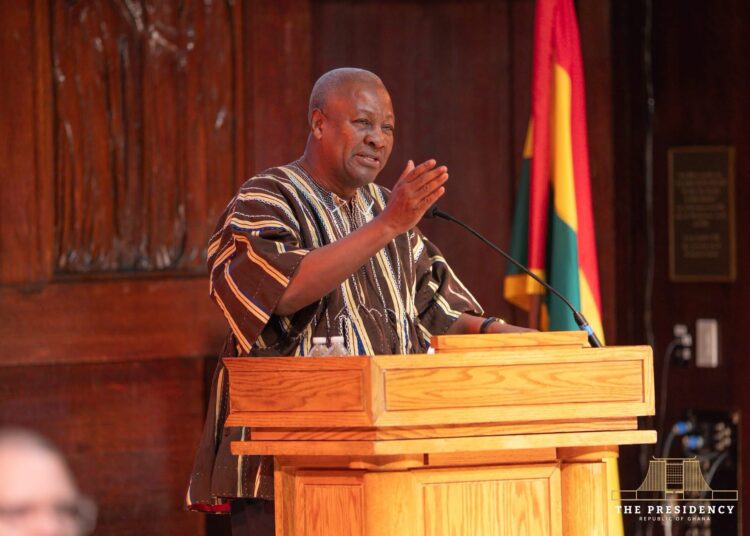
President John Mahama says government has prepared 10 state-owned enterprises (SOEs) for listing on the Ghana Stock Exchange (GSE), in a move aimed at strengthening corporate governance, improving financial performance and reducing political interference in the management of state companies.
The President made the disclosure during a business and investment engagement in New York on the sidelines of the 81st United Nations General Assembly. He said converting the selected enterprises into publicly listed companies would introduce greater accountability and broaden ownership by allowing Ghanaians to invest in state assets.
According to President Mahama, one of the central reasons for the planned listings is to address governance challenges that have historically affected some state-owned enterprises, particularly changes in management and boards following changes in political administration.
“They’ll become public companies, one, because we want to improve their governance, and two, because we want to reduce political interference in those state-owned enterprises.”
President of Ghana, H.E John Dramani Mahama
He explained that listing the companies would introduce other shareholders into their ownership structures, making it more difficult for governments to make management and board changes without consideration for the interests of other shareholders.
“If we list more of these companies, it makes it difficult for government to interfere and sack the management and dissolve the boards and all that.”
President of Ghana, H.E John Dramani Mahama
The proposed listings form part of a broader effort to reform Ghana’s state-owned enterprise sector and improve the contribution of state assets to economic growth.
The State Interests and Governance Authority (SIGA), which oversees the performance of state interests, recently published its 2025 State Ownership Report covering 162 of 175 approved specified entities.
The report covers 53 SOEs, 36 joint venture companies and 73 other state entities, providing information on their financial and operational performance. SIGA says the report is intended to support transparency, accountability and informed decision-making concerning state assets.
The Performance of the SEO Sector has Improved
President Mahama said the performance of the SOE sector had also improved, noting that the entities collectively recorded a net profit of almost GH¢19 billion in the latest reporting period, after years of collective losses. SIGA’s 2025 State Ownership Report puts the sector’s net profit after tax at GH¢19.8 billion.
Despite the reported improvement, the President argued that stronger market-based accountability was necessary to ensure that state companies remain financially disciplined.
He cited concerns over a culture in which employees and managers could continue demanding salary increases and bonuses even when enterprises were recording losses.
“There’s this notion of state enterprises where people just go and they’re guaranteed a monthly salary whether they perform well or not,” he said. “Even when they’re making losses, they’re asking for salary increments and asking for bonuses when you’ve made a loss.”
President of Ghana, John Dramani Mahama
The planned listings would therefore potentially change the relationship between the state and the enterprises by exposing the companies to the expectations of public shareholders and capital-market participants. Listed companies are generally required to provide regular financial and corporate information to the market, creating additional mechanisms for investors to assess performance.
The Ghana Stock Exchange has previously engaged both government and SIGA on the potential listing and capital raising activities of SOEs. In its 2025 market report, the GSE said discussions with SIGA focused on how state-owned enterprises could raise capital through the Exchange while improving transparency and corporate governance.
The initiative could also deepen Ghana’s capital market by increasing the number of sizeable companies available to domestic and international investors.
The Mobilisation of Private Capital for Expansion
The government has previously indicated that bringing SOEs onto the exchange could help mobilise private capital for expansion and development.
For Ghanaians living outside the country, President Mahama said the listings could create an additional avenue to participate directly in the ownership of Ghanaian businesses.
He has separately called for a shift in diaspora engagement from reliance on remittances towards long term investment. The Information Services Department reported that the President is working on a framework to enable Ghanaians abroad to invest safely in Ghana through structured investment opportunities.
The President also highlighted the recent performance of the Ghana Stock Exchange as part of the rationale for using the capital market to mobilise investment. He noted that the exchange had recovered strongly and that three initial public offerings had been completed in record time. “It’s a Good Place to Invest, Some of them are Paying Quite Good Profits,” he said.
The government’s plan builds on earlier efforts to use the GSE as a source of capital for state enterprises. In 2025, the GSE said its engagement with SIGA included discussions on SOE capital raising, transparency, accountability and sound corporate governance.
However, government has not yet publicly disclosed the names of the 10 enterprises selected for listing, the proportion of shares that would be offered to investors, or the specific timetable for the transactions.
Those details will be important in determining how the listings will affect public ownership, government control and investor participation.
The initiative therefore represents a proposed shift in the management and financing of selected state assets, with the government seeking to combine public ownership with greater participation from private and institutional investors.
For the Ghanaian economy, the success of the programme will depend on how the selected enterprises are prepared for listing, the quality of their financial reporting, the governance arrangements put in place and the level of investor confidence in the companies.
READ ALSO:Mahama Credits Fiscal Discipline for Ghana’s Economic Recovery