The UK-Ghana Trade and Investment Summit is bringing together government officials, business leaders, investors and development stakeholders in Accra as Ghana and the United Kingdom deepen efforts to expand trade, investment and private-sector partnerships.
Held under the theme, “A Decade of Trust, A Future Always On: Scaling the UK-Ghana Growth Partnership,” the summit is focusing on Ghana’s economic performance, investment opportunities and the role of the private sector in driving sustainable growth and export expansion.
The gathering comes as Ghana positions itself as an increasingly important investment and production hub within Africa, supported by improving macroeconomic indicators and policies aimed at strengthening industrialisation, exports and private-sector participation.
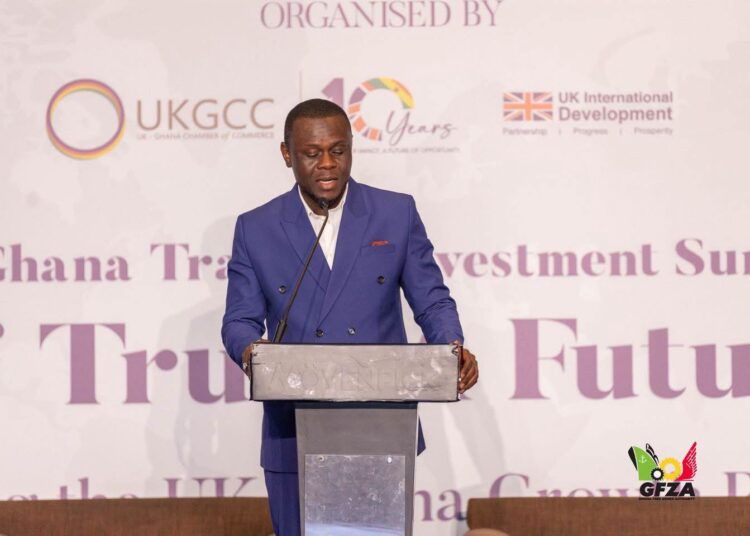
Deputy Minister for Trade, Agribusiness and Industry, Hon. Sampson Ahi, highlights the country’s recent economic performance, pointing to real GDP growth of about 6% in 2025 and 6.4% in the first quarter of 2026. Ghana’s economy has also crossed the US$100 billion mark and is ranked among Africa’s eight largest economies.
The economic figures form part of Ghana’s broader investment proposition as government seeks to attract capital into productive sectors, expand domestic manufacturing and increase the country’s participation in regional and international value chains.
The summit also places significant attention on market access and Ghana’s potential to serve as a gateway to the wider African market. This is particularly relevant as businesses seek to take advantage of the African Continental Free Trade Area (AfCFTA), which provides a framework for expanding intra-African trade and investment.
Ghana Free Zones Authority Supports Export Oriented Investment
A key feature of the discussions is the role of the Ghana Free Zones Authority (GFZA) in supporting export oriented investment.
Deputy Chief Executive Officer (Operations) of the GFZA, Mr. Lateef Apau Wiredu, highlights the incentives available under Ghana’s Free Zones Scheme and explains how investors can use the programme as a platform for producing in Ghana and accessing markets across Africa and beyond.
The Free Zones programme is designed to promote processing, manufacturing and high-value services primarily for export. The GFZA says the scheme provides investors with incentives including exemptions from import duties and levies on inputs used for production and exports.
A corporate income tax holiday on profits for an initial period, relief from certain withholding taxes and provisions supporting the repatriation of profits and dividends.
The scheme also permits 100% foreign or local ownership of Free Zones enterprises, while licensed businesses are required to export at least 70% of their annual production, with up to 30% permitted for sale on the domestic market under the applicable rules.
These incentives are being presented as part of Ghana’s strategy to attract businesses that can add value to locally available resources, create employment and generate foreign exchange through exports.
Mr. Apau Wiredu also participates in a fireside chat on positioning Ghana as a gateway to the wider African market. The discussion addresses issues around trade, investment, production, market access and the opportunities available to businesses seeking to establish an African base.
The GFZA’s Broader Mandate Supports this Positioning
The Authority identifies attracting foreign direct investment, creating employment, increasing foreign exchange earnings, promoting joint ventures and supporting technology and skills transfer as key objectives of the Free Zones Programme.
Ghana’s strategic location and trade connections further strengthenthe investment proposition.
The GFZA identifies access to the ECOWAS market, connectivity through Ghana’s ports and airports and preferential market opportunities under arrangements including the AfCFTA and the UK-Ghana Economic Partnership Agreement as important advantages for export-oriented investors.
The summit also features a strong business-to-business component. Organisers highlight a £410 million–plus investment pipeline involving 16 projects across areas including pharmaceutical manufacturing, agribusiness, circular economy, health technology and infrastructure. The investment matchmaking platform is designed to connect project promoters with development finance institutions, commercial banks and institutional investors.
For Ghanaian businesses, the engagement provides an opportunity to explore international partnerships, financing and access to new markets. For UK investors, the discussions offer insight into opportunities linked to Ghana’s industrial, agricultural, infrastructure and services sectors.
The focus on investment is also consistent with Ghana’s wider economic agenda, which emphasises productive activity, industrialisation, value addition and export growth. Recent government statements have identified initiatives such as the 24-Hour Economy and an accelerated export agenda as components of efforts to strengthen domestic production and attract investment.
For the Free Zones sector, the objective is to translate Ghana’s investment advantages into increased production and exports. The GFZA currently promotes opportunities in sectors including agro-processing, information and communications technology, pharmaceuticals, textiles and apparel, renewable energy, digital infrastructure and business process outsourcing.
The UK-Ghana Trade and Investment Summit therefore provides a platform for government and the private sector to connect economic policy with concrete investment opportunities.
As discussions continue, attention remains on how partnerships between Ghanaian and UK businesses can generate capital, expand production, create jobs and strengthen Ghana’s position within African and global supply chains.
With economic growth, export oriented incentives and expanding opportunities for investment, the summit places trade and investment cooperation at the centre of efforts to build a stronger and more internationally connected Ghanaian economy.
READ ALSO:Demand Accountability from the Right Institutions – GES Calls