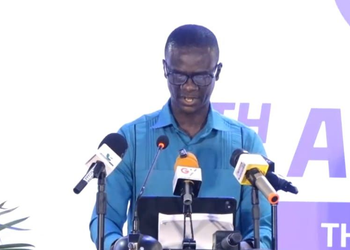
The Head of Public Relations at the Ghana Education Service (GES), Daniel Fenyi, has pushed back against attempts to place sole responsibility for the ongoing teacher strike on the GES, insisting that the grievances driving the industrial action are inter-agency and, in some respects, inter-ministerial in nature.
Fenyi argued that several institutions, including the GES, the Ministry of Education, the Controller and Accountant-General’s Department (CAGD), the Ministry of Finance, the Fair Wages and Salaries Commission (FWSC), and the teacher unions themselves, are all directly involved in the processes underlying the current dispute, making it inaccurate to frame the matter as a GES-specific failure.
Fenyi’s remarks came in direct response to an article published by public commentator Franklin Cudjoe, titled “Clarification on the Alleged Teacher Strike Over Promotion Arrears.”
According to Fenyi, Cudjoe’s article repeatedly suggested that GES had been late in submitting relevant documents to the Controller and Accountant-General’s Department and went further to encourage teachers to gather at GES headquarters to demand their arrears.
Fenyi contended that had Cudjoe more carefully reviewed the teacher unions’ letter declaring the strike, he would have identified three distinct reasons cited for the industrial action.
The renewal and renegotiation of the expired Collective Agreement, the placement of newly promoted teachers on appropriate salary scales along with payment of resulting arrears, and the implementation of the Deprived Area Allowance.
“reducing the entire industrial action to ‘GES failed to submit promotion letters’ does not only trivialise the issue, but also misrepresents the unions’ grievances.”
Head of Public Relations at the Ghana Education Service (GES), Daniel Fenyi

Acknowledging Institutional Responsibility Without Deflection
While defending the GES against what he characterised as an unfair, single-agency blame narrative, Fenyi was careful to acknowledge that the institution does bear certain responsibilities within the broader process.
He stated plainly that where GES is required to act, it must do so, and where delays are directly attributable to the institution, such delays should be openly acknowledged and addressed rather than dismissed, adding that he would not shield an institutional failure simply because of his affiliation with it.
However, he maintained that in a process involving multiple institutions, it would be neither fair nor productive to attribute the entirety of the problem to a single agency, arguing instead for a more accurate distribution of accountability across all the bodies genuinely responsible for different stages of the process.
Questioning The Call To “Storm” GES Headquarters
Fenyi specifically criticised the suggestion that teachers should gather at GES headquarters to press for outstanding payments, describing this approach as unhelpful in resolving an issue of this complexity.
He argued that, in reality, GES headquarters represents the least significant point of friction within the broader value chain responsible for processing teachers’ entitlements.

He further noted that Cudjoe’s commentary appeared unaware that the Ministry of Education had already convened a meeting involving teacher unions, the Controller, GES, and other relevant agencies, during which senior leadership from all institutions involved agreed on a roadmap and specific timelines for resolving the outstanding issues.
Fenyi noted that the outcomes of this meeting had been widely published, suggesting that more thorough research could have clarified the current state of engagement between the parties.
Refocusing On What Teachers Actually Want
Fenyi emphasised that, ultimately, teachers’ primary concern is not a contest over which institution bears the most blame, but rather the timely processing and payment of their legitimate entitlements.
He argued that this outcome should remain the central focus of all ongoing engagements and public discussions surrounding the dispute.
He outlined the GES’s role going forward as working collaboratively with the Ministry of Education, CAGD, the Ministry of Finance, the FWSC, and the teacher unions to identify every outstanding process, assign clear responsibility, remove existing bottlenecks, and ensure that eligible teachers ultimately receive what is due to them.
Call For Precision In Accountability
“Let us demand accountability. But let us demand it from the right institution, for the right responsibility, on the basis of the right facts.”
Head of Public Relations at the Ghana Education Service (GES), Daniel Fenyi
Fenyi closed his statement with a call for reduced rhetoric and increased action, stressing that “less words, more action” is what the current situation demands from all parties involved.

Fenyi noted that the Ministry of Education is scheduled to meet with the teacher unions on Monday and suggested that stakeholders await the outcome of that meeting before determining appropriate next steps in resolving the dispute.
As the strike continues to affect schools nationwide, the outcome of the anticipated Ministry meeting is likely to shape the next phase of negotiations, with pressure mounting on all implicated institutions to demonstrate tangible progress toward resolving the teachers’ outstanding grievances.
READ MORE: Mahama Outlines Ghana’s Ambitious Healthcare Reforms to Meet SDG Targets