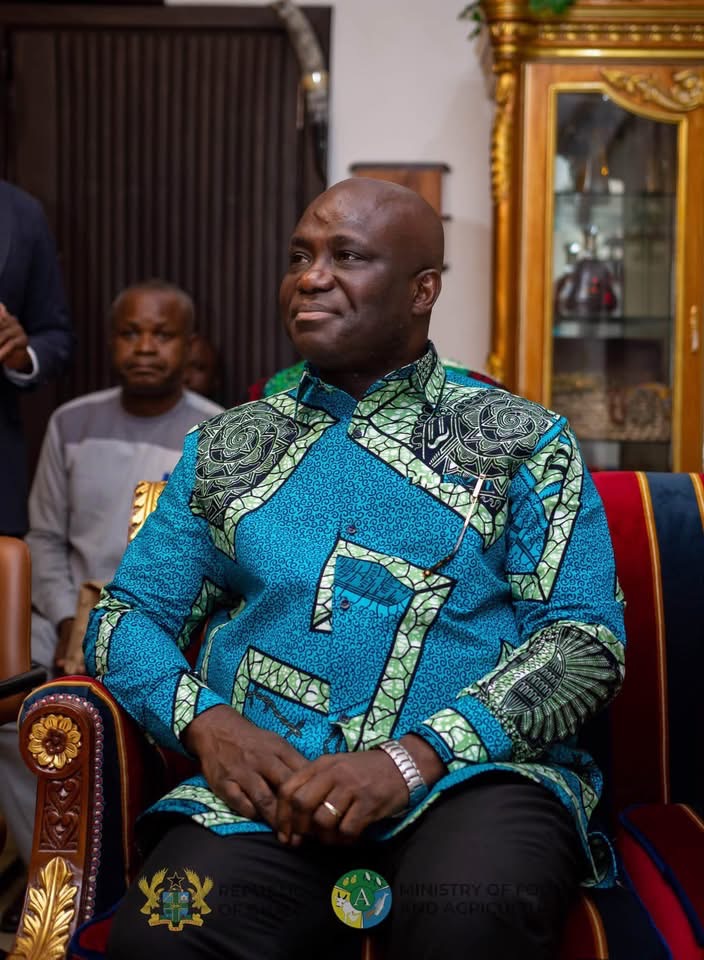
The Minister for Food and Agriculture, Eric Opoku, has engaged the Ga Mantse, Nii Teiko Tsuru II, on ways to strengthen collaboration between the government and traditional authorities to improve agricultural production and food security in Ghana.
The engagement forms part of efforts by the Ministry of Food and Agriculture to deepen cooperation with traditional leaders and use their influence at the community level to promote agricultural programmes, improve information dissemination and encourage greater participation in farming.
The meeting also comes at a time when Ghana is recording a significant surplus in maize production, with national output exceeding estimated domestic demand.
According to reports, Ghana produces more than 4.6 million tonnes of maize in 2025, against an estimated national requirement of about 3.6 million tonnes.
The figures indicate a surplus of roughly one million tonnes, creating opportunities for storage, processing, commercial utilisation and potential market expansion.
The development is significant for Ghana’s food security efforts, particularly as maize remains one of the country’s major staple food crops and an important input for the poultry and livestock industries.
Ga Mantse Called for Stronger Engagements
During the meeting, the Ga Mantse called for stronger engagement between the Ministry and traditional authorities to ensure that agricultural information reaches communities more effectively.
He noted that traditional leaders are strategically positioned to support the implementation of agricultural initiatives because of their direct connection with communities and local populations.
The Ga Mantse also urged the Ministry to place greater emphasis on maize production, highlighting the importance of the crop to the Ga people and the wider food system.
“Traditional authorities must be actively involved in the dissemination of agricultural information at the community level. Our chiefs are closer to the people and can help the Ministry communicate agricultural programmes and opportunities more effectively. We therefore welcome stronger collaboration between the Ministry and the traditional leadership.”
Ga Mantse, Nii Tackie Teiko Tsuru II
The call comes as the government seeks to increase agricultural productivity while improving the commercial prospects of farming.
Mr Opoku said the government’s objective is to transform agriculture from predominantly subsistence activity into a profitable business that can attract more young people and generate sustainable livelihoods.
He said agriculture must increasingly be treated as a business, with farmers supported to move beyond production for household consumption towards commercially viable enterprises.
“Government is working to transform agriculture from subsistence farming into a profitable business. We want agriculture to become attractive to the youth and create sustainable opportunities for them. This transformation requires stronger production, value addition, market access and investment across the agricultural value chain.”
Minister for Food and Agriculture, Hon. Eric Opoku
The Minister’s comments come amid renewed attention to Ghana’s food production capacity following the country’s reported maize surplus.
4.6 Million Tonnes of Maize Increment Beyond Domestic Consumption
The production of more than 4.6 million tonnes of maize compared with national demand of about 3.6 million tonnes suggests that Ghana has the capacity to produce beyond domestic consumption requirements when farmers have access to the necessary support and production conditions.
However, the surplus also creates the need for effective post-harvest management and market development.
Without adequate storage and reliable markets, increased production can expose farmers to price pressures, particularly when supply exceeds immediate domestic demand.
The government has therefore been focusing on measures to improve grain storage capacity and strengthen institutions responsible for managing agricultural commodities.
The Minister of Food and Agriculture has previously indicated that adequate allocations are expected in the national budget for the construction of silos to improve the storage of grains, including maize.
Such infrastructure is expected to help reduce post-harvest losses and provide greater flexibility in managing periods of excess production.
The maize surplus also presents opportunities for agro-processing industries, particularly businesses involved in poultry feed, livestock feed, starch, flour and other maize-based products.
For Ghanaian farmers, stronger links between production and processing could help create a more dependable market while supporting the development of local value chains.
The Role of Traditional Leaders in Ghana’s Agricultural Transformation
The engagement with the Ga Mantse also highlights the role traditional authorities can play in Ghana’s agricultural transformation.
Traditional leaders have influence over communities where agricultural activities take place and can support initiatives aimed at mobilising farmers, promoting modern farming practices and encouraging young people to consider agriculture as a viable source of employment and income.
The Ga Mantse assured the Minister of the continued support of the Ga State and welcomed him as a son of the soil.
The assurance is expected to strengthen cooperation between the Ministry and traditional authorities as government implements programmes aimed at improving agricultural productivity and food security.
Mr Opoku said collaboration with traditional institutions would remain important as Ghana works to build a more productive and commercially oriented agricultural sector.
“The transformation of agriculture cannot be achieved by government alone. We need traditional authorities, farmers, private sector operators and other stakeholders to work together to build a stronger agricultural economy. Our collective responsibility is to ensure that increased production translates into jobs, incomes and improved food security.”
Minister for Food and Agriculture, Hon. Eric Opoku
The meeting therefore provides an avenue for the Ministry and the Ga State to strengthen their partnership while addressing issues affecting agricultural development.
With maize production now exceeding estimated national demand, the focus is increasingly shifting towards ensuring that the additional output is properly stored, processed and marketed.
The development also reinforces the importance of connecting increased agricultural production with investments in infrastructure, agro-processing and markets.
As Ghana continues its efforts to achieve food security and make agriculture more attractive to the younger generation, stronger cooperation between government and traditional authorities is expected to support the delivery of agricultural information and programmes at the community level.
READ ALSO:Mahama Targets Africa’s Colonial Trade Routes In AU Chairmanship Plan