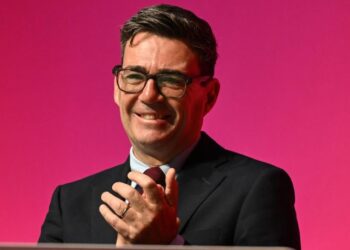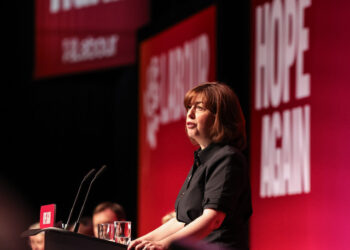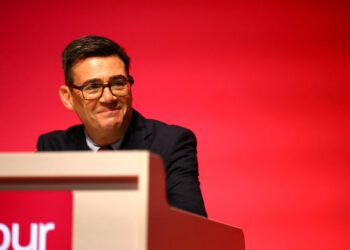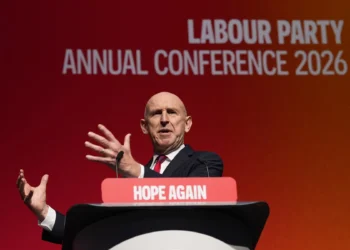
Reform UK has moved ahead of Labour in the latest YouGov voting intention figures, placing Prime Minister and Labour leader Andy Burnham under renewed political pressure just hours before he delivers his first major conference speech as party leader and Prime Minister.
The YouGov survey, conducted as Labour’s annual conference opened in Liverpool, puts Reform UK on 25%, up four points from the previous survey, while Labour stands at 24%. The Conservatives are on 19%.
The figures provide a new measure of the political challenge facing Burnham as he attempts to consolidate the momentum that followed his elevation to the Labour leadership and premiership.
The latest poll is particularly significant because it comes at a moment when attention has been concentrated heavily on Burnham and Labour. The party entered its conference seeking to project a sense of renewal around its new leadership, with the theme of “Hope again” underpinning the gathering.
Yet the latest figures place Reform UK back at the top of the voting-intention table, creating a difficult backdrop for Burnham’s keynote address.
YouGov’s latest figures show a close contest among the three largest parties, with Reform on 25%, Labour on 24% and the Conservatives on 19%. The Liberal Democrats are on 12% while the Greens are on 11%.
The Green figure is notable because it differs from earlier reports circulating around the conference, which had placed the party on 8%.
Earlier in September, the pollster published an MRP model which projected Labour as the largest party in a hypothetical election held at that time, despite the party’s position in national voting-intention polling being much closer to Reform. That model projected Labour on 241 seats, compared with 130 for the Conservatives and 123 for Reform UK.
The latest YouGov polling therefore provides an early test of whether that political repositioning is being reflected in public opinion.
Reform figures seized on the development almost immediately. Deputy leader Richard Tice mocked the Prime Minister on social media, posting: “Burnham Bounces down.”
Reform chair Lee Anderson also reacted to the figures with a brief: “Here we go!”
Labour, meanwhile, sought to avoid allowing the poll to dominate the conference narrative.
Party chair Bridget Phillipson stated that, “polls come and polls go, the important thing is we are authentic about ourselves.”
Burnham Faces Tough Choices
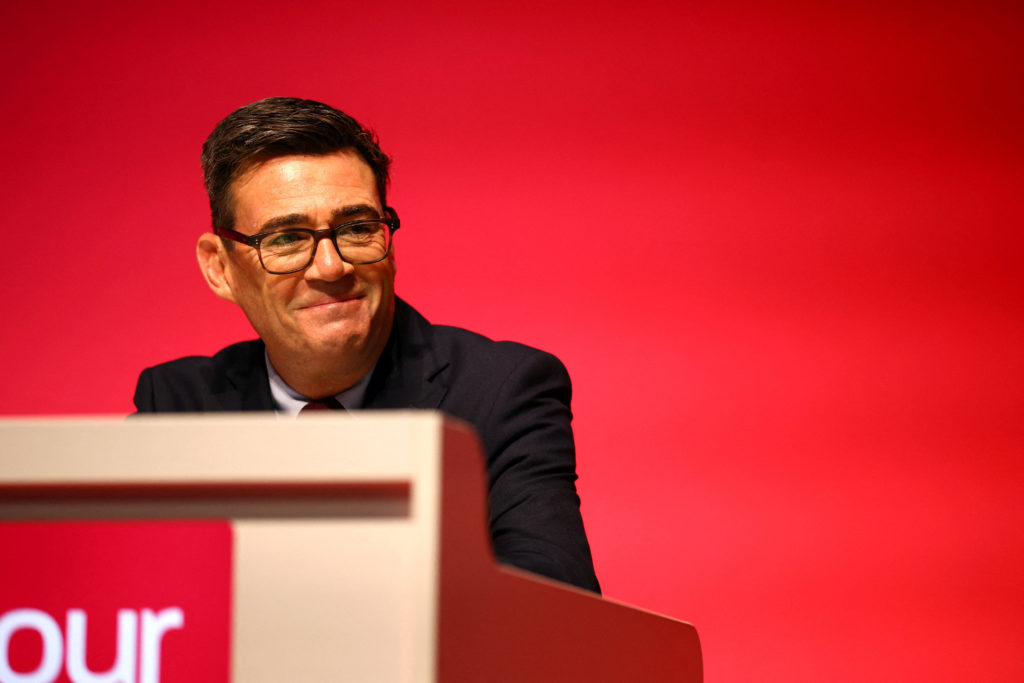
Burnham’s keynote address comes after an emergency cabinet meeting at the Labour conference and amid reports that his government is considering changes to the state pension triple lock as part of efforts to finance a national social care service.
The triple lock has long been a politically sensitive issue because it guarantees that the state pension rises each year by whichever is highest among average earnings growth, inflation or 2.5 %.
Any decision to weaken or remove the mechanism would therefore have implications for pensioners, public finances and Labour’s relationship with its traditional support base.
The reports have already generated opposition within parts of the Labour movement. Unite general secretary Sharon Graham described removing the triple lock as “electoral suicide” and “morally wrong.“
The controversy places Burnham in a difficult policy environment even before he sets out his wider plans.
Burnham is expected to argue that the country requires difficult decisions rather than another cycle of short-term political management.
“We can’t carry on as we are. Politics-as-usual has taken Britain backwards. More of the same isn’t good enough and isn’t going to get us where we need to be.”
Andy Burnham
Burnham is also expected to address the concentration of political power, returning to themes from his early leadership speeches by criticising the influence of “vested interests” and pledging to move away from the “flawed thinking of the last 40 years.”
That approach builds on the political identity Burnham developed during his time as mayor of Greater Manchester. Labour describes his mayoral record as including bringing buses into public ownership, establishing the Bee Network, securing greater powers for Greater Manchester and pursuing investment in regeneration and housing.
His government is now seeking to apply elements of that decentralisation and public-sector intervention agenda at national level.
Burnham is also expected to announce plans for a publicly owned “Great British Grid”, aimed at helping reduce energy costs while supporting the country’s transition towards a more integrated energy system.
The proposal sits alongside the government’s wider emphasis on industrial renewal and clean energy. Labour’s conference messaging has also focused heavily on reindustrialisation, with Business Secretary Jonathan Reynolds arguing that Britain’s economic renewal should involve cooperation between government, businesses and local communities.
Defence spending is also expected to feature in Burnham’s address, reflecting the government’s effort to combine domestic economic priorities with a stronger emphasis on national security.
The breadth of the agenda means the speech will serve several purposes at once.
READ ALSO: Ghana Seek Revival in AFCON Qualifiers Against The Gambia