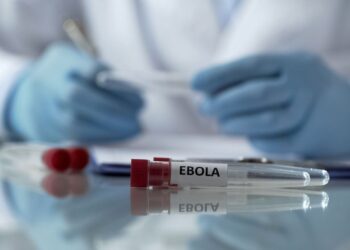



The Democratic Republic of the Congo’s battle against its largest Ebola outbreak has suffered another major setback after a key transit centre for patients requiring treatment was destroyed by fire in Ituri province, threatening to further reduce already stretched capacity to isolate and care for infected people.
According to Julien Harneis, the UN’s senior Ebola response official in DRC, the destruction of the facility is a major loss for an operation that has taken months of investment, staffing and logistical effort to establish treatment and transit capacity in some of the country’s most difficult-to-reach areas.
“It’s been a huge struggle to create Ebola transit centres and Ebola treatment centres; it’s required money, bringing in staff, and it’s been a struggle all across the east. So, when we lose a centre, that means we lose capacity, we lose investment, and we have to start again. And above all, it means that people do not get access to the care that they really need.”
Julien Harneis
The situation is concerning because the Kigonze facility is operating in an area where displacement, insecurity and limited access to healthcare have already complicated the response.
The camp itself, which had sheltered about 19,000 people fleeing violence, has now been abandoned following an exodus of residents amid reports of soldiers entering the site in search of weapons and people suspected of belonging to non-State armed groups.
The outbreak, caused by the Bundibugyo virus, has expanded rapidly since it was detected in May. According to reports, DRC has recorded more than 8000 confirmed cases.
Harneis described the blaze as “deeply disappointing,” noting that staff at the facility had been providing “essential and excellent” services to people requiring care. He said the UN was working with authorities to ensure that health facilities were protected.
Conflict Threatens to Undermine Ebola Containment
The security crisis surrounding the Ebola outbreak is increasingly becoming inseparable from the public health emergency.
In Ituri, more than 3,000 people reportedly fled the Rhoe displacement camp in Djugu territory after clashes intensified in late September. Humanitarian authorities reported that at least four people were killed and seven injured, while houses were burned in Blukwa.
Women and children account for much of the displaced population, according to humanitarian sources.
The continuing movement of civilians creates additional difficulties for Ebola surveillance because displacement can interrupt the monitoring of contacts, complicate the identification of new infections and make it harder for health teams to maintain regular communication with affected communities.
The same insecurity has restricted access to several health zones, including Fataki, Drodro and Lita in Ituri. Laboratory samples from Fataki to Bunia have faced transportation delays, while the transfer of confirmed Ebola patients to treatment facilities has also been disrupted.
Some aid organisations have suspended activities in areas affected by fighting, further reducing the ability of responders to maintain surveillance and provide healthcare.
Also, in neighbouring North Kivu, two people involved in the Ebola response were reportedly killed in Lubero on 27 and 28 September. Fighting in Masisi has also displaced more than 24,000 people since mid-September.
Violence has similarly been reported in South Kivu and Tanganyika provinces, where thousands more people have been forced from their homes.
The cumulative effect is a humanitarian environment in which health workers must attempt to contain a highly infectious disease while operating amid population movements, insecurity and damaged or inaccessible infrastructure.
WHO has previously warned that conflict, displacement and restricted access to basic services are hampering surveillance, case-finding, contact tracing, infection prevention and control, and timely access to treatment.
At the same time, the health response is being expanded. WHO and local health authorities have increased the number of mobile safe and dignified burial teams operating across Ituri. The response has also sought to expand the number of available patient beds and strengthen surveillance in communities where transmission remains intense.
WHO’s Africa office reported that surveillance teams remain a central line of defence, allowing authorities to detect alerts, investigate suspected cases and monitor contacts. The agency added that the outbreak had affected seven provinces and 63 health zones.
However, WHO has warned that more than 1,400 additional health professionals are needed to support the planned expansion of treatment capacity. The shortage illustrates the human-resource burden created by an outbreak that has continued to grow geographically while operating in an already fragile health system.
According to Dr Stéphane Mutombo, an anaesthesiologist and resuscitator involved in DRC’s Ministry of Health response, “increasing capacity allows us to admit more patients under better conditions and reduce delays. Rapid isolation and treatment of cases is essential.”
READ ALSO: Kane Eyes Ballon d’Or, Courtois Campaigns For Mbappé