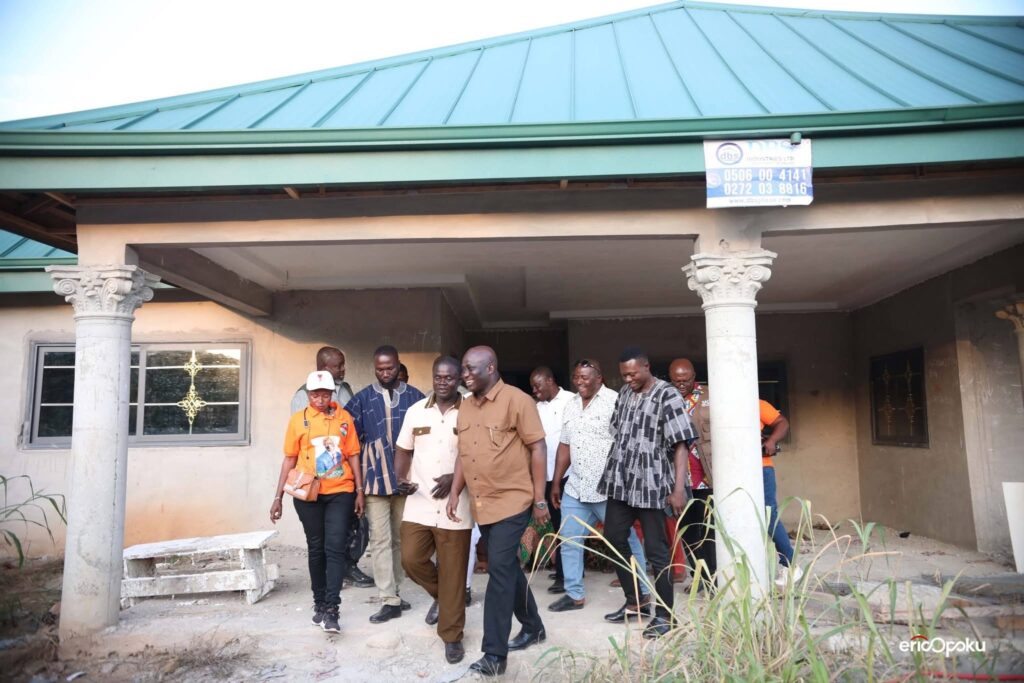
The Minister for Food and Agriculture, Hon. Eric Opoku leads an agribusiness development in the Ahafo Region. A strategic tour that focuses on expanding year round irrigation, improving farmers’ access to fertilisers and strengthening road infrastructure to connect producers to markets.
The initiative brings together government officials, regional authorities and other stakeholders to advance agricultural productivity, strengthen value chains and create better conditions for farmers and agribusinesses to expand their operations.
The Minister mentions that a major focus of the visit is agricultural development, particularly the expansion of sustainable irrigation systems capable of supporting farming activities throughout the year. The initiative is intended to reduce farmers’ dependence on rainfall and create more reliable conditions for crop production.
‘’The year round irrigation remains important to agricultural productivity because access to water enables farmers to extend production beyond the traditional rainy season. It also creates opportunities for multiple production cycles, potentially improving farm incomes, food availability and the supply of raw materials for agro processing.’’
Minister for Food and Agriculture, Hon. Eric Opoku
The tour is therefore placing emphasis on practical measures that can help farmers move from predominantly seasonal production towards more resilient and commercially oriented agriculture.
As part of the agricultural interventions, the team is also overseeing the systematic distribution of fertilisers to farmers. The fertiliser support is expected to assist farmers in improving soil fertility and crop productivity while reducing some of the input constraints confronting smallholder producers.
The distribution of agricultural inputs is particularly relevant to efforts to increase productivity and strengthen the livelihoods of farming communities. Ahafo is one of Ghana’s important agricultural areas, with farming playing a significant role in the economic activities of communities across the region.
Available agricultural data from the Ministry of Food and Agriculture also identifies substantial agricultural production activity in areas including Asunafo North and Asunafo South, underscoring the importance of productive inputs and supporting infrastructure to the local economy.
‘’The irrigation and fertiliser interventions are consequently being pursued as complementary measures. While irrigation provides farmers with greater control over water availability, fertiliser application supports crop development and productivity. Together, the interventions are expected to contribute to a more dependable agricultural production system.’’
Minister for Food and Agriculture, Hon. Eric Opoku
Examining Agricultural Infrastructure
Beyond farm level support, the tour is also examining infrastructure that directly affects agricultural communities and the movement of farm produce. The delegation is conducting site evaluations and progress assessments on key road networks across the region.
Road infrastructure remains critical to agricultural development because farmers depend on reliable transportation to move inputs to farms and transport harvested produce to markets and processing centres.
Recent inspections by the Ahafo Regional Coordinating Council have similarly focused on ongoing road projects, with regional authorities highlighting the importance of improved connectivity for mobility, trade and livelihoods, particularly for farmers and traders.
The ongoing road assessments therefore form part of a broader development approach in which agricultural production is linked to transportation and market access.
He stresses that better roads can help reduce difficulties associated with moving produce, while improved connectivity can strengthen relationships between farming communities, commercial centres and agro-processing businesses.
The delegation’s activities also include the unveiling of an ultra-modern office for the National Democratic Congress in the region.
The new facility represents an investment in the party’s regional administrative infrastructure and forms part of the wider programme of engagements during the tour.
While the party office serves an administrative and organisational function, the broader tour is highlighting agriculture and infrastructure as key components of regional development.
Emphasis on Continuous Development
The engagement comes against the background of continuing development activities in Ahafo. In April 2026, the Ahafo Regional Minister and the Minister for Roads and Highways conducted a joint inspection of road projects in the region, including the 55-kilometre Bediako–Kasapin–Camp 15 road.
The regional authorities say the road programme is intended to strengthen connectivity and support economic activity. The region is also pursuing other economic development initiatives.
The Ahafo Regional Coordinating Council reports that contracts have been signed for the construction of 24-hour economy model markets across the region’s Municipal and District Assemblies, reflecting efforts to expand economic opportunities and commercial activity.
Against this background, the current tour is bringing together agricultural production, irrigation, input distribution and infrastructure development as interconnected priorities.
The emphasis on irrigation has the potential to strengthen the resilience of farmers by providing a more dependable source of water for production. Fertiliser distribution, meanwhile, is supporting efforts to improve farm productivity, while road assessments are focusing attention on the infrastructure required to connect producers with markets.
For farming communities, the combination of these interventions is significant because agricultural development extends beyond the provision of inputs.
Sustainable growth also depends on access to water, roads, markets, storage, processing facilities and other services that enable farmers to convert production into sustainable incomes.
The Ahafo tour is therefore presenting agriculture as a central component of the region’s broader socioeconomic development agenda.
The continued assessment of projects and engagement with stakeholders is also providing an opportunity to identify gaps, monitor progress and strengthen coordination among government institutions, regional authorities and local communities.
With agriculture, irrigation and infrastructure receiving sustained attention, the tour is reinforcing the importance of coordinated development interventions that address both production and the systems required to move agricultural goods from farms to consumers.
The focus on year round irrigation, fertiliser support and road connectivity ultimately places farmers at the centre of a wider development strategy aimed at improving productivity, strengthening livelihoods and creating the conditions for sustained economic activity across the Ahafo Region.
READ ALSO:Prof. Annim Prescribes Five Fixes to Strengthen Africa Statistics and Policy Links