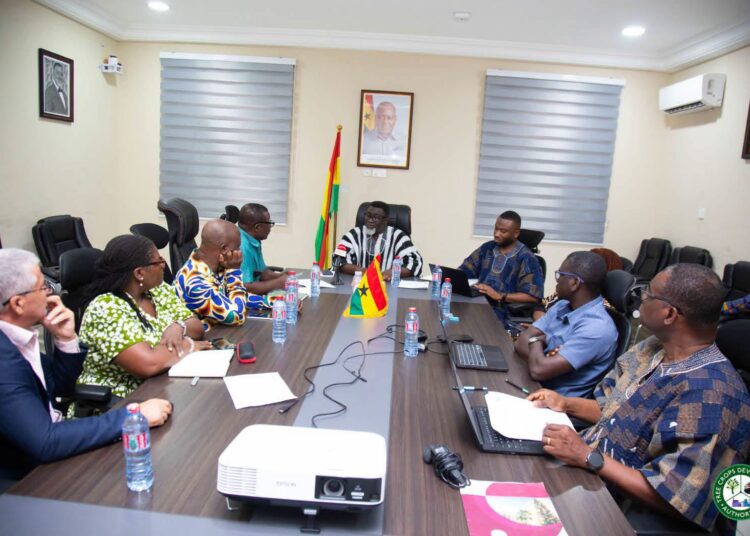
The Tree Crops Development Authority (TCDA) led by the Chief Executive Officer, Dr. Andy Okrah has reaffirmed its commitment to strengthening collaboration with the Cashew Council Ghana (CCG) to address production challenges, improve regulatory compliance and expand local processing in Ghana’s cashew industry.
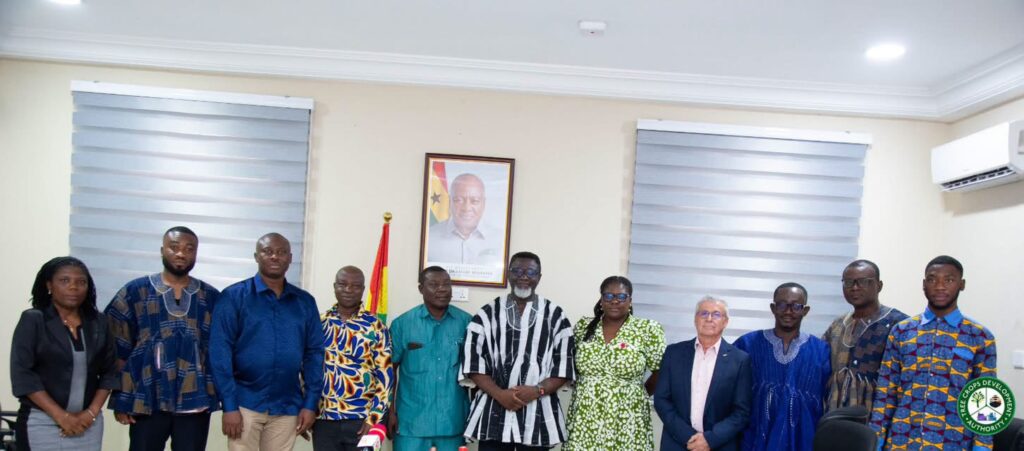
The commitment followed a strategic stakeholder engagement between the Authority and a delegation from CCG, led by its Board Chairman, Ed-Malvin Nii Ayi Bontey Smith, at the TCDA offices.
The meeting provided a platform for the Council to present six proposed areas of collaboration aimed at improving the performance and sustainability of the cashew value chain.
The discussions focused on coordinated action to tackle pests and diseases, strengthen industry regulation and enforcement, and ensure a dependable supply of raw cashew nuts for domestic processors.
The engagement also highlighted the importance of aligning private-sector participation with government efforts to promote agricultural productivity, industrial development and value addition.
“I welcomed these proposals and reaffirmed TCDA’s commitment to working closely with CCG and other industry stakeholders to address challenges across the cashew value chain and unlock the sector’s full potential.”
Chief Executive Officer, Mr. Andy Okrah
Strengthening Production and Pest
An effective pest and disease management remains essential to sustaining cashew productivity, protecting farmers’ investments and improving the quality of nuts supplied to local and international markets.
The proposed collaboration between TCDA and CCG seeks to strengthen public awareness of threats affecting cashew production. Such efforts could support the dissemination of technical information, encourage timely identification of crop diseases and pests, and promote the adoption of recommended farm-management practices.
The TCDA, established under the Tree Crops Development Authority Act, 2019 (Act 1010), has a statutory mandate to regulate and develop the production, processing and trading of six tree crops, including cashew.
Its responsibilities include facilitating farmer training, supporting scientific and economic research, providing technical advice and coordinating capacity-building activities across the value chain.
These responsibilities provide a framework for cooperation with industry organisations such as CCG, particularly in translating technical knowledge into practical interventions for farmers.

According to Ghana’s Feed Ghana Programme, the country’s cashew industry had an estimated 272,432 hectares under cultivation, involving more than 280,000 farmers and producing approximately 252,932 metric tonnes of raw cashew nuts during the 2023/2024 season.
The figures underscore the importance of protecting production capacity and improving farm-level performance to sustain the industry’s contribution to rural livelihoods and agricultural exports.
“The Authority’s mandate includes coordinating capacity-building activities for farmers in best agronomic practices, pest and disease management, and improved harvesting methods.”
Feed Ghana Programme
A coordinated awareness programme involving regulators, farmers and industry associations could also help improve the flow of information between research institutions and farming communities.
Regulation and Enforcement Across the Value Chain
The second major priority emerging from the engagement is the need to strengthen regulation and enforcement to improve transparency and accountability in the cashew industry.
Under Act 1010, the TCDA is empowered to register or license industry operators, oversee compliance with applicable quality standards and collect statistical information from the tree crops sector.
These functions are intended to support a more organised and sustainable industry, with reliable information to guide policy and commercial decisions.
Stronger cooperation between the Authority and CCG could improve communication between regulators and businesses, helping industry participants understand their obligations and identify recurring operational challenges.
The engagement also comes amid broader efforts to strengthen Ghana’s cashew industry and improve its competitiveness in international markets.
The African Cashew Alliance reported in February 2026 that the TCDA had introduced compliance and enforcement measures, including the deployment of compliance officers to work with relevant institutions in addressing illegal trading practices and protecting farmers and licensed operators.
“The Authority is committed to strengthening compliance, transparency and sustainability in the cashew industry through cooperation with stakeholders and the enforcement of applicable regulations.”
African Cashew Alliance
Securing Raw Materials for Local Processing
Ensuring a reliable supply of raw cashew nuts for domestic processors is another priority identified during the meeting, reflecting the broader challenge of retaining more value from Ghana’s agricultural production.
The Feed Ghana Programme identifies the development of the tree crops sector as an important component of its Feed the Industry initiative. Its approach emphasises increasing the production of quality agricultural raw materials to provide a consistent supply for domestic industries and support the development of value chains.
Industry data published by ComCashew show that Ghana’s estimated raw cashew nut production increased from 160,000 metric tonnes in 2021 to 249,000 tonnes in 2024.
The same dataset puts installed domestic processing capacity at approximately 65,570 tonnes in 2024, illustrating the importance of ensuring that processors can obtain sufficient raw materials to operate effectively.
The challenge is not simply to increase production but also to improve the connections between farmers, aggregators, traders and processing companies.
More reliable supply arrangements could help processors plan operations, improve capacity utilisation and develop stronger commercial relationships with producers.
“The Feed the Industry initiative seeks to boost the production of local raw materials to ensure a consistent and sufficient supply of high-quality agricultural produce for industrial use.”
CEO of TCDA, Dr. Andy Okrah
The TCDA leadership has indicated that the proposed areas of collaboration align with the Authority’s mandate and the objectives of the Agriculture for Economic Transformation Agenda (AETA), alongside the Feed the Industry initiative under the Feed Ghana Programme, championed by President John Dramani Mahama.
READ ALSO:IMF Opens Ghana Review as 2027 Budget Faces Critical Scrutiny