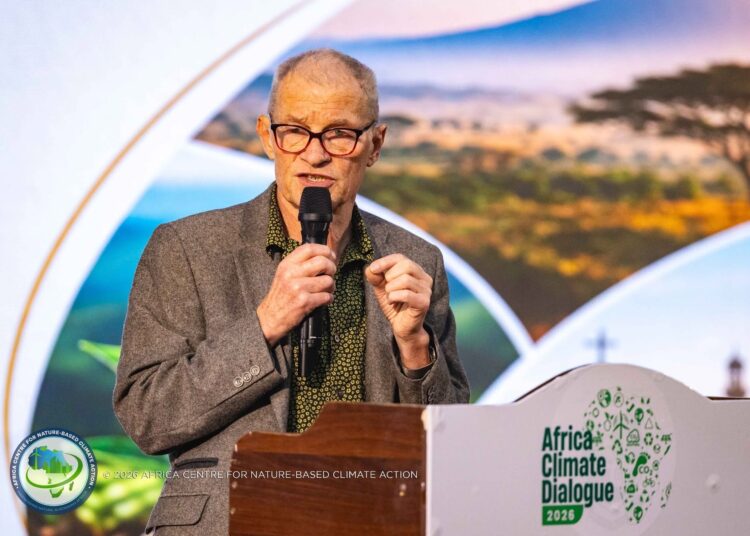
Prof. Jeffrey Haynes, Emeritus Professor of Politics at London Metropolitan University, UK, has linked Ghana’s escalating small-scale gold mining crisis, locally known as galamsey, to structural governance deficits and deep-seated political patronage.
Researching for a new book during a two-week field tour in Ghana, the renowned political scientist interviewed faith leaders, including Christian and Muslim figures, who overwhelmingly cited illegal mining as the primary cause of the nation’s environmental crisis.
Prof. Haynes observed that small-scale gold mining has shifted from a localized, artisanal livelihood into a structural crisis involving governance, national security, and ecological survival.
“Consequently, both parties are trapped in an electoral prisoner’s dilemma: neither can afford to enforce the law fully without risking a significant loss of rural votes. The environment becomes the ultimate casualty of Ghana’s political partisanship.”
Prof. Jeffrey Haynes
Expanding on this assessment, Prof. Haynes revealed that galamsey demonstrates the profound limits of state capacity when confronted with the dual pressures of globalized capital and entrenched domestic patronage.
Although manifested on the ground as an ecological disaster, galamsey represents an abject failure of regulatory authority, severely undermined by electoral calculations and institutional co-option.
This regulatory collapse stems from the fierce political competition between Ghana’s two major dominant parties, the National Democratic Congress (NDC) and the New Patriotic Party (NPP), as both parties aggressively battle for crucial votes in resource-rich rural swing constituencies.
Technological Escalation and Ecological Collapse
The environmental degradation unfolding across Ghana highlights a dramatic departure from historical artisanal mining practices.
Traditionally, small-scale mining provided a vital economic safety net for rural youth who lacked formal employment opportunities.
However, the contemporary manifestation of galamsey is radically different, defined by heavy mechanization, the introduction of foreign capital, and the widespread application of hazardous chemicals such as mercury and cyanide.

This rapid technological escalation has transformed what was once a manageable environmental footprint into an existential threat to the nation’s vital natural ecosystems.
Rivers that have sustained rural communities for generations, such as the Pra, Ankobra, and Birim, are now toxic, silt-laden channels incapable of supporting aquatic life or providing safe drinking water.
Furthermore, forest reserves are being systematically degraded, directly threatening biodiversity and jeopardizing long-term agricultural sustainability. This environmental destruction poses a direct risk to the cocoa sector, which remains a cornerstone of Ghana’s macroeconomy.
The Electoral Dilemma and Structural Governance Deficit
From a governance perspective, the persistence of illegal gold mining exposes a glaring paradox within Ghana’s democratic framework.
Ghana is frequently and rightly celebrated as a beacon of stable constitutional democracy in West Africa, distinguished by regular peaceful transitions of power and a robust civil society.
Yet, the state’s inability or unwillingness to enforce environmental laws against galamsey operators exposes a severe deficit in structural governance.
In closely contested swing districts, enforcing regulatory compliance poses a high-stakes political challenge for any sitting government.
When a government attempts a proactive crackdown by deploying military task forces to destroy excavators or arrest illegal miners, it risks triggering an immediate, localized electoral backlash.
During election campaigns, opposition parties historically capitalize on this rural resentment, sometimes promising a far more permissive approach to mining if elected into office.
The Urgent Need for Comprehensive Mining Reform
Detailed research into Ghana’s extractive sector emphasizes the crucial need for immediate, non-partisan regulatory intervention.
The imperative for this initiative lies in safeguarding Ghana’s long-term socio-economic stability, public health, and ecological infrastructure against irreversible collapse.
Without a unified consensus that decouples environmental enforcement from short-term electoral gain, regulatory authorities will remain co-opted, leaving critical river basins and forest reserves permanently depleted.
To break this destructive cycle, policy experts and civil society groups advocate for insulating environmental agencies from political interference, enforcing strict liability on illegal capital financiers, and establishing sustainable economic alternatives for rural youth.
Institutional reform must align legal small-scale mining with stringent environmental standards while completely prosecuting political actors who shield galamsey operations.
Preserving Ghana’s natural heritage requires prioritizing long-term ecological survival above short-term political expediency.