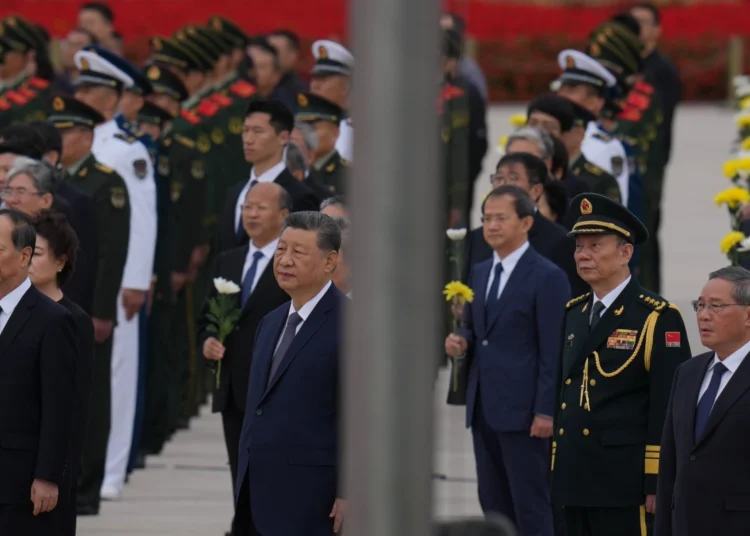
China’s Communist Party has elevated General Zhang Shengmin, the only remaining general on the country’s Central Military Commission (CMC), to the Politburo as President Xi Jinping intensifies efforts to enforce party discipline and combat corruption within the military and government.
The promotion was announced today, following a four-day closed-door meeting of senior Communist Party leaders in Beijing, known as the Fifth Plenum of the 20th Central Committee.
Zhang, who serves as Vice Chairman of the Central Military Commission, joins the Politburo, the party’s top governing body, after a series of purges removed several senior military officials from the party.
His elevation also restores military representation on the Politburo, which had been left without a People’s Liberation Army representative following the removal of other senior Generals.
Zhang additionally holds a senior disciplinary role within the military, serving as Deputy Secretary of the CMC Commission for Discipline Inspection, which oversees internal discipline and efforts to address misconduct within the armed forces.
Party Expels 33 Senior Officials
The Fifth Plenum also approved disciplinary review reports concerning 33 senior officials who have been expelled from the Chinese Communist Party over alleged serious violations of discipline and law.
According to a communiqué published by the state-run news agency, the officials include former Central Military Commission Vice Chairman Zhang Youxia and former Chief of the Joint Staff Department Liu Zhenli.
Other military figures named include Wang Renhua, Secretary of the CMC Political and Legal Affairs Commission; former Eastern Theater Command political Commissar Liu Qingsong; former Northern Theater Command Commander Huang Ming; and former Army Commander Li Chaoming.
Several senior civilian officials were also included in the expulsions. They include former Head of the Communist Party’s International Department Liu Jianchao, former Xinjiang Regional Party Secretary Ma Xingrui, former Guangxi Chairman Lan Tianli, former Inner Mongolia Chairperson Wang Lixia and former Industry and Information Technology Minister Jin Zhuanglong.
The expulsions emphasize the breadth of the party’s disciplinary campaign, which has affected senior figures in both the military and civilian administration.
The communiqué described the violations as “severe violations of discipline and law,” while the party reaffirmed its commitment to strengthening internal governance and maintaining strict standards among its members.
The reported expulsions also highlight the continuing upheaval within China’s military leadership as Xi seeks to reinforce political loyalty and discipline across the armed forces.
Xi Renews Anti-Corruption Drive
Beyond the personnel changes, party leaders adopted a resolution on advancing comprehensive and strict governance of the Communist Party.

A summary of the resolution said the tasks facing the party were “increasingly arduous,” including the responsibility of “uniting and leading the people to safeguard national sovereignty, security, and development interests.”
The party also stressed the need to strengthen self-governance, root out corruption and preserve ideological discipline.
According to the summary published by the state-run news agency, the party must, “with an eye on enhancing its long-term governance capacity, maintain its progressive nature and purity, and its close, flesh-and-blood ties with the people.”
Xi has made anti-corruption a central feature of his leadership since coming to power in 2012, overseeing a campaign that has targeted officials across government, the party and the military.
While the campaign has focused on corruption and violations of party discipline, analysts have also pointed to growing scrutiny of officials considered ineffective or underperforming.
The latest resolution signals that the leadership intends to maintain the campaign as part of a broader effort to strengthen the party’s authority and administrative capacity.
The removal of senior military figures and Zhang Shengmin’s promotion come as the party prepares for its next national congress, when China’s top leadership will be determined.
The communiqué said that the 21st National Congress of the Communist Party would be held in Beijing in the second half of next year. The congress is expected to shape the party’s leadership and political direction for the following five years.
Xi is widely expected to seek a fourth five-year term as party leader, although the final leadership arrangements will be determined through the party’s political process.
The Fifth Plenum was attended by 162 full members and 117 alternate members of the Central Committee, according to the supplied account, representing a combined total 36 fewer participants than at the Fourth Plenum last year.
The meeting’s decisions reinforce the leadership’s emphasis on internal discipline, political control and military oversight as Xi prepares for the next phase of his rule.
READ ALSO: Qatar Denies Israeli Election Interference As Fraud Claims Escalate