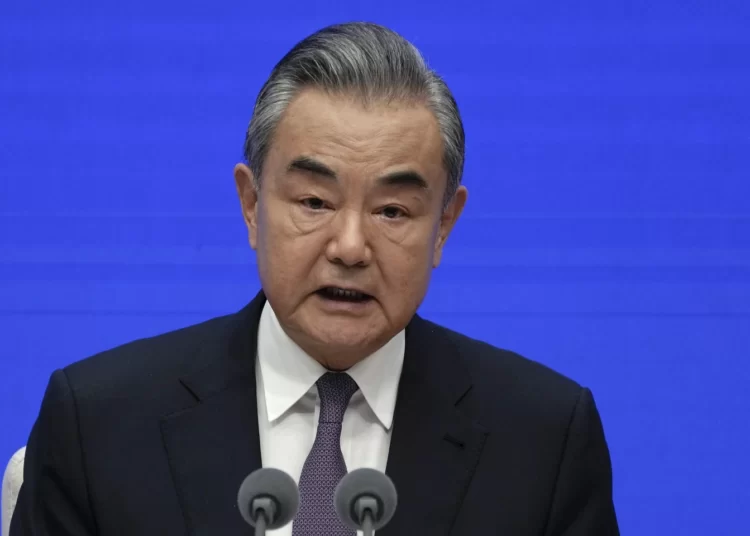
China’s Foreign Minister, Wang Yi has urged the Philippines to exercise caution in its handling of the South China Sea dispute, warning against what Beijing described as interference in relations between the two countries.
Wang delivered the message during a telephone conversation with Philippine Secretary of Foreign Affairs Theresa Lazaro, as tensions between the neighbouring countries continue over competing territorial claims in the strategically important waterway.
According to a statement from China’s Ministry of Foreign Affairs, Wang said that the bilateral relationship was facing “malicious interference” from certain Filipino politicians.
He urged Manila to “strengthen restraints on the relevant people, and speak with a unified, reasonable voice on policy towards China,” while also advising the Philippines to be “cautious in their words and deeds” regarding the South China Sea.
Lazaro described the conversation as “a frank and constructive” discussion about the direction of relations between the two countries. “Both sides emphasized the need for continued diplomatic dialogue and the proper management of differences anchored on mutual respect,” she said in a post on X, without providing further details.

Despite the differences, the two governments indicated that they intended to maintain diplomatic engagement.
Diplomatic Tensions Escalate Over South China Sea
The latest exchange comes amid longstanding disagreements over overlapping maritime claims in the South China Sea, where confrontations between Chinese and Philippine vessels have intensified in recent years.
The disputes have involved physical clashes between sailors and collisions involving vessels, raising concerns about the risk of further escalation in the region.
Tensions have also increasingly featured in diplomatic exchanges between Beijing and Manila, with officials from both countries trading criticism over their respective positions.
In recent weeks, the Philippines’ Defence Secretary described China as a “troublemaker” in the region, prompting a response from China’s Ambassador to the Philippines.
The Chinese Envoy dismissed the accusation as nonsense but made remarks about Beijing’s military capabilities that triggered a strong reaction from Philippine officials. “If we want to use force, we may easily win but no, we will not choose force and we love peace,” the Ambassador said.
The comments drew criticism in Manila, including from Philippine President Ferdinand Marcos Jr., who said the statement sounded like a threat.

The latest telephone conversation between Wang and Lazaro followed the exchange, with the Chinese Foreign Minister calling for restraint in public statements and urging the Philippines to manage its differences with Beijing carefully.
Countries Consider Resuming Energy Talks
The two diplomats also discussed the possibility of restarting long-stalled negotiations over joint oil and gas exploration in the Reed Bank, according to a Philippine official familiar with the conversation.
The official, who spoke to a news agency on condition of anonymity, said that the issue was among the subjects raised during the call.
The Reed Bank, an offshore area in the South China Sea, is claimed by both China and the Philippines. However, it lies within the Philippines’ exclusive economic zone, according to Manila’s position under international maritime law.
An exclusive economic zone extends up to 200 nautical miles (approximately 370 kilometres) from a country’s coastline and grants it sovereign rights to explore, exploit, conserve and manage natural resources under the United Nations Convention on the Law of the Sea (UNCLOS).
Philippine efforts to explore the Reed Bank for oil and natural gas have been hindered for years by China’s objections to activities in the disputed area.
The possibility of joint exploration has previously been discussed by the two governments as a potential way to pursue economic cooperation despite their competing maritime claims. However, earlier efforts have stalled amid disagreements over the legal and political terms of such an arrangement.
A resumption of discussions could provide an opportunity for both countries to explore cooperation in energy development, although the competing claims remain a significant obstacle.
The South China Sea is a major international trade route and an important source of marine and energy resources. Its waters are subject to overlapping claims involving China, the Philippines, Vietnam, Malaysia, Brunei and Taiwan.
Beijing claims sovereignty over most of the sea, while other parties maintain claims over particular islands, reefs and maritime areas.
The dispute has become a recurring source of tension between China and the Philippines, with maritime encounters and competing diplomatic statements complicating efforts to maintain stable relations.
For Manila, protecting its maritime rights and access to resources within its exclusive economic zone remains a central concern. Beijing, meanwhile, continues to oppose what it regards as challenges to its territorial claims.
The latest conversation between Wang and Lazaro shows the difficulty of separating diplomatic relations from the countries’ maritime disagreements.
Although both sides have expressed support for continued dialogue, their differing positions over the South China Sea and the Reed Bank remain unresolved.
Whether the proposed energy discussions can resume will depend on the willingness of both governments to find terms for cooperation amid their continuing territorial dispute.
READ ALSO: Trump Predicts Better-Than-Expected Midterm Results For Republicans