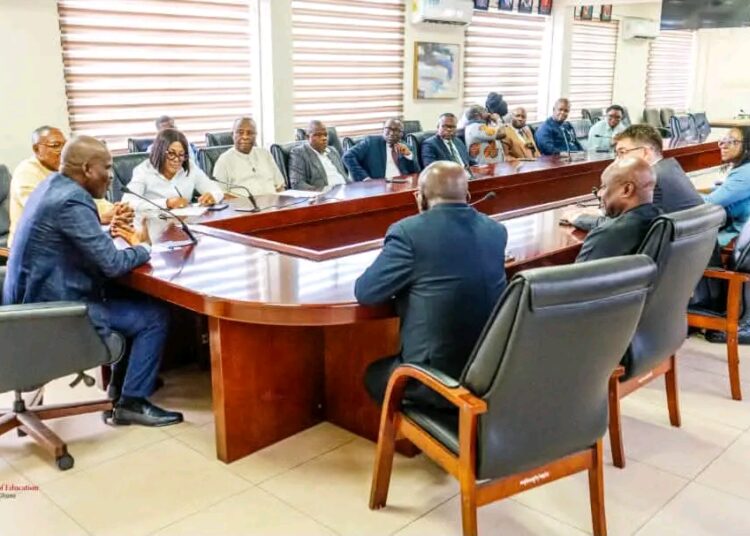
The Minister for Education has reaffirmed the Government’s commitment to strengthening Ghana’s research capacity and supporting locally driven innovations towards malaria elimination.
The Minister gave the assurance when a delegation from the Ghana National Research Fund (GNRF) and the Gates Foundation paid him a courtesy call. The GNRF team was led by its Board Chairman, Prof. Eric Yirenkyi Danquah and the Gates Foundation team was led by Mr Bruno Moonen, its Deputy Director for Malaria.
Delegation briefs Minister on malaria research
The discussions centred on building local expertise in emerging malaria-control technologies. They focused in particular on the development of “malaria-free mosquitoes,” a approach that would be pursued through research, technology transfer and institutional capacity building.

The meeting explored a possible partnership between the Ministry, the GNRF and the Gates Foundation. The accounts of the meeting did not say whether any agreement had been signed. They also gave no details of funding, timelines or the institutions that would take part.
The Minister for Education, Haruna Iddrisu, was the host of the courtesy call. The Ministry oversees public universities and research bodies, and the GNRF is the national agency for funding research. The call therefore brought together the main actors who would be involved in any local research programme.
Professor Awandare urges local capacity for new technology
Prof. Gordon Awandare, the Pro Vice-Chancellor of the University of Ghana, spoke on the need to equip Ghanaian scientists with the expertise and resources to develop and adapt the technology locally.
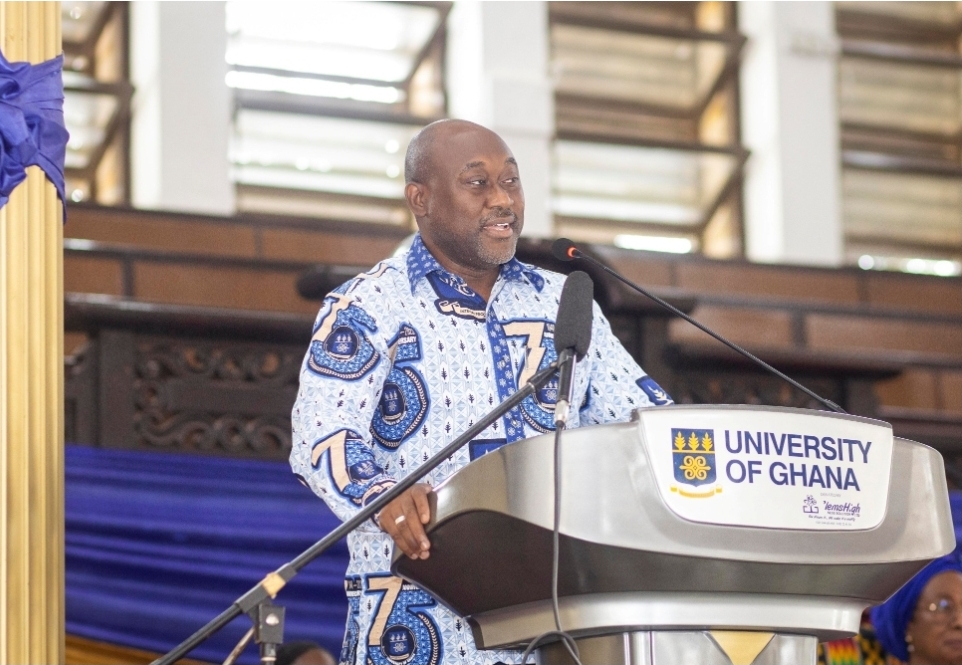
His point reflects a concern in global health research that new tools are often designed abroad and then brought to African countries. Building skills at home would let Ghanaian researchers adapt such tools to local conditions and take part in decisions about how they are tested and used.
The report however, did not give his full remarks, and they did not say which Ghanaian institutions already work on the technology. Details of the University of Ghana’s role, if any, were also not provided.
Minister pledges sustained investment in research
The Minister stressed the importance of sustained investment in research, talent development and strong local institutions. He said the ultimate goal of the collaboration was to reduce malaria transmission and support Ghana’s ambition of eliminating the disease.
The Minister’s emphasis on talent development and institutions suggests the Government sees the partnership as a way to build lasting capacity, rather than only to import a technology. His remarks did not mention a budget line, a new funding commitment or a target date for elimination.
His message was also general. A pledge to support “locally driven innovations” will be tested by whether the Ministry, the GNRF and the Gates Foundation set out specific programmes, funding and timelines.
Partnership faces questions on scope and timeline
Malaria remains a major public health concern in Ghana. Any technology that reduces transmission would be of interest to health authorities, researchers and communities. The accounts of the meeting did not discuss how the technology would be tested, regulated or approved in Ghana, or how communities would be consulted.

Those questions are likely to matter as the discussions move forward. Novel approaches to vector control, particularly ones involving modified mosquitoes, usually require close scientific review and public engagement before they can be tested outside the laboratory. The reports did not mention whether such steps were discussed.
For now, the meeting signals intent rather than commitment. The Ministry has welcomed the idea, and the GNRF and the Gates Foundation have opened the conversation. Attention will turn to whether the talks lead to a formal agreement, a funded programme and a clear role for Ghanaian scientists and institutions.
READ ALSO: Ministry of Health Warns of 2,000 Annual Breast Cancer Deaths