


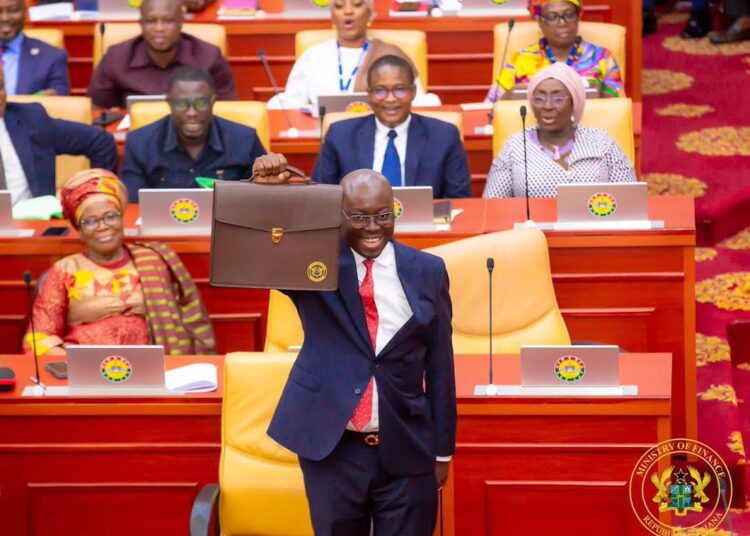
Ghana’s petroleum revenue projections for 2027 reveal a cautious fiscal approach to the country’s oil earnings, with Government proposing to lower the benchmark crude oil price from the statutory seven-year moving average of US$80.46 per barrel to US$74.93.
The adjustment, presented in the 2027 Budget Statement by Finance Minister Dr Cassiel Ato Forson, reflects concerns that relying solely on the statutory moving average could produce an unrealistic estimate of the petroleum revenue available to support the national budget.
Although the revised benchmark is intended to make revenue projections more prudent, it also exposes the importance of managing expectations around Ghana’s petroleum earnings, particularly as the medium-term outlook points to a sustained decline in receipts.
Government projects total petroleum receipts of US$1.1286 billion in 2027, comprising US$156.6 million in royalties, US$404.2 million from Carried and Participating Interest (CAPI), US$566.8 million in Corporate Income Tax and approximately US$920,000 in acreage fees.
However, the projections decline to US$909 million in 2028, US$795.7 million in 2029 and US$736 million in 2030. By the end of the four-year period, projected petroleum receipts would have fallen by approximately 34.8 per cent from the 2027 estimate.
The figures raise questions about the durability of petroleum revenue as a source of budget financing and the country’s ability to sustain public investment while oil production from existing fields faces long-term constraints.
Why Government Is Revising The Benchmark Price
Under the Petroleum Revenue Management Act, 2011 (Act 815), the benchmark crude oil price is ordinarily determined using a seven-year moving average.
For 2027, that methodology produces a benchmark price of US$80.46 per barrel. Government, however, argues that prevailing market conditions make the historical average unsuitable as the sole basis for estimating the revenue expected during the year.

The alternative price of US$74.93 was calculated using Brent crude oil futures prices obtained from the Intercontinental Exchange through Bloomberg.
The Finance Ministry used a five-day observation period between August 5 and August 11, 2026, taking the average of the last-settled futures prices for each 2027 delivery month.
The difference between the statutory moving average and the alternative assumption is US$5.53 per barrel, representing a reduction of approximately 6.9 per cent.
The decision is supported by Section 17 of Act 815, as amended by the Petroleum Revenue Management (Amendment) Act, 2015 (Act 893), which allows the Finance Minister to recommend a revision where petroleum price movements or production conditions threaten to produce a significant overestimation or underestimation of benchmark revenue.
The amendment provides that:
“The Minister may recommend to Parliament a revision of the Benchmark Revenue if it becomes evident that unexpected petroleum price movements or production conditions have resulted or are likely to result in a gross over projection or under projection of the Benchmark Revenue.”
The provision is important because it recognises that petroleum revenue estimates must respond to market conditions rather than mechanically follow historical price averages.
For Ghana, an inflated oil price assumption could create a mismatch between expected receipts and actual inflows, potentially complicating budget execution if the Government commits expenditure against revenue that does not materialise.
The 2027 budget also projects the average gas price at US$7.93 per million British thermal units (MMBtu), using the seven-year moving average prescribed under the petroleum revenue framework.
Production And Revenue Outlook Remain Under Pressure
Beyond the revised price assumption, the production estimates provide another important indication of the sector’s medium-term fiscal outlook.
Ghana’s benchmark crude oil production for 2027 is projected at 37.40 million barrels, equivalent to approximately 102,465 barrels per day. This is based on the production forecasts of the individual producing fields.
The Government’s share of the projected output is estimated at 7.48 million barrels, comprising 2.09 million barrels in royalties and 5.39 million barrels in carried and participating interest.
However, the benchmark production estimate declines to 31.10 million barrels in 2028, 28.47 million barrels in 2029 and 26.57 million barrels in 2030.
This represents a reduction of approximately 29 per cent between 2027 and 2030.
The decline in projected output is significant because petroleum receipts depend not only on international crude prices but also on the volume of oil produced and the Government’s fiscal entitlement under petroleum agreements.
Even where prices remain relatively favourable, lower production can reduce royalty payments, carried and participating interest and the taxable income generated by petroleum operations.
The revenue composition for 2027 also highlights the importance of corporate income tax. At US$566.8 million, it accounts for approximately half of projected petroleum receipts, exceeding both CAPI and royalties.
That makes the revenue outlook sensitive to the profitability of petroleum operators, which can be influenced by production levels, operating costs, investment expenditure and prevailing crude prices.
Corporate income tax is projected to decline to US$421 million in 2028, US$359.8 million in 2029 and US$339.3 million in 2030. The decline reinforces the need to examine the assumptions behind future petroleum earnings rather than rely solely on headline production targets.
How The Revenue Will Be Shared
Of the projected US$1.1286 billion in petroleum receipts for 2027, GNPC is expected to receive US$177.7 million.
This comprises US$137.7 million for Equity Financing Cost and approximately US$40 million representing the Corporation’s 15 per cent share of net CAPI after the deduction of equity financing costs.
The remaining US$950.9 million constitutes Benchmark Revenue available for distribution between the Annual Budget Funding Amount (ABFA) and the Ghana Petroleum Funds.
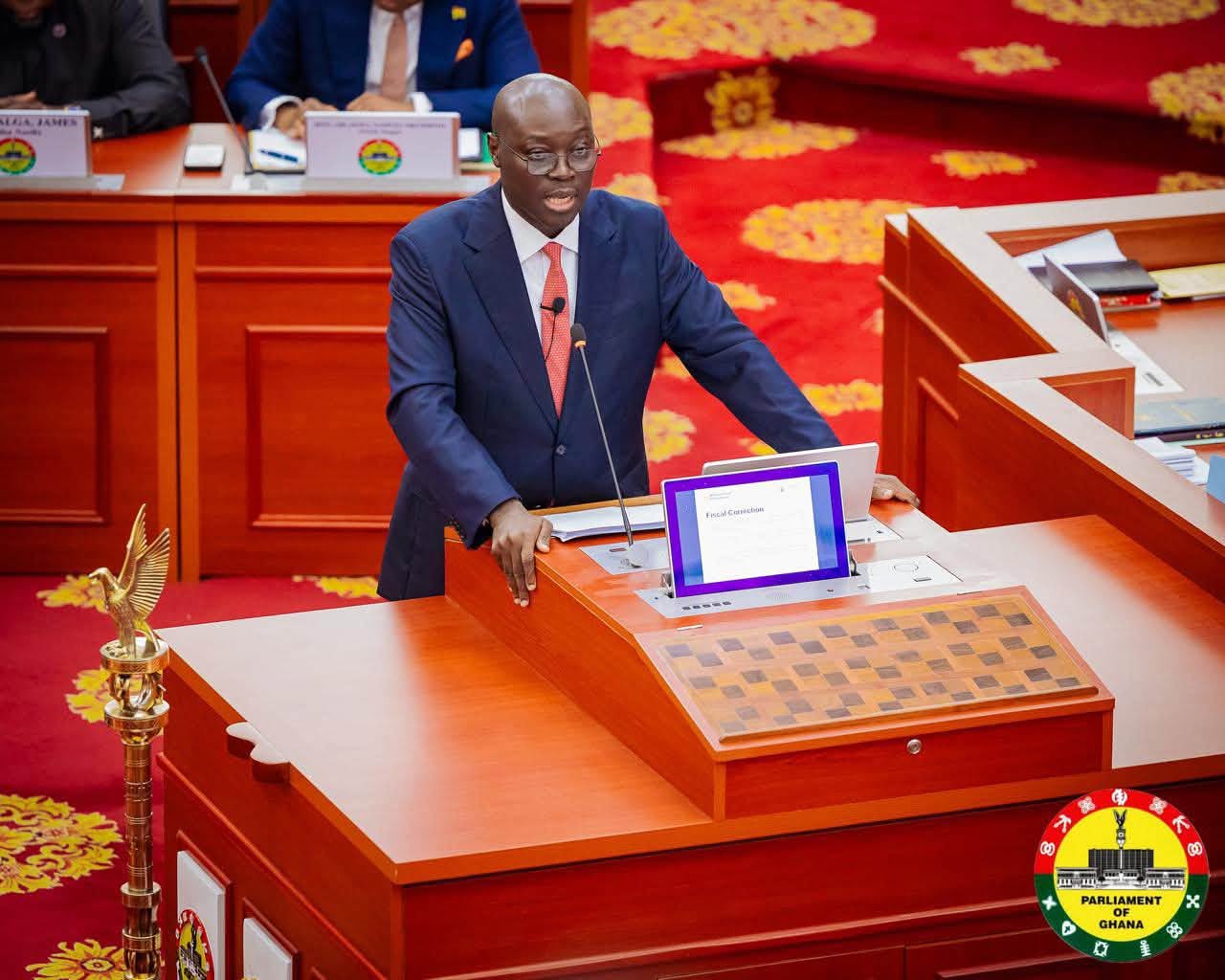
Under the proposed allocation, US$665.6 million, representing 70 per cent of Benchmark Revenue, will go to the ABFA, while US$285.3 million, representing 30 per cent, will be transferred to the Ghana Petroleum Funds.
The latter allocation will be divided between the Ghana Stabilisation Fund, which is projected to receive US$199.7 million, and the Ghana Heritage Fund, which is expected to receive US$85.6 million.
The distribution reflects the statutory framework intended to balance immediate budgetary requirements with savings for future generations and protection against economic shocks.
Section 18 of the Petroleum Revenue Management Act provides that:
“The Annual Budget Funding Amount from petroleum revenue shall not be more than seventy percent of the Benchmark Revenue.”
This restriction is central to the management of petroleum wealth because it limits the share of benchmark revenue that can be directed towards current budget expenditure, while preserving a portion for the country’s petroleum funds.
Nevertheless, the projected US$665.6 million ABFA allocation remains dependent on the revenue assumptions underpinning the budget. If actual petroleum receipts fall below projections, the amount available for allocation could also be affected.
A Narrower Revenue Base Raises Questions About Sustainability
The medium-term projections suggest that Ghana cannot assume petroleum receipts will remain at the 2027 level.
By 2030, total petroleum receipts are expected to fall to US$736 million, while Benchmark Revenue is projected to decline from US$950.9 million in 2027 to US$594.7 million.
The ABFA allocation is similarly projected to decrease from US$665.6 million in 2027 to US$416.3 million in 2030.

This has implications for the Government’s capacity to rely on petroleum revenues to finance infrastructure and other development priorities. It also places greater importance on ensuring that petroleum receipts are invested in projects capable of generating lasting economic value.
The outlook strengthens the case for sustained investment in exploration, field development and production optimisation. However, new investment must translate into additional commercially viable production if it is to materially change the revenue trajectory.
Ghana’s upstream sector has been seeking renewed investment following years of declining crude oil output. Government has also pursued petroleum agreement extensions, changes to the fiscal framework and negotiations with international oil companies to encourage new exploration and development activity.
Those measures may support production recovery, but their impact on petroleum revenue will depend on the timing of investment, successful drilling, commercial discoveries and the ability to bring new production onstream.
The 2027 projections therefore present two connected fiscal challenges: ensuring that the country does not overestimate the revenue it can collect in the short term, while taking steps to prevent the production base from narrowing further over the medium term.
The revised benchmark price addresses the first concern by adopting a more cautious market assumption. The declining production and revenue forecasts, however, show why prudent forecasting alone cannot secure the future contribution of petroleum to Ghana’s public finances.
For the Government, the longer-term priority will be to convert renewed investor interest and exploration activity into sustainable production, while ensuring that the petroleum revenues received are managed within the limits of the country’s fiscal and savings framework.
READ ALSO: Ghana Government Allocates GH¢782m to Sports