
Finance Minister, Dr. Cassiel Ato Forson has announced a targeted government intervention to conduct geological investigations across 13 designated areas in Ghana to delineate viable mineralised zones for allocation to formalised small-scale mining operators.
Unveiled during the presentation of the 2027 Budget Statement and Economic Policy to Parliament, the initiative represents a decisive shift toward structured resource extraction by mapping confirmed mineral deposits prior to licensing.
“Mr. Speaker, to promote responsible small-scale mining, geological investigations will be conducted across 13 designated areas to delineate viable mineralised zones for allocation to formalised operators.”
Finance Minister, Dr. Cassiel Ato Forson
Beyond geological mapping, the policy package integrates decentralisation of regulatory oversight and domestic value retention to overhaul Ghana’s extractive sector.

The Minerals Commission has already completed and commissioned regional and district offices in Kumasi and Damang, with additional facilities in Tamale and Kyebi scheduled for completion before the end of 2026.
Concurrently, the Commission will convene the second edition of the Mining Local Content Summit to evaluate industry progress, resolve operational bottlenecks, and strengthen Ghanaian participation across the mining value chain.
Ending Blind Prospecting Through Geological Mapping
For decades, artisanal and small-scale gold mining (ASGM) in Ghana has been plagued by trial-and-error excavation, where operators clear vast tracts of arable land and river buffers without verified subsurface data.
By deploying state-led geological surveys across 13 blocked-out zones, the Ministry of Lands and Natural Resources and the Minerals Commission aim to eliminate speculative digging and direct licensed miners strictly toward proven ore bodies.
Industry observers note that under the Minerals and Mining Act, 2006 (Act 703), lack of accessible geological data has historically driven licensed operators into informal arrangements or encroaching concessions, compounding environmental degradation.

Providing pre-investigated blocks ensures that small-scale licensees nrestricted by law to Ghanaian citizens aged 18 and above on parcels not exceeding 25 acres can secure financing, plan mine layouts, and adopt mercury-free processing technologies with commercial certainty.
As earlier explained during stakeholders’ engagements on the blocked-out areas framework, “the idea is to move from chaotic and dangerous mining practices to more structured and sustainable mining” so that every operator “knows exactly what is there and how to mine sustainably”.
Transitioning small-scale miners from blind prospecting to data-backed extraction directly curbs the pollution of major water bodies while safeguarding rural livelihoods and boosting formal gold recovery into national reserves.
Decentralising Enforcement Across Mining Districts
Regulatory effectiveness in Ghana’s mining hubs has long been constrained by administrative centralisation in Accra, which slowed down permit processing, field inspections, and compliance monitoring.
The commissioning of the Kumasi Regional Office and the Damang District Office marks a structural expansion of the Minerals Commission’s physical footprint in key gold-producing belts.
Completing the Tamale Regional Office and the Kyebi District Office by year-end will further bridge oversight gaps across both the northern savannah belt and the Eastern Region’s Birim basin.
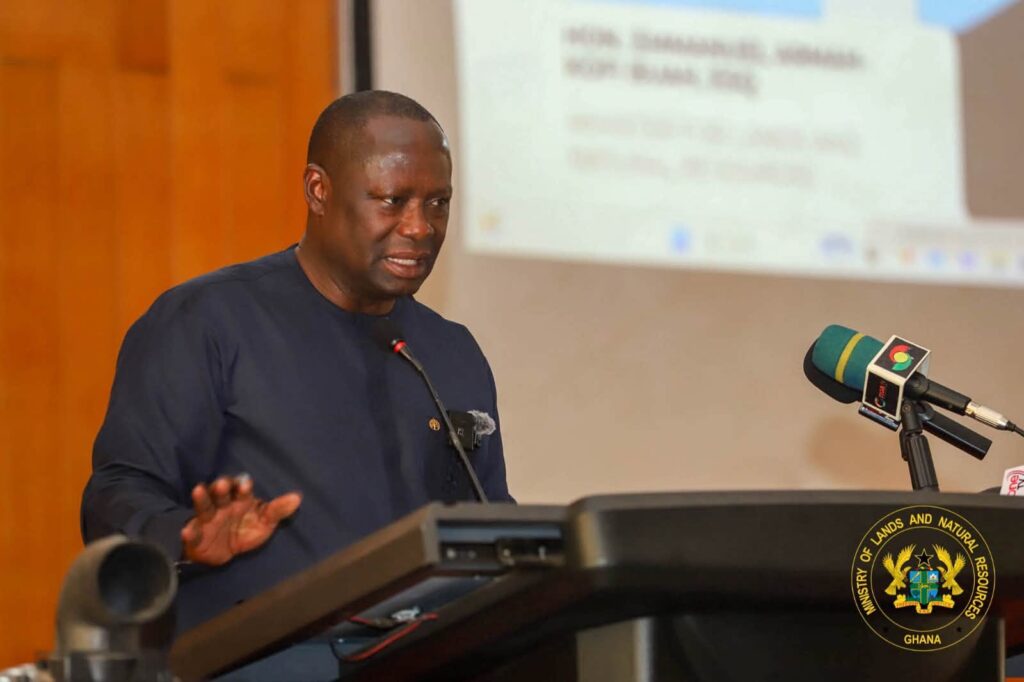
Closer proximity enables district officers and District Mining Committees to enforce the Minerals and Mining (Local Content and Local Participation) Regulations, 2020 (L.I. 2431) alongside environmental permit conditions issued by the Environmental Protection Agency.
During the inauguration of the Kumasi facility, Deputy Minister of Lands and Natural Resources Yusif Sulemana highlighted that “for over 40 years the services of the commission were centralised in Accra,” noting that regional infrastructure finally brings regulatory supervision directly to mining communities.
Strengthened field presence allows inspectors to track earthmoving equipment, audit concession boundaries, and intervene rapidly against unauthorised operations before irreversible ecological damage occurs.
Deepening Local Value Retention Along the Value Chain
While formalising upstream extraction protects the environment, retaining mineral wealth within the domestic economy remains central to Ghana’s long-term industrial strategy.
Convening the second edition of the Mining Local Content Summit builds on the inaugural gathering held in Takoradi in February 2026, offering a structured platform to audit compliance with Ghana’s expanded Procurement List and indigenous ownership targets.

Despite record gold output and rising global bullion prices, capital flight through foreign-dominated procurement, technical contracting, and raw mineral exports has historically limited domestic economic multipliers.
The upcoming summit will examine barriers preventing Ghanaian engineers, fabricators, and financial institutions from capturing higher-tier contracts across the extractive supply chain.
READ ALSO: GSE Trading Surges 292% as Market Activity Explodes