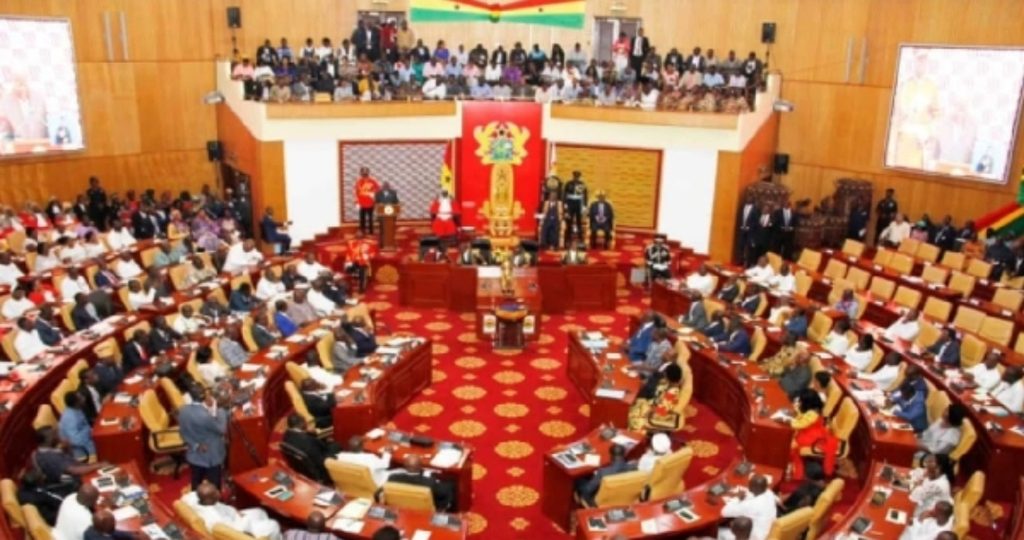
Parliament has begun examining Ghana’s 2027 Budget Statement and Economic Policy, with lawmakers urged to subject government spending plans, economic targets and proposed investments to rigorous scrutiny to ensure accountability, fiscal discipline and value for money.
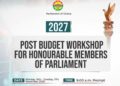
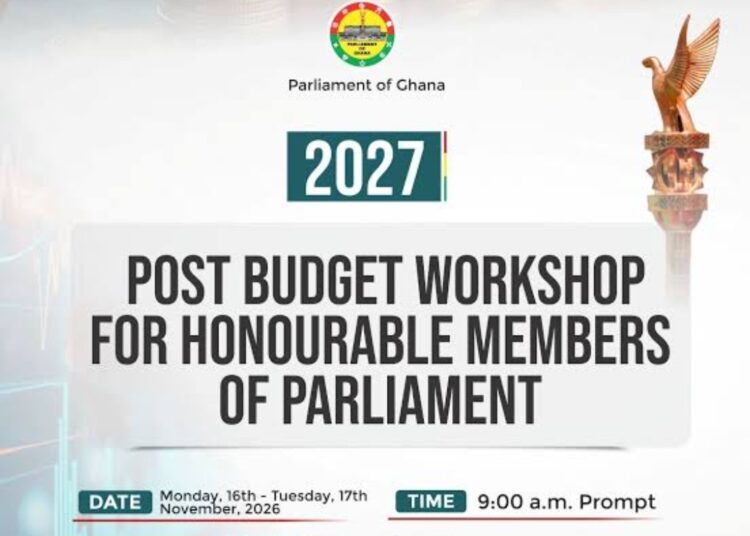
The call was made on Monday, November 16, 2026, during the opening of a two-day post-budget workshop organised by the Parliamentary Service through the Parliamentary Training Institute in Accra.The workshop follows the presentation of the 2027 Budget by Finance Minister Dr Cassiel Ato Forson on November 12, under the theme, “The New Economy, New Ghana, Jobs and Prosperity.”
It is intended to equip Members of Parliament with the technical knowledge required to examine the government’s fiscal proposals before the commencement of parliamentary debate.
Parliament Urged to Strengthen Budget Oversight
Clerk to Parliament, Ebenezer Ahumah Djietror, emphasised that the workshop provides an important platform for lawmakers to assess whether the proposed policies and resource allocations align with Ghana’s development priorities.
He maintained that economic stability must translate into tangible improvements in production, employment, household incomes and living conditions rather than remain an achievement measured solely through economic indicators. Mr. Djietror further highlighted Parliament’s constitutional responsibilities under Articles 174 and 179 of the 1992 Constitution, particularly its authority over taxation, public expenditure and approval of government financial proposals.
He also urged lawmakers to strengthen oversight of ministries, departments and agencies by monitoring expenditure against approved estimates, performance targets and actual project delivery. The Clerk disclosed that efforts were underway to professionalise Parliament’s Office of Budget and Fiscal Analysis to provide independent, specialised and evidence-based technical support for legislative scrutiny.
Majority Leader Highlights Economic Recovery
Majority Leader and Member of Parliament for Builsa North, James Agalga, described parliamentary scrutiny as a fundamental part of Ghana’s constitutional checks and balances. He explained that while the Executive formulates and presents the national budget, Parliament has the responsibility to examine, debate and approve its proposals while ensuring prudent management of public resources.
Hon. Agalga maintained that the 2027 Budget’s emphasis on production, employment and economic transformation was necessary to sustain recovery and address challenges confronting businesses.Presenting the government’s reported economic performance, he highlighted a fiscal deficit of 2.3 per cent of GDP, annual average inflation of 4.6 per cent and public debt equivalent to 47.5 per cent of GDP as of October 2026.
He also noted that Ghana’s gross international reserves covered 4.5 months of imports as of September 2026, while the cedi recorded a 10.1 per cent depreciation against the US dollar by the end of October. According to the Majority Leader, these developments reflected progress towards macroeconomic stability despite external and domestic economic pressures, including declining cocoa prices, flooding and disruptions to electricity generation.
Government Outlines 2027 Economic Targets
Representing the Finance Minister, Deputy Minister of Finance Thomas Nyarko Ampem reiterated the government’s commitment to transforming economic stability into increased production, sustainable employment and improved household incomes.He described the 2027 Budget as a commitment to the Ghanaian people that required Parliament’s scrutiny and approval to ensure effective implementation.
“The 2027 Budget is not just a statement of Government’s intentions, but it is a contract with the Ghanaian people.”
Deputy Minister of Finance Thomas Nyarko Ampem
He reported that Ghana’s economy grew by 6.2 per cent in the first half of 2026, while inflation stood at 5.5 per cent in October. Gross international reserves reached US$12.1 billion, equivalent to 4.5 months of import cover, by the end of September.
For 2027, the government is targeting real GDP growth of at least 5.2 per cent, non-oil GDP growth of 5.7 per cent, end-year inflation of 8 per cent within a two-percentage-point margin, and a primary surplus of at least 0.5 per cent of GDP. It also intends to increase gross international reserves to cover at least six months of imports.The targets align with the government’s broader US$10 billion New Economy investment programme covering 2027 to 2030, which seeks to expand productive sectors and generate employment.
MPs Prepare for Budget Debate
The workshop will provide lawmakers with expert presentations and discussions covering macroeconomic stability, fiscal discipline, public debt sustainability, infrastructure development, revenue mobilisation and public expenditure efficiency. Other areas include decentralisation, peace and security, and the proposed US$10 billion investment programme.
Hon. Agalga urged MPs to approach the forthcoming debate with objectivity and evidence-based arguments, stressing that their contributions should reflect the interests of citizens rather than political rhetoric. He further encouraged parliamentary committees to examine sectoral budget estimates carefully and ensure that ministries and government agencies implement programmes in accordance with approved allocations.
The workshop is expected to strengthen Parliament’s capacity to hold the Executive accountable as lawmakers prepare to debate the 2027 Budget from November 18. The exercise therefore marks an important stage in the national budget process, shifting attention from the government’s proposed spending priorities to the legislative scrutiny that will determine their approval and subsequent oversight.
READ ALSO: Dangote Explores Africa’s Investment Future