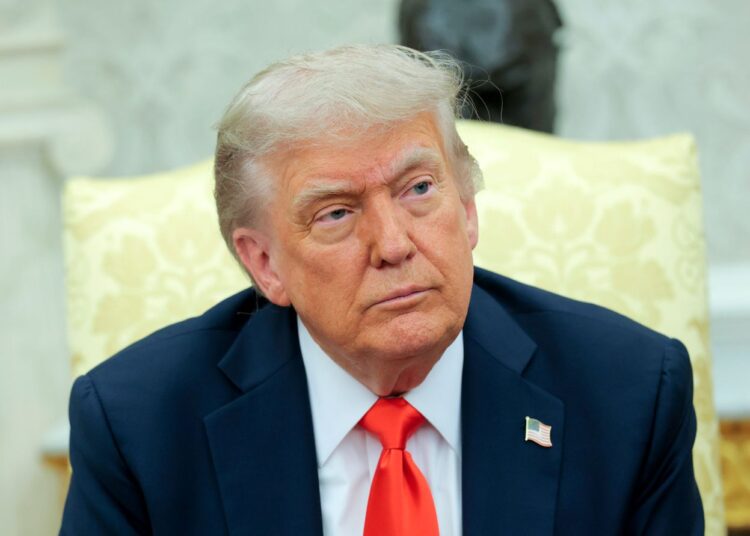
US President, Donald Trump has departed for Asia, where he is expected to pursue trade agreements, discuss the war in Ukraine and explore the possibility of renewed engagement with North Korea, as his administration navigates mounting political challenges at home.
Trump’s itinerary begins in Manila, where he is scheduled to meet Southeast Asian leaders, before continuing to Shenzhen, China’s technology hub. The visit will include a highly anticipated meeting with Chinese President Xi Jinping and Russian President Vladimir Putin, with discussions expected to cover nuclear issues and the wider international security landscape.
Before leaving the White House today, Trump disclosed to reporters that he might also meet North Korean leader Kim Jong Un during his time in China, as Washington considers renewed diplomatic engagement with Pyongyang over its nuclear programme.

He also indicated that Russia’s war against Ukraine would feature prominently in his discussions with Xi and Putin.
“We’ll talk about, my favorite subject, Ukraine. Ukraine’s losing Ukraine. Russia is losing 25,000 soldiers in the month. So we’ll be talking about that.”
Donald Trump
His remarks suggest that the President intends to use the meetings to address some of the major geopolitical disputes confronting his administration, particularly the continuing conflict in Ukraine and tensions surrounding nuclear weapons.
Trump’s planned engagement with Xi and Putin has raised concerns in Kyiv about the possibility of major powers making decisions that could affect Ukraine’s future without its participation.
Ukrainian President Volodymyr Zelenskyy has expressed reservations about the proposed meeting, warning against any arrangement that could result in the redistribution of global influence among powerful countries.
He previously compared the potential outcome to the Yalta Conference of 1945, when the leaders of the United States, Britain and the Soviet Union agreed on arrangements for the occupation of Germany and Berlin following the Second World War and discussed the postwar international order. “We really don’t want this to turn into ‘Yalta 2, 3, 4’ with a redistribution of influence,” Zelenskyy said last month.
The Ukrainian President’s concerns reflect fears that discussions among Washington, Moscow and Beijing could influence the security arrangements surrounding Ukraine without adequately accounting for Kyiv’s sovereignty and interests.
Trump, however, has indicated that he intends to raise the war directly with both leaders. He cited the scale of Russian military losses while suggesting that the conflict remains an important subject for discussion.
Beyond Ukraine, the meetings are expected to address broader relations between the United States, China and Russia, including nuclear security and the balance of power among the three countries.
Trump Seeks Trade, Regional Cooperation In Manila
Before travelling to China, Trump is expected to meet Southeast Asian leaders in Manila, where regional governments are seeking continued US engagement amid growing tensions with Beijing.
The Philippines and other countries in the region have looked to Washington for diplomatic and security support as they navigate disputes involving China and its activities in the Indo-Pacific.
Trump’s visit also provides an opportunity to advance his administration’s trade agenda. The White House said the President plans to sign a trade agreement with Thailand while in Manila.
The proposed agreement forms part of Washington’s broader effort to strengthen economic partnerships in the region while maintaining its strategic influence.
His trip comes at a politically difficult moment for the administration. Republicans suffered significant losses in the November midterm elections, losing control of both chambers of Congress, while domestic concerns over air travel disruptions have placed additional pressure on the government.
Trump’s departure followed several days in which he had remained largely out of public view as a nationwide ground stop disrupted air traffic and raised questions about the administration’s handling of the situation.
The President said Transportation Secretary Sean Duffy and Homeland Security Secretary Markwayne Mullin had kept him informed about developments on Friday. The two officials subsequently held a briefing to address the public.
Trump defended his decision to allow Cabinet members to handle the public communication rather than addressing the matter himself. “I didn’t think there was any reason for me to do it,” he said, adding, “I thought they did a very good job.”
Nvidia Controversy Casts Shadow Over China Visit
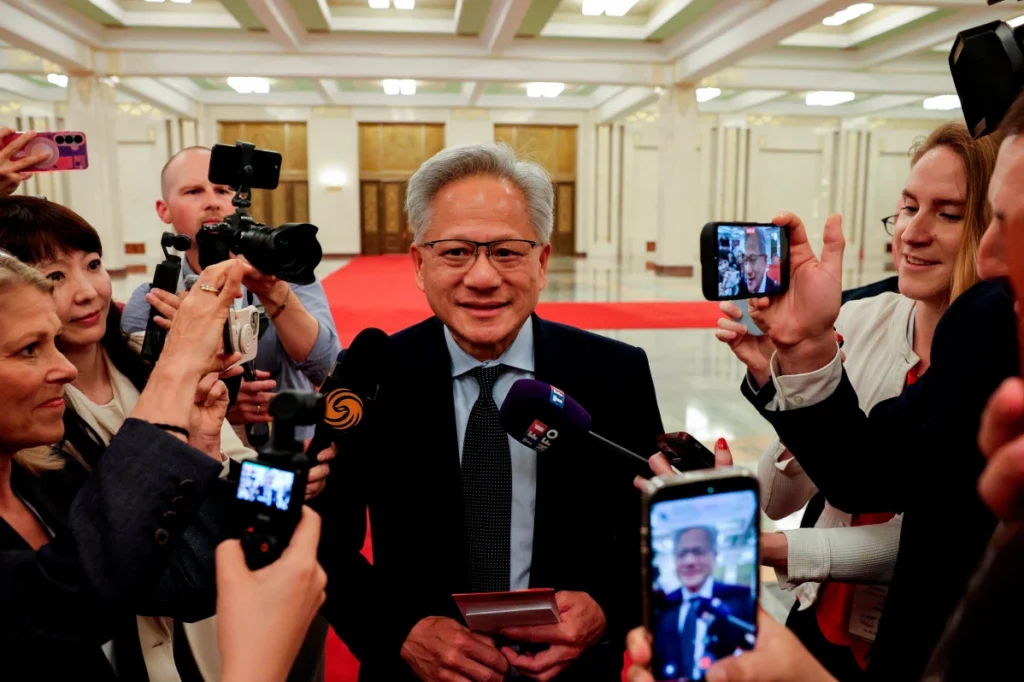
The controversy surrounding Nvidia and its former Chief Executive, Jensen Huang, is also expected to remain a subject of scrutiny during Trump’s visit, particularly given the company’s importance to the global artificial intelligence industry and US-China technology competition.
Huang stepped down as Nvidia’s Chief Executive last week following reports about his personal relationship with a senior executive at Megaspeed, a Singapore-based cloud computing and AI infrastructure provider.
The Executive has been alleged to have links to the Chinese government, although the allegations have not been established. Beijing has denied involvement.
US officials briefing journalists ahead of Trump’s visit said the President did not plan to raise the controversy with Xi.
However, Trump defended Huang when questioned by reporters before departing Washington, saying he had not been informed that US authorities had established that the woman was a Chinese intelligence agent.
“Well I don’t know that she’s a spy at all. Nobody’s proven that. He probably shouldn’t have been doing on a personal basis what he did. That’s a different story.”
Donald Trump
The President also expressed that he would like to see Huang reinstated as Nvidia’s Chief Executive.
Huang has maintained a visible relationship with Trump. He accompanied the President aboard Air Force One during his previous trip to China in May and has periodically appeared with him at the White House.
Their relationship has attracted attention because Trump has repeatedly emphasised the importance of maintaining American leadership in artificial intelligence, warning of serious consequences if China overtakes the United States in the sector.
The controversy has also prompted questions about the administration’s handling of Nvidia’s business activities, including the Commerce Department’s delay in imposing restrictions on the company’s chip exports to Megaspeed.
As Trump prepares to meet Xi, scrutiny of the administration’s decisions involving the technology company is likely to remain part of the wider debate over Washington’s approach to China.
The President’s Asian tour therefore carries several overlapping objectives, from advancing trade and regional partnerships to addressing the Ukraine war and nuclear security. Whether the meetings produce meaningful diplomatic progress will be closely watched, particularly as Trump seeks to demonstrate progress abroad amid political and economic challenges at home.
READ ALSO: Imran Khan Appeals to Pakistan’s Top Judges Over Medical Care