Dr. John Osae-Kwapong, Democracy and Development Fellow, CDD-Ghana, and Project Director, the Democracy Project
In my opinion piece last week, I wrestled with the prospects of a Dr. Bawumia presidency, with the 2028 election just two years away. I noted that a key challenge is the legacy problem of how to answer for the challenges Ghanaians faced, especially in the last two years of the NPP administration.
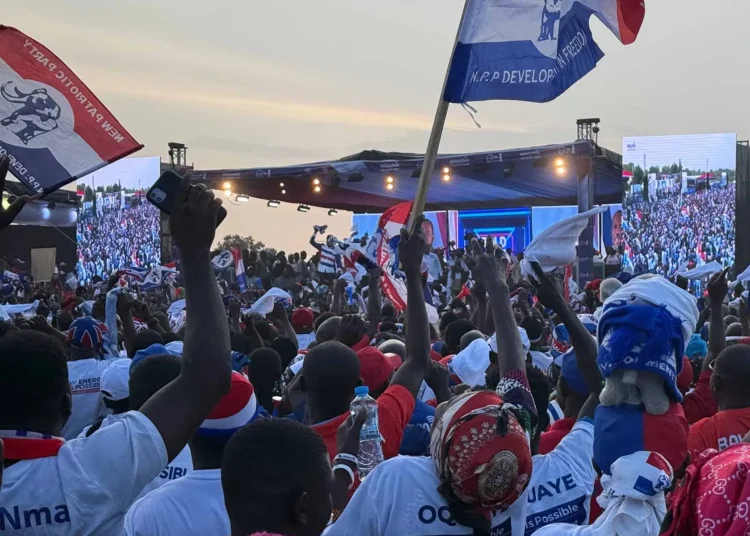
I now turn to the New Patriotic Party, because it is on the party’s ticket that Dr. Bawumia will contest the presidency. Public perceptions of the party will shape his prospects. In Ghana, the competition between the two leading parties, NPP and the National Democratic Congress (NDC), means that a candidate is rarely judged in isolation.
Voters consider the party’s record, its conduct in and out of office, and the trust it has earned or squandered. A party that is judged favorably offers its candidate a reservoir of goodwill.
A party judged unfavorably hands its candidate a burden that personal appeal may struggle to overcome. Because Dr. Bawumia’s candidacy is so closely tied to the party’s governing record, how the public views the NPP is part of the terrain on which 2028 will be fought.
A Context That Can’t Be Ignored
There was a time when the NPP was, by a clear margin, the more favored party. CDD-Ghana’s pre-election surveys asked citizens to rate each party from 0 (strongly dislike) to 10 (strongly like).
In July 2016, 47 percent rated the NPP on the “like” side of the scale, against 38 percent for the NDC. The advantage held in October 2020, when the NPP was in government and carried the burdens of incumbency: 55 percent to 41 percent.
Trust told the same story. In both October surveys (2016 and 2020), about 59 percent said they trusted the NPP “somewhat” or “a lot”, compared with 47 percent for the NDC. In 2020, nearly 59 percent said the NPP looks after the interests of all Ghanaians rather than a few regions or groups, against 52 percent for the NDC.
The NPP once enjoyed a reservoir of goodwill that its main rival did not. Over time, the important ingredient of trust in the party eroded. Afrobarometer asks Ghanaians how much they trust the ruling party. During NPP years, the share saying “a lot” looked like this – 51% (2002), 41% (2005), 42% (2008), 33% (2017), 23% (2019), 9% (2022) and 10% (2024).
To compound the problem of trust, is the changing political attachment to the party. Among Ghanaians who identify with a party, the NPP’s share dropped from 66 percent in 2017 to 46 percent in 2024. For the first time since Afrobarometer Round 1 (1999), slightly more Ghanaians (51%) say they feel close to the NDC.
The losses were steepest among the young. Among 18 to 25-year-olds, the NPP’s share fell from 69 to 39 percent. It fell from 58 to 31 percent among Muslims and from 69 to 44 percent among Ghanaians with secondary education.
The Search for Redemption
These two data points show that perceptions of a party and support for it are not the same thing. Many reasons drive support for a party and dwindling trust may sometimes not threaten it.
However, one cannot ignore the perception signals. In my view, eroding trust eventually has a way of affecting political support even if the trajectory is slow. A close look at the results of the Afrobarometer survey over ten rounds bears this out. The decline in support among the youth and the educated illustrates this point.
A party that reads its remaining base as proof that the party remains in good public standing is reading the wrong indicator. I offer this with caution, since the data is from 2024 and we await the 2026 Afrobarometer to learn whether the NPP’s standing has recovered or slipped further.
There is a harder point. Explanations don’t redeem. The NPP points to the global shock of COVID-19 and to interventions such as the Domestic Debt Exchange Programme (DDEP), which its officials defend as necessary to stabilise the economy.
But Ghanaians do not remember a government’s explanations. They remember how its decisions felt in their homes, their savings and their livelihoods. They still carry the “wounds” of the NPP’s time in office, and no appeal to circumstances closes them.
Redemption will therefore not depend only on what the NDC fails to do in government. It will depend as much on what the NPP is willing to acknowledge and atone for in its dealings with Ghanaians.
A party that wants to be trusted again must first say plainly where it hurt people. In my opinion, that calls for a little less adversarial politics and a lot more reconciliation. Voters are far more likely to listen to a party that begins by listening to them.
READ ALSO: Ghana Must Move Beyond 10% Mineral Benefit — Mpraeso MP