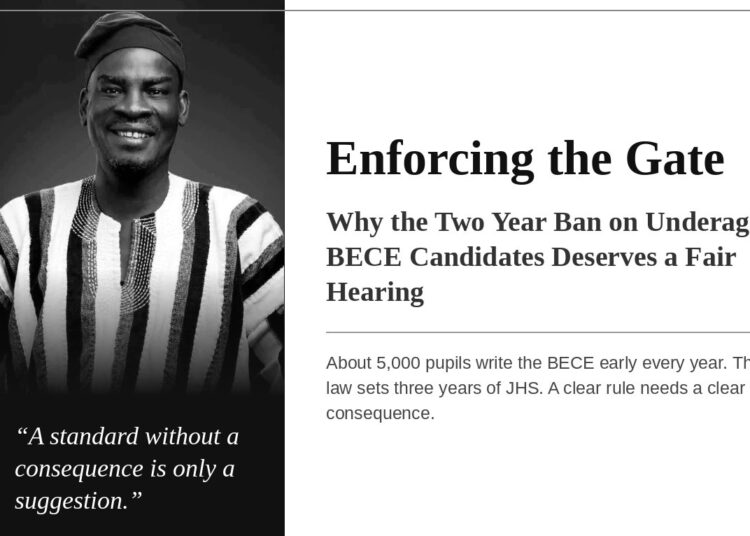
Author: Evans Senior Owu: Climate Policy Professional & Columnist
Ghana’s new two-year BECE ban for pupils who write the examination early has drawn sharp criticism. Some call it unfair to children. Others say it offends constitutional safeguards, and that the parents and teachers who enable early registration should bear the sanction instead.
These concerns are sincere. Yet much of the criticism is defensive, and much of it ignores the context of the directive. My view is simple. A standard without a consequence is only a suggestion. The ban deserves refinement, not rejection.
On 23 November 2026, at the opening of National Education Week, Education Minister Haruna Iddrisu directed the Ghana Education Service (GES) to apply the rule: a pupil in JHS 1 or JHS 2 who jumps ahead to write the BECE should be barred from the examination for two years.
The directive seeks to promote fairness and discipline, protect continuous assessment records, and give planners accurate candidate numbers. Exceptionally gifted pupils may still be exempted through special approval. The scale of the problem explains the urgency. GES puts the number of early BECE candidates at about 5,000 every year.
That is not a handful of prodigies. It is a pattern, sustained by schools and families who see an early result as a shortcut to senior high school. Each of those candidates distorts placement planning, weakens assessment records, and competes for places with pupils who completed the full course.
Earlier responses have not stopped it. In 2022, the GES warned heads against registering JHS 1 and JHS 2 pupils and threatened to nullify their results. In 2023, it ordered district directors to check attendance records to identify pupils who skipped class to write early. Audits and nullification came after the fact, and the practice persisted. A clear, predictable deterrent is the logical next step.
The law is on the side of the standard
The Pre-Tertiary Education Act, 2020 (Act 1049) fixes the structure of basic education. Section 1 provides for two years of Kindergarten, six years of Primary School and three years of Junior High School.
Section 2 makes basic education free, compulsory and universal, and requires every child to complete the course of instruction laid out in the national curriculum. Three years of JHS is a statutory requirement, not a preference. A pupil who leaves JHS 2 to write the BECE cuts short the education the law guarantees.
The standards-based curriculum gives this structure practical force. A BECE candidate needs three years of continuous assessment scores, which carry a significant share of the final grade, commonly put at 30 per cent. A JHS 2 pupil cannot have three years of records.
The school must either submit an incomplete record or fill it with figures that reflect no real assessment. Either way, the result loses its integrity. The Minister also has the power to act. Section 17 of Act 1049 states that “the Minister may give directives to the Council on matters of policy and the Council shall comply.”
Under Section 11, the GES Council must implement standards for basic education. Under Section 20, the Director-General coordinates policy at regional and district levels and disciplines school heads. The directive follows exactly the chain the law designed.
WAEC law points the same way. The West African Examinations Council Act, 2006 (Act 719) already bars candidates for at least two years if they obtain leaked papers or assault examination officials, and for three years for impersonation. Parliament accepts that a candidate who undermines an examination may lose access to it for a set period.
To be fair, Act 719 does not name early sitting as an offence, and Section 10 applies the Juvenile Justice Act to young persons. Perhaps both points argue for care in implementation. Neither argues against the policy.
Eligibility rules are normal across our education system. At university, a student must take prescribed courses each semester, pass prerequisites and complete the full program, usually four years, before a degree is awarded.
A brilliant first-year student cannot sit final-year papers and graduate early. We recognize exceptional ability, yet we still insist on the structure, because a certificate certifies a process as well as a score.
The BECE certifies nine years of basic education. So, the question for critics is direct. Do we want eligibility conditions for the BECE or not? If not, we should say so and change the law. If we do, breaches must carry consequences.
Where the critics are right, and where they are not
The constitutional objection is weaker than it sounds. Article 25 of the 1992 Constitution guarantees the right to education. It does not guarantee a right to write a terminal examination before completing the course.
The ban removes no child from school. The pupil stays in class, completes JHS, and writes the BECE with peers. In practice, a JHS 1 pupil who writes early would normally write again in JHS 3, two years later. The ban mainly removes the gain from cheating the timeline.
The critics are right that adults carry most of the blame. No 13-year-old registers for the BECE alone. But this is not a choice between the child and the adult. Both should face consequences. The candidate ban removes the prize, and that is what makes it a deterrent.
The stronger criticism concerns process, and the Ministry should take it seriously. Article 296 of the Constitution requires discretionary power to be exercised fairly, candidly and without arbitrariness.
Five steps would meet that standard. First, codify the rule in a legislative instrument, using the Minister’s power under Section 14 of Act 719 or regulations under Act 1049. Second, give clear notice before the next registration window and apply the rule only to registrations made afterwards.
Third, publish transparent criteria for the gifted pupil exemption, so it cannot be bought with connections. Fourth, give each pupil and parent a hearing and a right of appeal. Fifth, pair every candidate ban with disciplinary action against the heads and teachers involved, and publish the outcomes each year.
Better still, verify enrolment and JHS 3 attendance before any candidate number is issued. Prevention is cheaper than punishment. We should be careful not to talk this directive out of existence. It does not attack children. It defends the value of a certificate that hundreds of thousands of pupils earn each year honestly after three full years of JHS.
Ghana must be a society of standards, with cautious, streamlined, and regulated exceptions. That is what this directive seeks. It deserves our support, and our scrutiny in equal measure.
READ ALSO: The New Patriotic Party (NPP) – In Search of Redemption