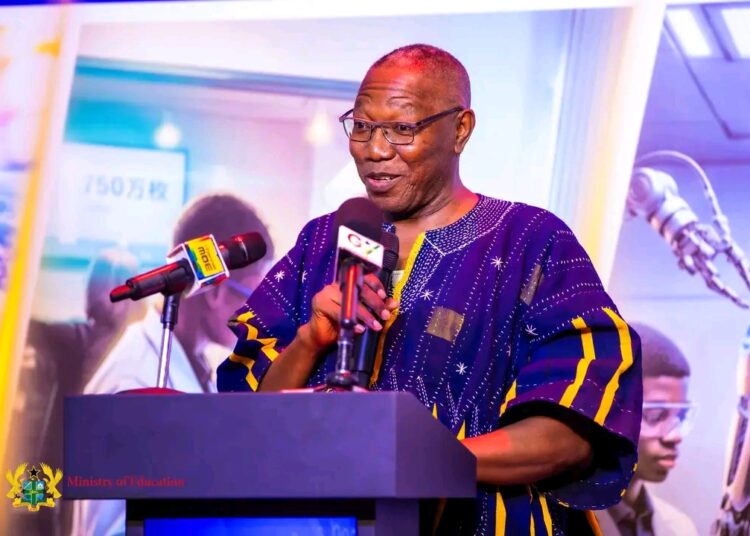
Ghana’s Deputy Minister of Education, Dr Clement Abas Apaak, has urged African countries to commit at least two per cent of their Gross Domestic Product (GDP) to digital technology, arguing that sustained investment is essential if the continent is to harness artificial intelligence (AI) in education.
He made the call at the closing ceremony of the 26th National Education Week and Evidence Summit in Accra. The gathering brought together policymakers, educators, researchers and development partners to examine how emerging technologies could reshape teaching and learning.
Dr Apaak stressed that AI adoption must be matched by investment in digital infrastructure, stronger data security and training for teachers and learners. He cautioned that poor infrastructure, limited connectivity, funding constraints and ethical concerns could prevent education systems from benefiting fully from technological advances.
“These deliberations have reinforced that AI integration is not merely a technological matter; it is also an issue of education policy, institutional readiness, human capacity, governance and national development.”
Dr. Clement Abas Apaak, Deputy Minister for Education
Infrastructure gaps and ethical risks remain major obstacles
While highlighting AI’s potential, Dr Apaak acknowledged that inadequate infrastructure, limited internet connectivity and funding constraints remain significant barriers to integrating digital tools into education. Ethical concerns, including the responsible handling of information and protection of learners, also require clear safeguards.

Schools need clear guidance on AI use, data collection and learner protection. Teachers also require the skills to use digital tools in ways that strengthen learning.
The Evidence Summit was organised by the Ministry of Education in collaboration with Innovations for Poverty Action and other partners. Its programme focused on AI governance, sustainable innovation, teacher development and workforce readiness, with discussions intended to draw on evidence relevant to Ghana’s education system.
The findings are expected to inform a draft National AI in Education Roadmap for 2027–2030, alongside ethical guidelines and a data privacy framework for AI use in education.
Inclusive policies must protect learners at risk of exclusion
Dr Apaak emphasised that digital transformation must benefit all learners, including children with disabilities and those who experience learning difficulties. He urged stakeholders to ensure that new technologies do not create further barriers for pupils who already face challenges accessing quality education.

An inclusive approach must consider diverse learning needs and ensure technology complements, rather than replaces, human support.
Education stakeholders urged to turn recommendations into action
The Deputy Minister identified three priorities for the sector: improving learning outcomes, placing people at the centre of digital transformation, and strengthening implementation and accountability.
He urged participants to translate the week’s discussions into practical measures that can be assessed in classrooms and education institutions.
“The success of this National Education Week must be measured not simply by the number of participants or presentations, but by the extent to which our deliberations inform policy, influence institutional practice and result in tangible improvements.”
Deputy Minister for Education, Dr. Clement Abas Apaak.
The 26th National Education Week and Evidence Summit was held under the theme, “Harnessing Artificial Intelligence for Inclusive and Transformative Education in Ghana.”
For Ghana and other African countries, the challenge is to match technological ambition with resources, safeguards and sustained investment. The impact of the proposed GDP commitment will depend on whether digital infrastructure reaches underserved schools and teachers and learners are equipped to use it effectively.
READ ALSO: Minister of Communications Tasks GMet To Improve Forecast Accuracy