
The New Patriotic Party (NPP) has outlined alternative measures it believes could address examination registration irregularities without preventing academically advanced pupils from progressing.
The party’s Education Sector Policy Committee wants the Ministry of Education to implement the existing Gifted and Talented Education (GATE) Policy, establish a register of eligible learners and strengthen verification procedures to protect public school placement quotas.
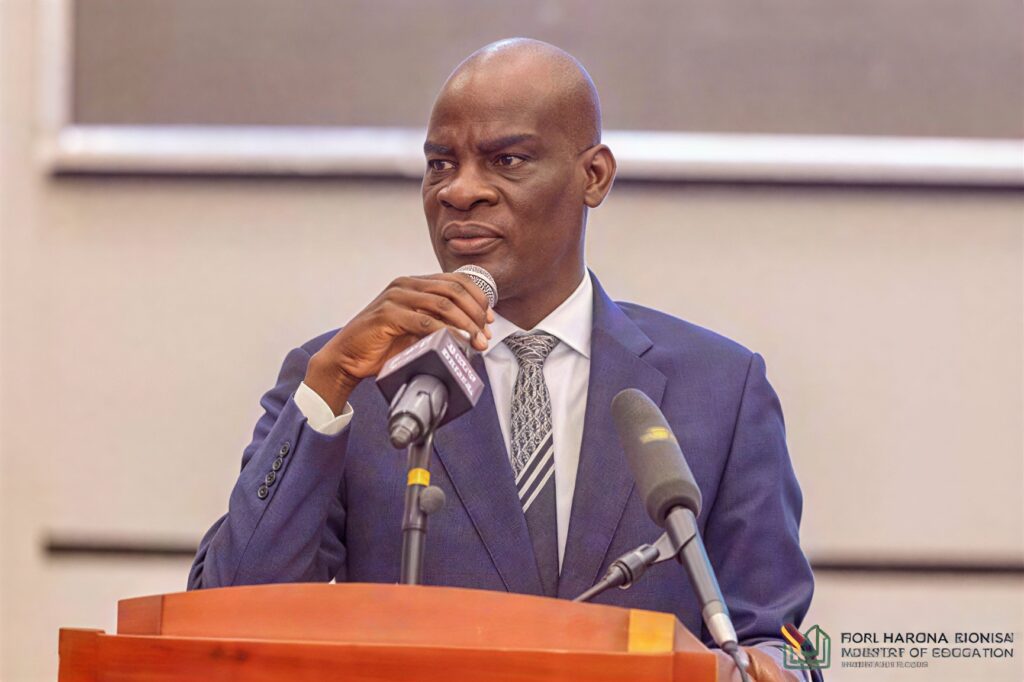
Speaking at a press conference held at the party’s headquarters, Dr Prince Hamid Armah presented the proposals as a more targeted response to the concerns underpinning the Minister of Education’s directive. He contended that registration fraud should be addressed through “reliable records and sanctions against those responsible, not by imposing a blanket restriction on children.”
“It is not a crime to be intelligent. It is not a crime. You must not be punished for being intelligent. You must not be punished for being smart.”
Dr Prince Hamid Armah
The first measure calls for immediate implementation of the GATE Policy, which the NPP claims remains with the Ministry and has not been withdrawn. Dr Armah proposed that NaCCA should develop selection guidelines, while every school establishes a register of gifted learners through teacher nominations and assessed attainment, supervised by trained district coordinators.

He explained that the register could be shared with the West African Examinations Council (WAEC) and the placement authority, enabling officials to verify pupils eligible to sit the BECE before reaching JHS Three.
Under the second proposal, pupils below JHS Three would qualify for early registration only after identification under the GATE framework and inclusion in the school register. Such registration, he indicated, should also require agreement among the school, parent and District Education Office.
The third measure targets the reported manipulation of the 30 percent public school quota under the Computerised School Selection and Placement System. Dr Armah proposed a minimum period of continuous enrolment in a public junior high school, verified through official Ghana Education Service records, with sanctions for falsification.
He disputed the need to penalise early candidates to resolve the quota issue, arguing that existing enrolment data could provide the planning figures required by the Ministry.
The former legislator further pledged that a future NPP government would implement the GATE Policy in full. He maintained that identifying exceptional learners and creating legitimate pathways for their progression would protect academic ambition while preserving the integrity of examination registration.
Ghana’s Historical Antecedents Supports Special Learning
The New Patriotic Party (NPP) also challenged the Ministry of Education to justify the two-year BECE restriction against Ghana’s longstanding practice of allowing academically advanced pupils to progress through school ahead of their age group.
The party’s Education Sector Policy Committee contends that the directive contradicts established educational principles and existing policy frameworks designed to accommodate learners with different intellectual abilities.
Dr Prince Hamid Armah invoked Ghana’s former educational structure to demonstrate that accelerated progression was not an unfamiliar concept in the country’s education system. He recalled that under the pre-1987 arrangement, pupils who passed the Common Entrance Examination could proceed to secondary school without completing the conventional middle-school pathway.
“So our history itself shows that we have always taken account of the learning abilities of our people, and accounted for the slow learners as well as the fast learners.”
Dr Prince Hamid Armah
Using the Common Entrance Programme, he noted that some prominent Ghanaians entered secondary school as early as nine years old, illustrating how the former system accommodated differences in academic readiness.
For the Education Specialist, the principle underpinning that arrangement remains relevant to contemporary education. He asserted that “the hands are not the same”, with children possessing varying abilities and learning capacities that should inform how they progress through school.

He also connected this position to the Gifted and Talented Education Policy developed under the previous NPP administration in 2024. The framework, he explained, recognised the need to support learners who struggle academically while creating opportunities for faster learners to accelerate their studies.
Moreover, this principle should govern examination regulations just as it guides classroom instruction. He therefore challenged the Ministry to explain how restricting early BECE candidates accords with policies it has already issued and continues to retain.
The Former Member of Parliament also questioned the coherence of implementing a directive that, in his assessment, conflicts with the Ministry’s own educational commitments. He called for an explanation of the rationale behind the restriction, particularly where existing frameworks recognise grade skipping as a legitimate form of support for gifted pupils.
READ ALSO: NPP To Education Minister: Withdrawal Two-Year BECE Ban