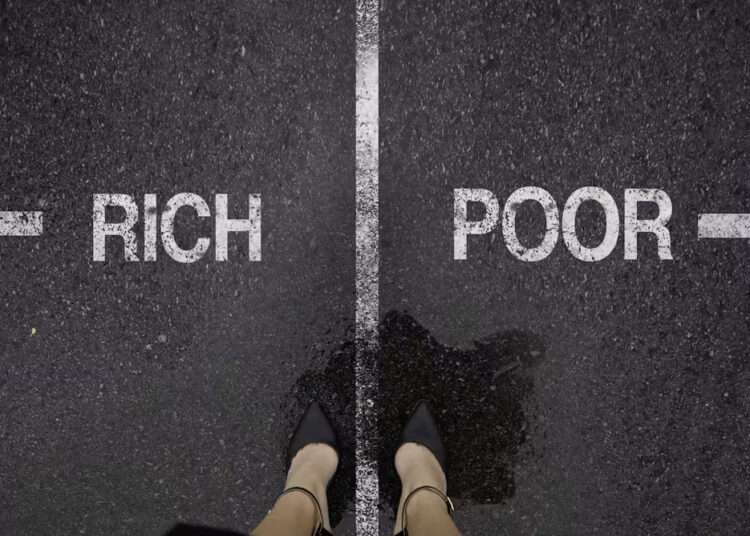
The prosperity gap in Africa has become a pressing issue, highlighting stark economic disparities between countries, regions, and social groups.
The term refers to the average factor by which incomes must increase to ensure that all individuals meet the prosperity standard of $25 per person per day.
However, since the COVID-19 pandemic, this gap has remained stagnant due to slowed economic growth and widening income differences across nations.
“Between 1990 and 2024, the Global Prosperity Gap improved at an annual rate of 2.3 percent, with global mean income increasing at a yearly rate of 1.48 percent and global inequality declining by 0.86 percent.
“The changes in the Global Prosperity Gap can be exactly decomposed into growth in mean income and changes in inequality,”
World Bank Global Prosperity Gap Report
The report identifies Latin America, the Caribbean, and Sub-Saharan Africa as the regions with the highest levels of inequality, despite a decline in the number of economies classified as high-inequality worldwide. Within Africa, Southern and Central regions exhibit the greatest economic disparities.
Economic inequality often translates to limited social mobility, hindering poverty reduction efforts and restricting shared prosperity. Societies with lower inequality levels tend to experience greater social cohesion and stability.
As highlighted in the World Bank report, “In countries where levels of income or consumption inequality are higher, an increase in growth results in a smaller reduction in poverty (Bourguignon 2003).” This suggests that simply increasing economic growth without addressing inequality may have limited benefits for poverty alleviation.
Experts argue that reducing inequality could significantly accelerate poverty reduction across Africa. The report states, “Improvement inequality has also been a missed opportunity for poverty reduction (Sinha, Inchauste, and Narayan 2024) in a region where many countries have abnormally high levels of inequality.”

The Global Prosperity Gap Index: A New Economic Measure
To provide a more comprehensive assessment of economic performance, the World Bank has introduced the Global Prosperity Gap Index. This innovative measure calculates the average income shortfall from the $25-a-day benchmark, reflecting both income growth and income distribution within a nation.
If incomes rise or inequality decreases, the index improves; if incomes drop or disparities widen, the index deteriorates. This new approach offers deeper insights into economic imbalances and underscores the necessity for targeted interventions.
According to experts, the persistence of Africa’s prosperity gap can be attributed to several factors. Historical circumstances, including colonialism and industrialization, have left a lasting economic imprint, with wealthier nations benefitting from early development while many African countries continue to struggle with the consequences of resource extraction and exploitation.
Additionally, uneven economic growth patterns have played a significant role. While rapid development in Asia has lifted millions out of poverty, it has also exacerbated inequality in some regions. Countries that remain on the fringes of the global economy, especially those affected by conflict, face an enduring cycle of poverty.
Policy decisions have a direct impact on inequality levels. Access to education, healthcare, and fair wages significantly influence how wealth and opportunities are distributed. Furthermore, emerging technological advancements pose additional risks; artificial intelligence and automation are reshaping labor markets, potentially marginalizing economies that rely heavily on traditional manufacturing.
To effectively address the prosperity gap, experts recommend prioritizing income equality measures. Governments should ensure that the top 10% of earners do not accumulate excessively more wealth than the bottom 40%. Public investments in healthcare, education, and food security are also essential in leveling the economic playing field. Additionally, implementing equitable fiscal policies can enhance tax redistribution and reduce the income divide.
Structural solutions are equally vital. Policies that promote equal access to human capital development and market opportunities can help create a more balanced economic landscape. Addressing these underlying issues is crucial for fostering long-term prosperity and sustainable economic growth.
The Global Prosperity Gap highlights the urgent need for comprehensive economic reforms to curb inequality and promote shared prosperity. By tackling structural disparities and implementing effective economic policies, African nations can work towards a more equitable future.
READ ALSO: NSA Ghost Names Scandal: Fourth Estate Fireback at Fmr. Directors