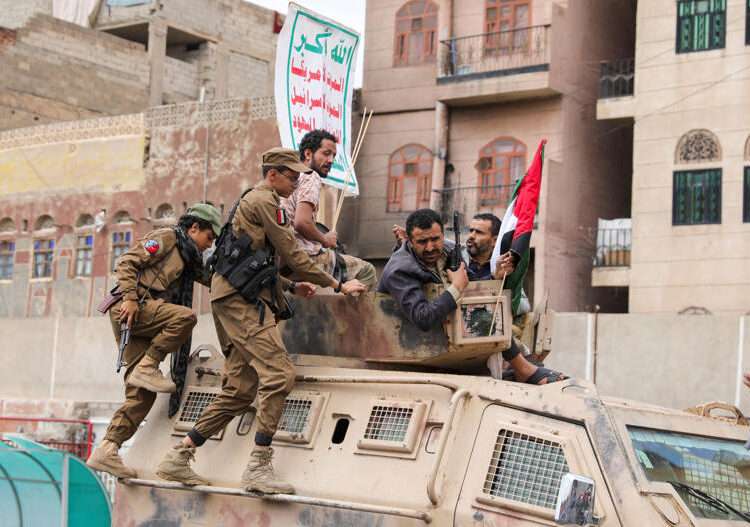
Iran-backed Houthi rebels have seized the key Yemeni port city of Mokha on the country’s western coast, rapidly expanding their territorial gains in an area with major strategic importance for shipping through the Red Sea.
Houthi and Yemeni officials said the group took control of Mokha on Thursday after an overnight offensive against forces loyal to Yemen’s internationally recognized government. Houthi fighters were also reported to have advanced south against government troops following the capture of the coastal city.
Mokha is located approximately 80 kilometres (50 miles) from the Bab el-Mandeb Strait, one of the world’s most strategically important maritime chokepoints. The strait connects the Red Sea with the Gulf of Aden and ordinarily carries about 12% of global goods shipments.
The seizure comes at a particularly sensitive time for international maritime trade, as shipping through another major regional chokepoint, the Strait of Hormuz, has been impeded by Iran during its war with the United States and Israel. The developments along Yemen’s western coast therefore add another layer of uncertainty to an already disrupted regional shipping environment, particularly given the Houthis’ history of attacking commercial vessels in and around the Bab el-Mandeb Strait.
The rebels have increasingly targeted Yemen’s internationally recognized government in recent months and have declared a blockade against Saudi Arabia, which supports the government. While the Houthis have their own longstanding reasons for opposing Saudi Arabia, their actions also serve Iran’s broader interests by increasing pressure on the US-allied oil producer.
Houthi Spokesperson Mohammed Abdul Salam defended the latest offensive, describing the rebels’ actions as “limited to specified targets and are defensive.” He said that the group’s ongoing operations would stop once attacks on Yemen ended and the blockade was lifted.
Abdul Salam also insisted that Yemen had no ambitions to expand its territory beyond its borders. “Yemen harbours no territorial ambitions regarding any neighbouring country,” he said.
According to the Houthi Spokesperson, the group’s operations along the western coast were intended to “assert Yemeni sovereignty and address the challenges and ambitions that threaten civil peace.”
The Houthis subsequently accused Saudi Arabia of carrying out airstrikes in Yemen’s southwestern Taiz province following the capture of Mokha. Houthi-affiliated Al-Masirah TV reported that the “Saudi enemy launched 10 strikes on the Dhubab district in western Taiz.”
The claim has added to tensions surrounding the latest territorial advances, with the Houthis and Saudi Arabia remaining on opposing sides of Yemen’s prolonged conflict.
Houthis Say Red Sea Shipping Remains Safe
Despite the seizure of Mokha and the group’s repeated attacks on commercial vessels, the Houthis’ Humanitarian Operations Coordination Centre said that the Red Sea remains safe for international shipping, while maintaining a ban on Saudi vessels.
The Yemeni news agency Saba reported that the centre said that the Red Sea was safe for global shipping companies, although restrictions against Saudi ships remained in place.
Abdul Salam similarly maintained that navigation and international trade through the Red Sea and Bab el-Mandeb Strait remained unaffected. “Remain safe and uninterrupted,” he said of navigation and international trade in the two waterways.
The Houthi Spokesperson further said that freedom of navigation and international trade “will not be threatened.” The assurances come despite a series of attacks by the group on commercial vessels in the Bab el-Mandeb Strait since July. The Houthis have justified those attacks by accusing Yemen’s Saudi-backed government of maintaining a blockade against areas under Houthi control in the north.
While the Houthis insist that their actions will not threaten international maritime traffic, control of a coastal city so close to the Bab el-Mandeb gives the group a strategically important position along a major international shipping route.
The waterway has become increasingly important to global energy and trade flows amid disruptions elsewhere in the region. Any sustained threat to shipping through the Bab el-Mandeb could have consequences well beyond Yemen, potentially affecting vessels travelling between the Red Sea and the Gulf of Aden.
For Yemen, meanwhile, the capture of Mokha represents another significant development in the country’s continuing conflict. The Houthis have been seeking to consolidate their position while confronting forces aligned with the internationally recognized government and Saudi Arabia.The latest offensive and the reported Saudi strikes in Taiz could further intensify fighting along the western coast.
With Houthi forces reportedly continuing their advance south of Mokha, attention will now turn to whether the group can consolidate its control of the city and surrounding areas and how government forces and their allies respond.
READ ALSO: Sánchez Rules Out Moroccan Role In Ceuta Migrant Surge