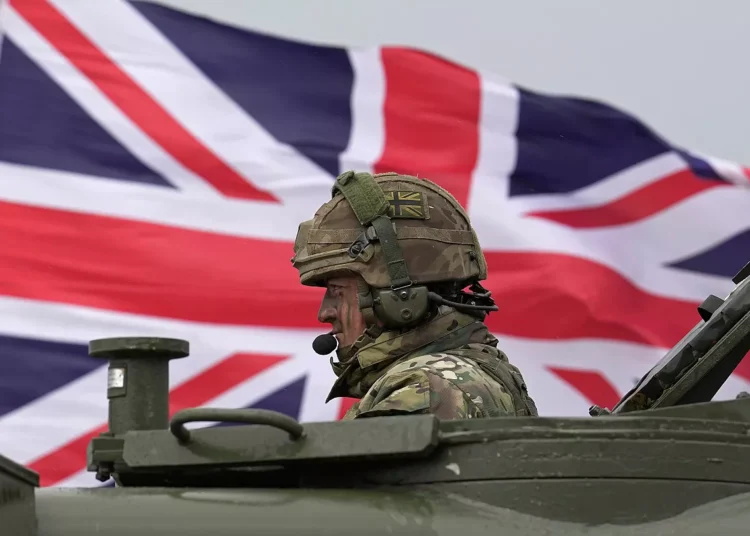
UK Conservative Party has pledged £10 billion for a new national missile and drone defence system, warning that Britain faces a rapidly changing security environment in which relatively cheap aerial weapons can threaten cities, military installations and critical infrastructure.
The proposed system, named “Britannia Shield,” would combine advanced radar, command and control infrastructure, interceptor missiles and counter-drone capabilities into an integrated network designed to detect, track and respond to incoming threats across the United Kingdom, its sovereign territories and British military bases overseas.
The pledge was announced during the Conservative Party’s annual conference in Birmingham as the opposition sought to place national security and defence spending at the centre of its political agenda ahead of the next general election.
Conservative leader Kemi Badenoch accused the Labour government of failing to adequately prepare Britain for emerging military threats and linked the proposed defence investment to wider plans to increase defence spending while reducing government expenditure on welfare.
“The world will not wait for Britain to get ready. War has returned to Europe. Missiles and drones are transforming warfare in the Middle East. Cheap weapons can now threaten cities, military bases and critical infrastructure in ways that would have sounded like science fiction a generation ago.
“If a missile or drone is launched at Britain, we do not get a second chance to wish we had prepared.”
Kemi Badenoch
She added, “that is why today we are announcing Britannia Shield: a new national missile-and-drone defence system to protect the whole United Kingdom, our sovereign territories and British bases overseas.”
The Conservatives argue that the proposed system would address that gap by bringing together sensors, decision-making infrastructure and defensive weapons into a national network capable of responding to different forms of aerial attack.
The scale of the proposed investment would make Britannia Shield one of Britain’s most significant defence programmes in decades.
The party explained that it would seek to have the system fully operational by the end of its first term if it returns to government, although an initial minimum deployable capability is expected to take about five years to establish, with further improvements introduced during the following five years.
According to Shadow Defence Secretary James Cartlidge, “with a £10bn budget, this would be one of Britain’s most significant military programmes since the Cold War. But one that is totally necessary because of the threats we face.”
The proposal is being presented by the Conservatives as a British equivalent of Israel’s Iron Dome, a multi-layered air defence system designed to intercept incoming rockets and other aerial threats.
Israel’s system has become one of the world’s most prominent examples of integrated missile defence, particularly amid repeated attacks involving missiles, rockets and drones. Its manufacturer, Rafael, claimed in May that Iron Dome had successfully intercepted 99 percent of its targets since 2023.
Britain’s existing capabilities are considerably more limited. UK currently lacks a land-based missile interceptor capability comparable to the US Patriot systems that have played an important role in Ukraine’s defence against Russian missile attacks. Much of Britain’s ability to intercept sophisticated aerial threats depends on its six Type 45 destroyers, which are equipped with advanced air-defence systems.
The Type 45 fleet is itself facing a long-term transition, with all six ships due to be replaced by hybrid Common Combat Vessels by 2038 following the abandonment of plans for a new guided missile destroyer. Only three of the six Type 45 destroyers were operational in January 2026.
The Conservatives are therefore seeking to frame Britannia Shield not simply as a new weapons programme but as part of an effort to rebuild Britain’s ability to defend its airspace.
Defence Spending Takes Centre Stage
The proposed £10 billion system has quickly become part of a wider political dispute over the future of Britain’s armed forces, government spending, and the competing demands on public finances.
The Conservatives have pledged to raise defence spending to three percent of GDP by 2030, with Badenoch proposing to fund the additional spending partly through welfare reforms, including reinstating the two-child benefit cap and changing housing benefit.
The party emphasised that Britannia Shield would be financed within its existing commitment to increase defence spending, alongside a reprioritisation of government expenditure.
Meanwhile, the ruling government has committed to spending at least 3.5 per cent of GDP on defence by 2035, while spending is estimated at about 2.6 percent of GDP this year. The government has also faced questions over how it intends to finance the transition towards the higher NATO target.
At the same time, the government’s Defence Investment Plan has allocated hundreds of millions of pounds towards strengthening Britain’s existing ground-based air defence.
More than £350 million is earmarked to double the number of Sky Sabre systems operated by the British Army, adding to Britain’s wider air and maritime defence capabilities.
The government has also set aside £298 billion in investment over four years to improve Britain’s defences in line with the Strategic Defence Review. However, only £790 million has been specifically allocated towards protecting the UK and overseas bases against air, drone and missile threats.
The Conservatives argue that the gap demonstrates the need for a dedicated national system capable of protecting critical infrastructure and military installations against increasingly diverse aerial threats.
The proposal has nevertheless drawn a sharp response from the Labour government, which accused the Conservatives of attempting to compensate for weaknesses created during their 14 years in power.
Defence Secretary Wes Streeting described the Conservatives’ record as an “abysmal record” of defending Britain, adding that “they owe Britain an apology, not another lecture.”
READ ALSO: Mahama Pardons 863 Convicted Persons for Ghana’s 70th Anniversary