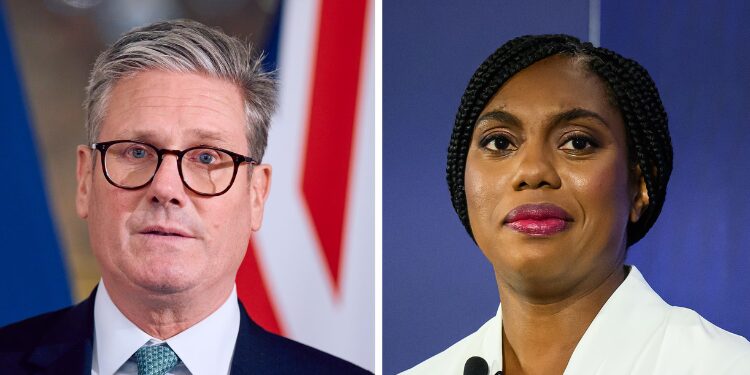
Conservative leader Kemi Badenoch has intensified pressure on Prime Minister Keir Starmer after accusing his government of leaving behind a multi-billion-pound shortfall in funding for Britain’s ambitious defence spending programme, warning that the next administration could inherit a difficult fiscal challenge.
The dispute centres on the government’s newly unveiled £15 billion Defence Investment Plan (DIP), which sets out a significant increase in military spending over the coming years as Britain seeks to strengthen its armed forces in response to evolving global security threats.
According to Treasury figures accompanying the announcement, almost one-third of the planned increase has yet to be fully financed, leaving an estimated £4.7 billion funding gap that would need to be addressed in a future Budget.
The disclosure has fuelled criticism from the Conservatives, who argue that the current administration is committing future governments to spending without clearly identifying how it will be paid for.
The issue quickly became the focus of Prime Minister’s Questions, where Badenoch questioned whether the government’s defence ambitions were financially credible.
She argued that the funding package failed to match the scale of the challenge facing Britain’s armed forces and suggested the next government would be forced to choose between raising taxes, increasing borrowing or cutting spending elsewhere to bridge the gap.
Referring to the anticipated leadership transition, Badenoch asked whether Andy Burnham had already agreed to finance the outstanding shortfall, accusing Starmer of leaving “this mess to his successor” with a “limited plan.”
The Prime Minister rejected the criticism, instead directing attention toward the previous Conservative government’s record on defence spending.
Keir Starmer accused the Conservatives of weakening Britain’s military capabilities during their years in office, arguing that his administration was now reversing years of underinvestment.
The subject at hand comes as Britain strives to modernise its armed forces in the face of rising geopolitical tensions, with a focus on missile defence, cyber capabilities, new weapon systems, and military industrial capability. The Defence Investment Plan aims to provide long-term predictability for defence procurement while also encouraging indigenous production and technological innovation.
However, questions over how the programme will ultimately be financed have overshadowed many of its policy objectives.
Government ministers have sought to reassure both Parliament and defence stakeholders that further financial decisions will be made through the normal Budget process and that leaving elements of long-term spending to future fiscal statements is not unusual.
Nonetheless, opposition parties argue that announcing major expenditure without fully identifying funding sources risks creating uncertainty for both the Treasury and the armed forces.
Government Defends Spending Plans as Opposition Pushes Back
Despite concerns about the unresolved funding shortfall, government ministers stressed that the Defence Investment Plan is one of the largest commitments made to the British military in recent years.
Luke Pollard suggested that the publication of detailed funding allocations coincided with the official release of the plan, explaining that even ministers had only received the full financial breakdown when it became public.
Further, Pollard stated that Downing Street has been in close contact with Andy Burnham’s team and informed him of the figures when the Treasury released the statement and breakdown of financial costs yesterday.
During Prime Minister’s Questions, Badenoch questioned whether the proposed increase would be sufficient to address Britain’s defence requirements.
“The chief of the defence staff made it known that the armed forces needed a minimum of £28bn more to defend the country. Can the prime minister tell us why he thinks half that amount is enough?”
Kemi Badenoch
She continued,“we can count, the generals can count, the Kremlin can count. His plan doesn’t add up. How can the prime minister possibly stand there and say that this is enough?”
Keir Starmer responded by defending both the scale of the investment and the backing it had received from senior military leaders.
He stated that the programme would take Britain’s defence spending to £300 billion over the next four years and had received support from the Chief of the Defence Staff, the First Sea Lord and the Chief of the Air Staff.
“All people who know what is in the plan, and welcome it. Contrast that with their record in government, because they hollowed out the armed forces.”
Keir Starmer
Meanwhile, Dan Jarvis, the Minister of Defence, has rejected claims that the funding shortfall was a political issue for the new government.
He stated that he was “assured that, as Prime Minister, Andy Burnham will make sure that we’ve got the investment coming into defence” and expressed confidence that future leadership would continue to prioritise defence investment.
READ ALSO: Corruption Persists Despite Worship Culture, Apostle Nyamekye Questions National Values