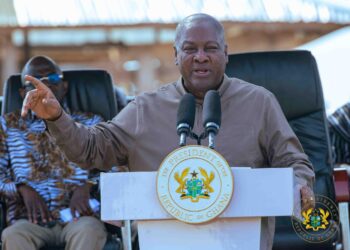

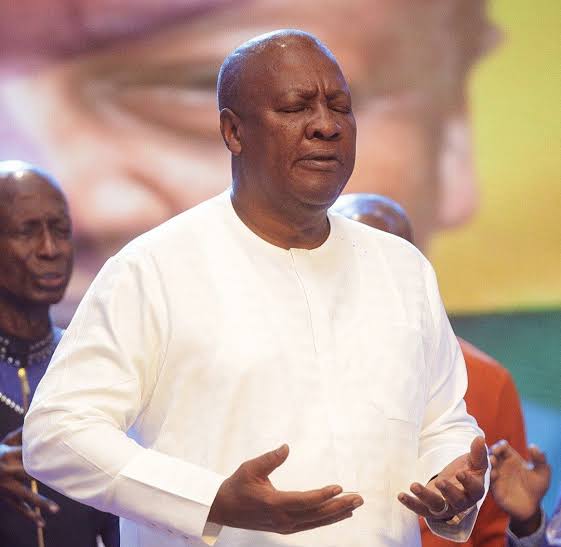
President John Dramani Mahama led Ghana in a National Day of Prayer and Thanksgiving Service at the forecourt of the Presidency on Wednesday, July 1, 2026, calling the nation to pause, reflect and renew its covenant with God even as communities continue to count the losses from recent devastating floods.
Opening his remarks with the words of the hymn “Showers of Blessings,” President Mahama set a tone that balanced joy with sorrow, gratitude with petition. He thanked God for protection and mercy extended to the nation, and asked that Ghana continue to receive exceptional divine favour.
The moment was deliberate, choosing a hymn of longing for greater blessing while acknowledging the mercy already received, spoke directly to the spirit of a nation still processing a painful season.
The gathering brought together some of the country’s most senior figures across government, the church, traditional leadership and the diplomatic community.
Vice President Professor Jane Nana Opoku-Agyemang attended, as did First Lady Lodina Mahama, First Deputy Speaker of Parliament Ben Adahi Afofe, and a representative of the Chief Justice.

The ruling NDC National Chairman Johnson Asiedu Nketiah was present alongside heads of security services, members of the Council of States, ministers of state, members of parliament and representatives of the diplomatic corps.
A Powerful Sermon and the Call for a New Ghanaian
Apostle Eric Nyamekye, Chairman of the Church of Pentecost, delivered the sermon, and President Mahama commended him warmly for it. “That was a very powerful sermon,” the President said, adding that it did justice to the theme adopted for the day.
He summarized Apostle Nyamekye’s central message as a call for transformation at the deepest levels of national life, urging Ghanaians to become new in their minds, new in their hearts, and new in their attitudes.
That call for a new Ghanaian carried particular weight given the day’s context. For President Mahama, the concept of national renewal was not merely spiritual but practical, connecting the inner transformation the Apostle described to the behavioral changes that crises like the recent floods make urgently necessary.
Among the other prominent clergy in attendance were Right Reverend Stephen Wengam, General Superintendent of the Assemblies of God Church, and Archbishop Nicholas Duncan-Williams, General Overseer of Action Chapel International, whom President Mahama described as one of his spiritual mentors.
Apostolic fathers, heads of ecumenical bodies and clergy from across the country also gathered for the service.
Why Ghana Pauses
President Mahama told the congregation that today’s gathering was not a declaration that the national journey is complete, but a recognition that every nation seeking lasting greatness must occasionally stop to remember, to give thanks, to reflect and to renew its covenant with God and with one another.
He rooted that conviction in Ghana’s history, observing that whenever the country has faced moments of triumph or seasons of adversity, Ghanaians have turned instinctively to God, seeking His guidance in uncertainty, His strength in hardship and His blessings in times of abundance.
He described that enduring faith as one of the defining pillars of national identity. This thread runs through Ghana’s life regardless of which government holds power or which challenges dominate the moment.
The President drew on that shared identity to frame the gathering as one that transcends political, ethnic and religious divisions.
“Today, therefore, we gather not as members of different political parties, of ethnic groups or religions, but as one people under God,” he said, positioning the service as a rare moment of national convergence.
Giving Thanks in the Shadow of Loss
President Mahama addressed the floods directly, acknowledging that Ghanaians are still mourning lives lost and property destroyed in what he described as recent devastating flooding. He did not minimize the pain, but placed it within a scriptural framework that calls for gratitude even in suffering.
Citing 1 Thessalonians 5 verse 18, which instructs believers to give thanks in all circumstances, and the Psalms, which call God’s people to praise His name, President Mahama argued that the act of gathering for thanksgiving in the wake of disaster is itself an act of faith.
The floods, in his framing, were not a reason to withhold gratitude but a reason to seek God’s mercy with greater urgency. That combination of mourning and praise gave the service a texture that a straightforward celebration would have lacked.
It acknowledged suffering without surrendering to it, and offered gratitude not as a denial of hardship but as a response to it.
Faith, Action and the Partnership Behind National Progress
President Mahama pressed further into the meaning of the day by insisting that thanksgiving demands honesty alongside gratitude.
He told the congregation that the gathering was first and foremost a day of thanksgiving, not because every challenge confronting Ghana has disappeared or because the nation’s work is complete, but because through every challenge, God has remained faithful.
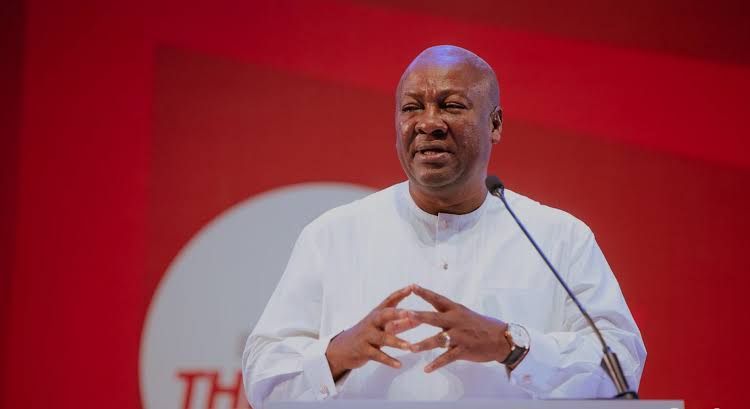
He listed what that faithfulness looks like in concrete terms: preserved peace, sustained democracy, wisdom granted during difficult times and the blessing of the work of Ghanaian hands.
He then offered a framing of national progress that refused to separate spiritual dependence from practical effort. “Our progress has come through the partnership of faith and action, prayer and responsible leadership, God’s grace and the resilience of the Ghanaian people,” he said.
He grounded that claim in Psalm 127 verse 1, which warns that unless the Lord builds the house, the builders labour in vain. For President Mahama, that scripture applied directly to governance.
He said that behind every wise decision, every successful reform and every national achievement stands a God who bestows wisdom, courage and strength on the nation, acknowledging that the credit for whatever has gone right does not belong to government alone.
He closed that portion of his remarks with a statement that was both candid and confident. “Over the last year and a half, God has been good to us,” he said, framing the service not as an abstract religious obligation but as a honest accounting of a nation that has received more than it deserved and knows it.
A Renewal of National Covenant
Running beneath the entire service was the idea of covenant renewal, of a people choosing to recommit to God and to one another at a moment when the country needs both spiritual grounding and social solidarity.
President Mahama’s framing of the day as a pause rather than a conclusion suggested a government aware that the work of rebuilding, reforming, and preparing Ghana for future challenges is far from over.

The presence of traditional leaders, clergy from across denominations, security chiefs, parliamentarians, diplomats and civil society figures at the same forecourt sent its own signal.
In a country where public life is often fractured along political lines, a gathering that brings those constituencies together under a single act of national thanksgiving carries meaning beyond the words spoken from the podium.
As the congregation dispersed, President Mahama’s closing prayer that God would continue to grant Ghana exceptional favour lingered as both a spiritual aspiration and a political statement, one that frames the nation’s wellbeing as ultimately dependent on something greater than policy, budgets or engineering solutions alone.