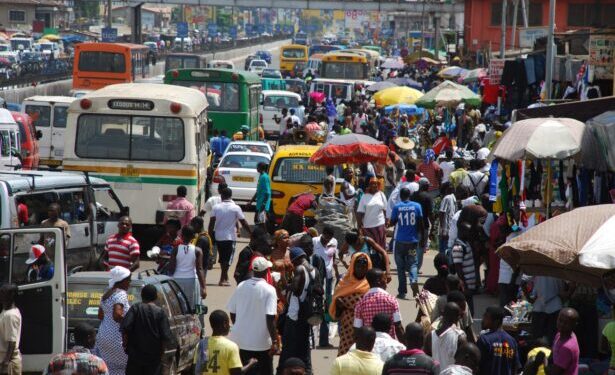
Efforts at urban decongestion in Ghana’s major cities, particularly Accra, are under scrutiny following strong concerns raised by the IMANI Center for Policy and Education.
The prominent policy think tank has criticized ongoing decongestion exercises, warning that these actions—while intended to bring order to bustling urban centers—may actually be draining the economic life out of the very streets they aim to manage.
IMANI argued that when urban decongestion policies are implemented without strategic foresight, they do more harm than good.
The organization pointed out that many of the people most affected by these policies—informal traders, food vendors, transport operators, and artisans—form the economic backbone of urban Ghana.
“Accra’s recent decongestion efforts raise critical questions: Are we creating functional urban spaces, or are we inadvertently draining economic vibrancy from our streets?”
IMANI Center for Policy and Education
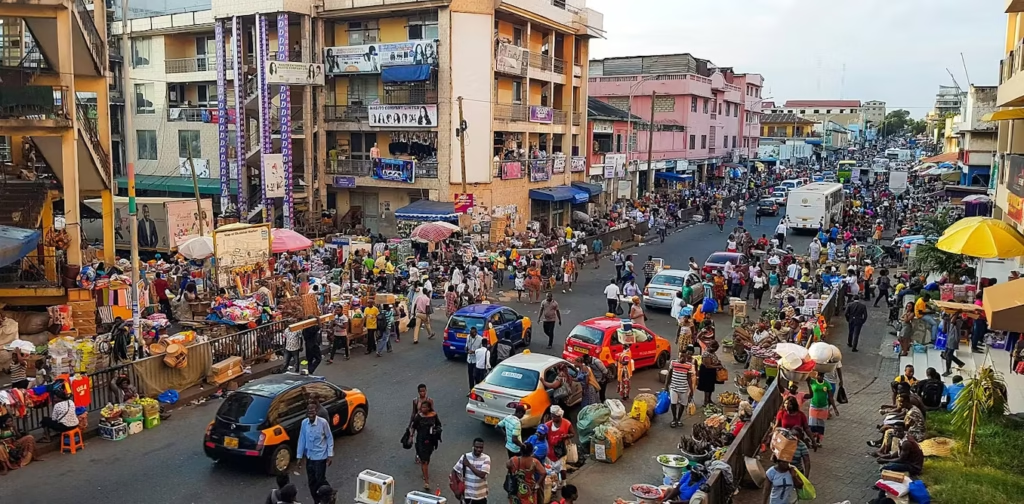
IMANI noted that a “bustling street” should not be dismissed as chaotic; rather, it should be recognized as an “economic ecosystem” that supports millions of livelihoods.
In particular, Accra’s Central Business District (CBD), once a hub of commercial vitality, is now at risk of becoming sterile and hollow, IMANI cautioned.
The group stressed that without a deliberate plan to integrate informal trade into the broader structure of city planning, efforts at cleaning up the streets may backfire economically.
What Accra Can Learn From Global Cities
Highlighting global best practices, IMANI cited how cities like New York, London, and Marrakesh have taken more thoughtful approaches to urban decongestion.
In New York City, for instance, rather than simply banning street vendors, authorities have issued permits, designated vending zones, and even created seasonal marketplaces. This approach balances legal oversight with support for informal economic activity.
“London’s approach to urban planning integrates commerce, pedestrian movement, and city beautification. Areas like Covent Garden and Borough Market thrive because they blend formal retail with informal trade, ensuring economic vibrancy without congestion.”
IMANI Center for Policy and Education
These iconic locations not only accommodate vendors but also enhance the city’s appeal to both locals and tourists. IMANI explained that such integration is key to sustaining economic vibrancy while also ensuring urban order.
In Marrakesh, the bustling souks offer yet another example of how informal trade can be preserved without compromising public order.
Accordingly, IMANI pointed out that instead of displacing traders, city authorities have designed structured market areas where economic activity flourishes within designated boundaries.
IMANI argued that Ghanaian urban authorities should take a cue from these cities. “Ghana’s urban authorities must redefine decongestion beyond mere evictions,” the think tank stated.
It urged decision-makers to see street traders not as nuisances but as critical contributors to city economies.
Balancing Economy and Urban Decongestion
A more effective and inclusive strategy, IMANI suggested, would involve setting up designated vending areas, enacting time-based trading rules to manage foot traffic, and pursuing public-private partnerships aimed at integrating informal commerce into long-term urban planning.
This kind of approach would not only reduce congestion but also sustain livelihoods and support local economic growth.
“Accra and other Ghanaian cities must learn from global models that balance order with commerce, ensuring that decongestion enhances rather than erases economic activity.”
IMANI Center for Policy and Education

The think tank’s central message is clear: urban decongestion must evolve beyond brute-force evictions. The objective should be to reimagine city spaces so they are orderly, inclusive, and economically alive.
Instead of prioritizing empty pavements and cleared-out streets, authorities should aim to design spaces that foster both mobility and commerce. “A thriving city is not just organized—it is economically alive,” IMANI emphasized.
At the heart of the issue lies the definition of what makes a city successful. For many policymakers, success has meant clean streets, unblocked walkways, and the absence of street vendors.
However, for the ordinary Ghanaian who relies on the informal economy, success means being able to make a living, feed a family, and participate in the local economy.
The informal sector in Ghana accounts for a significant percentage of employment and GDP, and policies that threaten its survival also threaten the broader economy.
IMANI’s caution comes at a crucial time as local governments roll out new enforcement campaigns aimed at “reclaiming” city spaces.
In the absence of inclusive planning, these campaigns may ultimately alienate more citizens than they help. As IMANI put it, street vendors are not just filling space—they are filling economic gaps.
With mounting calls for economic inclusion and smarter urban governance, the path forward for Ghana’s city authorities lies in innovation, not intimidation.
The future of Accra—and other urban centers—depends not just on how clean their streets are, but on how vibrant, inclusive, and economically resilient their city life becomes.
READ ALSO: AfDB Forecasts Ghana’s Economy to Expand by 4.5% in 2025 Amid Fiscal Gains