Ghana’s President, John Dramani Mahama, has called on citizens to embrace the true spirit of Eid-ul-Adha by showing compassion, generosity, and solidarity with the less fortunate.
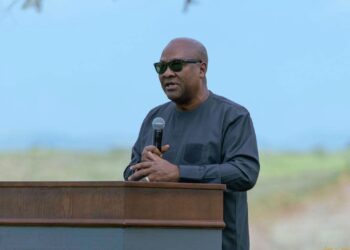
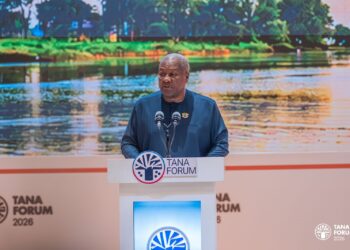
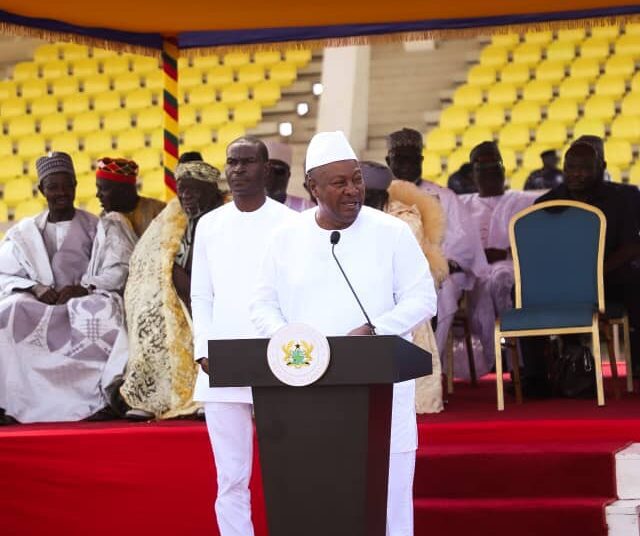
Addressing a massive congregation at the Black Star Square to mark the Eid-ul-Adha festivities, President Mahama spoke passionately about the symbolic meaning of the Islamic festival and outlined significant policy directions to support the Muslim community in Ghana.
In a message rich in spiritual reflection and national unity, President Mahama emphasised that Eid-ul-Adha is not merely a religious ritual but a powerful reminder of social responsibility and shared humanity.
He reminded worshippers of the threefold division of the sacrificial meat — one part for family, one for friends and neighbours, and one for the poor — as an expression of Islamic values and national solidarity.
“Eid Al-Adha is not only about the physical act of sacrifice; it is also about compassion, sharing, and community. Let this celebration be an opportunity to reach out to those in need not just with food, but with kindness, support, and presence of mind.”
HE President John Dramani Mahama
President Mahama stressed that Ghana is strongest when its people care for one another across religious and ethnic divides. “Ghana is at its best when we care for each other across faiths and backgrounds in the spirit of national unity and brotherhood,” he remarked.

Hajj Pilgrimage
Turning to the issue of the annual Hajj pilgrimage, the President acknowledged the financial strain that many Muslim families continue to endure. Despite efforts to reduce the cost, he conceded that it remains relatively high but expressed hope for a more affordable pilgrimage next year.
“This year, despite efforts, the cost remains high even though we cut it. But I want to assure you that we are working closely with the relevant agencies and our Saudi counterparts.
“If Allah accepts our supplications and the Cedi continues to show the recent strength that it has shown, I’m optimistic that next year we’ll see a very significant drop in the Hajj fare.”
HE President John Dramani Mahama
President Mahama noted that if the pilgrims currently in Mecca were embarking on the journey now, the fare would be around GHC 45,000 — significantly lower than the earlier cost.
He pledged continuous efforts to ensure Hajj becomes more accessible to all Ghanaian Muslims. In a landmark policy announcement, President Mahama revealed that his government has prepared a bill to make Eid al-Fitr, the festival that marks the end of Ramadan, a statutory public holiday.
“This will soon be presented to Parliament. It means that it will be a law; it will no longer be by executive instrument,” the President said. The decision, he said, honours the deep spiritual significance of the festival in Muslim life and responds directly to longstanding appeals from the Muslim community.

Support for Muslim Education
President Mahama further revealed that the Ministry of Education has been tasked with engaging the Islamic Education Unit to revamp and strengthen Islamic education in the country.
As part of this initiative, the government will increase the recruitment and training of qualified Arabic instructors nationwide to ensure Islamic schools are adequately resourced and supported.
In a significant boost to tertiary Islamic education, President Mahama announced that stalled infrastructure development at the Alpha Rook College of Education in Wenchi would resume shortly.
“The college will become a critical institution for training professional teachers within the Islamic education framework, and we will not relent until its full potential is realised”.
HE President John Dramani Mahama
Underscoring his administration’s commitment to educational equity, President Mahama disclosed that the Director-General of the Scholarship Secretariat has been instructed to develop a dedicated support program for Muslim students pursuing advanced studies in key disciplines such as medicine, law, ICT, engineering, and social sciences.

“This is part of our broader equity agenda to empower all segments of our society to contribute meaningfully to national development,” he noted. President Mahama’s speech included a roadmap for compassion, inclusivity, and progressive policy reform in addition to a call for celebration.
His speech, which echoed the core values of Eid—sacrifice and love for one another—acted as a spiritual reminder as well as a model for governance based on fairness, justice, and unity within the country.
READ ALSO: BoG Records GH¢1.82 Billion Exchange Loss on Gold-for-Oil