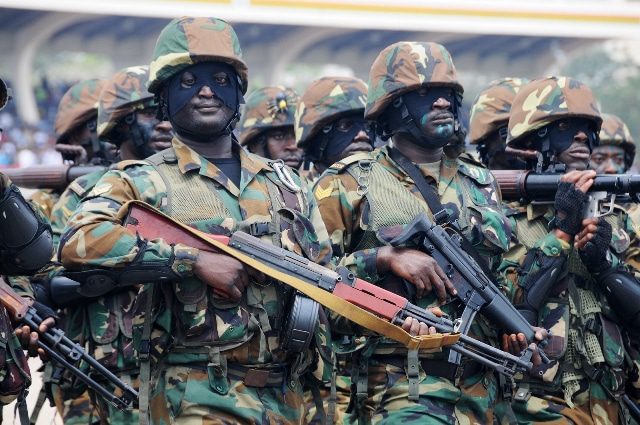
A Renowned Market Researcher and IMANI Centre for Policy and Education fellow, Kay Codjoe, has renewed his call for the Ghana Armed Forces (GAF) to take the lead in the fight against illegal mining, popularly known as galamsey, arguing that the menace has evolved into a full-blown national security threat that demands a military-led strategy rather than civilian-led committees.
In his follow-up piece titled “If the Armed Forces Say No to Galamsey, There Will Be None,” Codjoe said Ghana’s struggle against illegal mining is not simply an environmental issue but a national security emergency threatening the Republic’s food, water, and sovereignty.
“For years we have chased galamseyers with sirens and slogans, yet the excavators keep returning like ghosts that refuse to die.”
Kay Codjoe
According to him, what Ghana faces today is not chaos but “a coordinated structure — a shadow economy sustained by its own command.” Codjoe explained that galamsey thrives on what he called “three pillars: Man, Machine, and Material.”
The Man represents the cartels, political patrons, and local protectors who sustain the illegal trade. The Machine stands for the excavators, pumps, and above all, the fuel that powers them. The Material represents the forests, rivers, and mineral-rich lands being destroyed in the pursuit of profit.
“This triad forms the true center of gravity. Cut one, and the system suffocates. That is where strategy, not slogans, must strike,” he remarked. For Codjoe, the solution lies in rethinking Ghana’s defense posture. “To protect the Republic’s wealth, we must start from the baseline that this is a security mission first and everything else follows,” he stated.
Interior Operations Grid
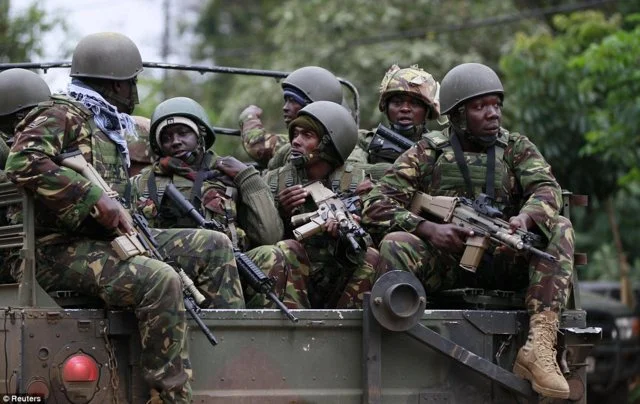
He argued that national security extends beyond defending borders and includes protecting “the sources of life.” He called for the creation of an “interior operations grid — a belt of intelligence and enforcement linking air mobility to ground control,” where mineral and forest corridors are treated as defense zones.
“The army that can track insurgents should be able to track excavators. The same discipline that guards the flag should guard the forest,” Codjoe asserted. He emphasized that the Ghana Armed Forces already possess the capabilities needed to neutralize illegal mining.
“If the Armed Forces say no to galamsey, there will be none. NAIMOS may coordinate civilian resources, but only the GAF possesses the integrated land, air, and water power to neutralize illegal mining nationwide. That is not bravado; it is constitutional fact and operational reality.”
Kay Codjoe
Codjoe commended the National Anti-Illegal Mining Operations Secretariat (NAIMOS) for recent operational successes, describing them as proof that discipline and leadership can yield results.
“They have proven that with discipline, leadership, and lawful force, we can reclaim what we lost. But more must follow, because even the sea collects rain. Isolated victories are not enough; we need a steady current of resolve to cleanse the nation’s conscience like the rivers we seek to restore”.
Kay Codjoe
Reversal of Socioeconomic Problems
He also pointed out that galamsey persists because its rewards outweigh its risks, calling for a reversal of that dynamic. “The state must invert that equation. Let the cost of illegality exceed its comfort,” he said, adding that the government must also address the socioeconomic roots of the problem.

“Before everything else, the people want food. Galamsey feeds families where governance has failed. If the Republic does not replace hunger with hope, the pickaxe will always defeat the policy.”
Kay Codjoe
Codjoe argued that Ghana must adopt a national security doctrine focused on defending its natural wealth. “Illegal mining threatens food, water, and order. By every measure, it is a national security emergency. Yet we fight it with committees, drones, and moral appeals instead of the full muscle of the state,” he lamented.
The Army with Special Capacity
Outlining a clear operational framework, Codjoe said the Armed Forces already have specialized units to execute such a mission.
“Engineers can deny access. Aviation can monitor and interdict. Riverine units can secure waterways. What is missing is alignment — a decision that this battle sits within the defence portfolio, tethered to civilian authority but strategically led by the Armed Forces.”
Kay Codjoe
He stressed that the military’s involvement must operate under lawful authority and democratic oversight.
“The defence of Ghana’s resources must rest on constitutional fidelity. Every deployment must respect rules of engagement, civilian oversight, and human rights. When soldiers act under lawful authority to protect the national estate, they do not militarise governance; they secure it.”
Kay Codjoe
Codjoe warned that Ghana’s loss of control over its “economic, moral, and environmental elements of national power” has left the country vulnerable from within. “The invader is not foreign; it is domestic. When we allowed excavators to invade our forests, we lost sovereignty and invited terror in the name of trade,” he stated.

He also drew a sharp contrast between Ghana’s external peacekeeping commitments and its domestic neglect. “The same energy that sends troops abroad to defend oil in South Sudan should send them home to defend gold in Obuasi. We do not need another international mission to remind us of our domestic duty,” Kay Codjoe urged.
In closing, Codjoe underscored the moral and strategic duty of the Armed Forces to act decisively in defense of the nation’s resources.
“The Ghana Armed Forces are not just an institution of war; they are an instrument of order. If they sit idle while the Republic’s lifeblood drains away, our medals will gleam on a dying body. But if they rise to guard the resources that guard the nation, Ghana will find strength again, not in fear but in fidelity”.
Kay Codjoe
He concluded with a sobering warning: “In the end, the equation is simple: a nation that cannot defend its wealth cannot defend its future. And if we cannot afford to defend our gold, our rivers, and our forests, then we cannot afford to call ourselves free.”
READ ALSO: US Government Shutdown Persist For Ninth Day