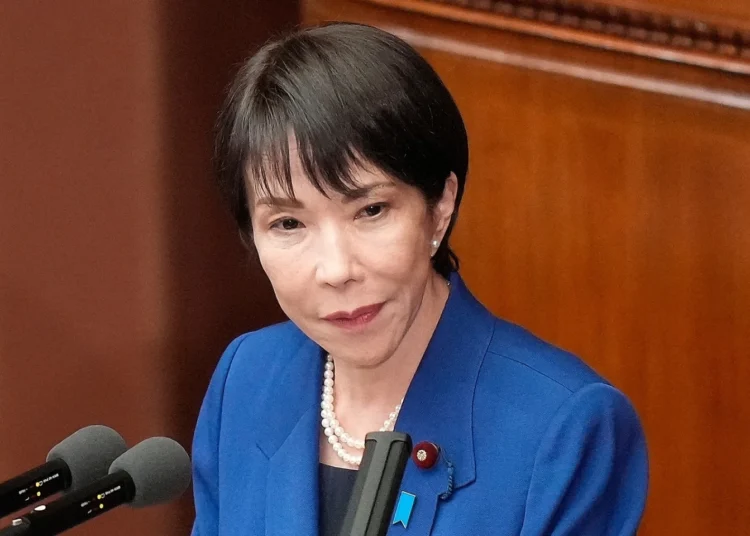
Japan’s Prime Minister, Sanae Takaichi has announced that she will dissolve parliament on Friday and call a general election to seek voter backing for her spending plans and other policies.
At a news conference, Takaichi averred, “Today, I, as the Prime Minister, have decided to dissolve the lower house on January 23.”
The snap vote on February 8 will decide all 465 seats in parliament’s lower house and mark Takaichi’s first electoral test since becoming Prime Minister.
According to the Yomiuri Shimbun newspaper, a clear mandate for Takaichi and the governing Liberal Democratic Party (LDP) could also help break the deadlock in a diplomatic spat with China.
Ties have deteriorated severely since Takaichi suggested in November that Japan could intervene militarily if China ever launched an attack on Taiwan, the self-ruled island it claims.
Beijing has announced a broad ban on the export to Japan of “dual-use” goods with potential military applications, and has reportedly been choking off exports of rare-earth products crucial for making everything from electric cars to missiles. Last month, Takaichi said that she was “always open” to dialogue with China.
On January 13, the Japanese Prime Minister hosted South Korean President Lee Jae Myung in her hometown of Nara to discuss the two nations’ security and economic ties.
For its part, the Lee administration has stressed its goal of “restoring” ties with China, which remains South Korea’s largest trading partner. At the same time, it has said that Lee’s approach of “practical diplomacy” aims to maintain strong ties with Japan and the United States, South Korea’s most important ally.
The snap election announcement comes just three months into Takaichi ‘s tenure as Japan’s first female Prime Minister.
Calling an early election would allow her to capitalise on strong public support to tighten her grip on the governing Liberal Democratic Party (LDP) and shore up her coalition’s fragile majority.
Domestically, the LDP, which has governed Japan almost uninterrupted since the mid-1950s, faces scrutiny over a lingering political funding scandal and the rising cost of living.
The election will test voter appetite for higher spending at a time when the rising cost of living is the public’s top concern. A poll released by a public broadcaster last week found 45 percent of respondents cited prices as their main worry, followed by diplomacy and national security at 16 percent.
In response, the coalition is considering suspending the 8% consumption tax on food items for two years. Media reports have also suggested Takaichi may seek to ban on political fundraisers by Ministers in an effort to ease public anger over the widespread use of slush funds by party MPs.
An advocate of big spending to boost Asia’s second-biggest economy, Takaichi said at the weekend that she had instructed Ministers to ensure the implementation of a supplementary budget for the fiscal year, which runs through March, and secure parliamentary approval for next year’s budget.
Takaichi Deems Election As Test Of Her Fitness As Prime Minister
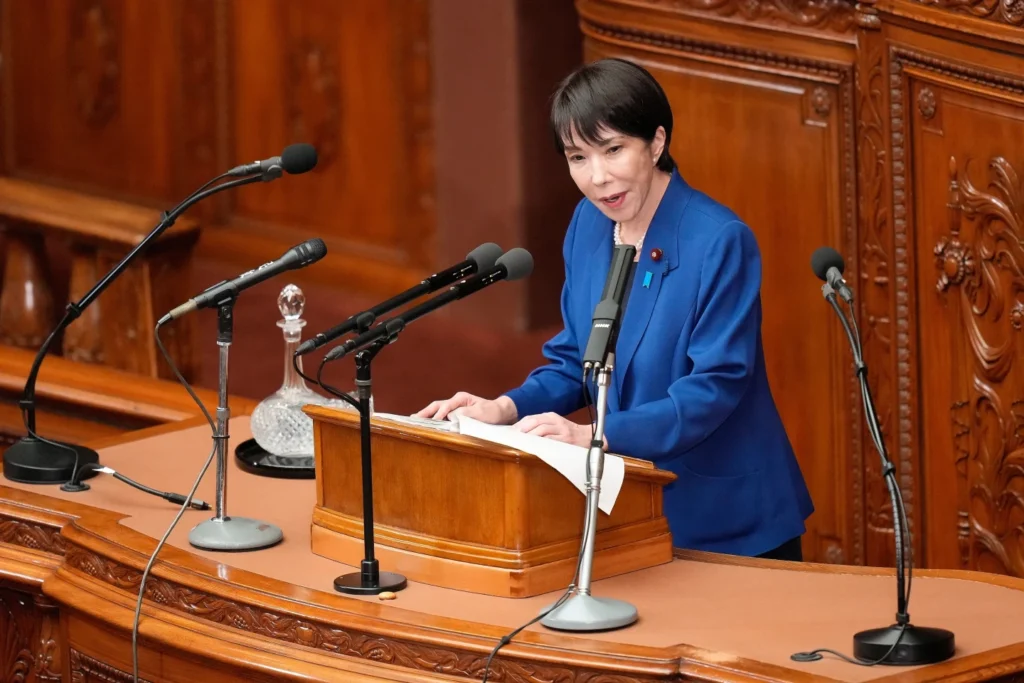
Speaking at the press conference, Takaichi, who took office after the resignation of her predecessor, said that she wanted voters to judge whether she was “fit” to continue in the role.
Describing the decision to call as snap election as “very difficult”, Takaichi told reporters that she is putting her future as Prime Minister on the line.
“I want the people to decide directly whether they can entrust the management of the country to me.”
Sanae Takaichi
The next lower house poll was not due until October 2028, but Takaichi appears confident she can use her personal popularity to reverse the Liberal Democratic party’s (LDP) recent run of poor election results.
The LDP and its former junior coalition partner Komeito lost their majorities in the powerful lower house in October 2024 and in the upper house last July, forcing Takaichi to forge a fragile partnership with the populist Japan Innovation party, which shares many of her conservative views, when she became Prime Minister in October.
READ ALSO: Energy Analyst Attributes Fuel Price Relief to Regulation, Strong Cedi and NPA Coordination