
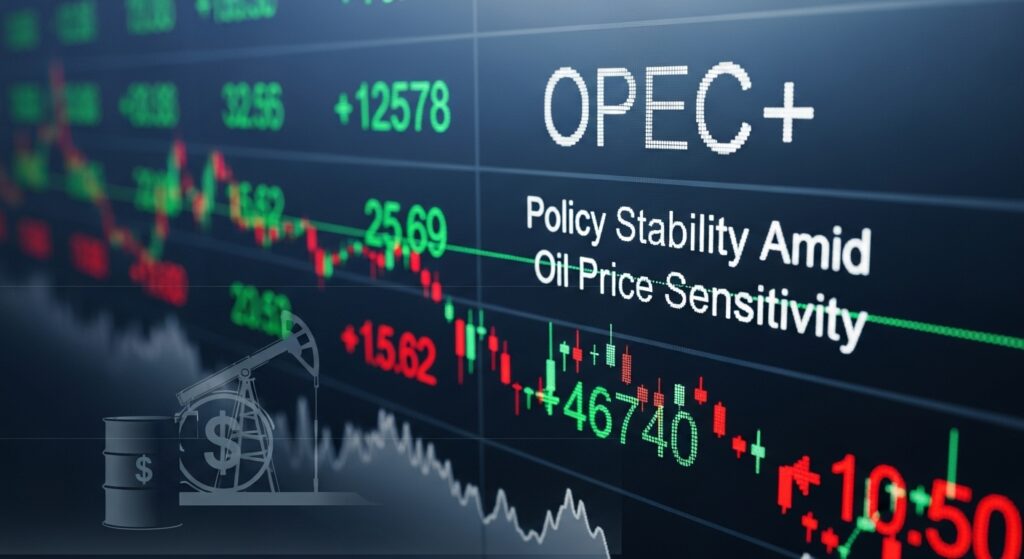
Global oil prices are expected to remain sensitive to supply-side decisions after the OPEC+ alliance signalled it will maintain its current oil production policy and extend its pause on output increases into March.
The producer group is widely anticipated to affirm the decision at its meeting this weekend, reinforcing its view that current market conditions do not warrant additional crude supply.
In a statement, OPEC+ confirmed that it plans to extend the pause on crude oil production hikes, pointing to what it described as “healthy oil market fundamentals as reflected in low inventories.”
The group’s position suggests confidence that existing supply levels are sufficient to meet global demand, at least in the near term.
Under the current framework, OPEC+ has withheld plans to gradually restore 1.65 million barrels per day of production that had previously been curtailed. According to the group, the withheld volumes could still return to the market, but only under specific conditions.
“The 1.65 million barrels per day may be returned in part or in full subject to evolving market conditions and in a gradual manner.”
OPEC+
This cautious approach reflects the group’s desire to avoid destabilising fuel prices by releasing supply too quickly into a market that remains sensitive to economic and geopolitical signals.
Market watchers note that the announcement was largely expected, given earlier indications from the group that it saw little justification for boosting global oil supply at this stage of the year.
Weak Seasonal Demand Shapes Decision
OPEC+ has repeatedly pointed out that the first quarter of the year is typically the weakest period for oil demand growth.
This seasonal slowdown has reinforced the group’s reluctance to raise production, even as some forecasters warn of a potential oversupply later in the year.
Those warnings have been firmly rejected by OPEC+, which maintains that demand remains resilient and inventories are not building at levels that would justify a policy shift.
The decision to maintain the pause involves eight OPEC+ members, including Saudi Arabia, Russia, Iraq, the United Arab Emirates, Algeria, Kazakhstan, Oman and Kuwait.
For fuel prices, the continuation of restrained output means that supply is unlikely to surge in the short term, potentially limiting downward pressure at the pump.
The decision comes against the backdrop of heightened geopolitical uncertainty, which has contributed to sharp swings in oil prices in recent weeks.
Brent crude briefly climbed above $70 per barrel last week amid speculation that the United States could carry out a strike on Iran, injecting a fresh risk premium into global markets.
However, that rally proved short-lived. Oil prices began the week with a drop of more than 5 per cent after comments from U.S.
President Donald Trump suggested that Iran was ready to negotiate with Washington over its nuclear programme. The remarks were widely interpreted by traders as a signal of potential de-escalation, easing immediate supply disruption fears.
These rapid price movements underscore how geopolitical developments continue to influence oil prices, even as OPEC+ focuses on fundamentals such as inventories and demand trends.
Analysts Question Oversupply Narrative
Despite persistent talk of a looming supply glut, some analysts are increasingly sceptical of the oversupply narrative. Market signals, they argue, do not fully support the idea that oil markets are heading for a significant surplus.
ING analysts Warren Patterson and Ewa Manthey highlighted this disconnect in a recent note, pointing to the structure of the oil futures market.
They observed that “the strength in the timespreads is at odds with expectations of a large surplus.” According to them, the forward curve has moved deeper into backwardation, indicating tighter near-term supply conditions.
“The forward curve has moved deeper into backwardation this month, with the curve backwardated all the way through to the Aug-27 contract.”
ING analysts Warren Patterson and Ewa Manthey
For consumers and policymakers, OPEC+’s decision to hold output steady has direct implications for oil prices. By keeping supply constrained, the group is effectively placing a floor under global oil prices, even as demand growth remains modest in the early months of the year.
In countries heavily reliant on oil imports, this means that domestic pump prices will continue to be influenced not only by exchange rates and taxes, but also by OPEC+’s supply discipline and geopolitical risks.
As the March meeting approaches, markets will be watching closely for any change in tone from the producer group. For now, OPEC+ appears content to stay the course, betting that disciplined supply management will support price stability in an otherwise volatile global energy landscape.