
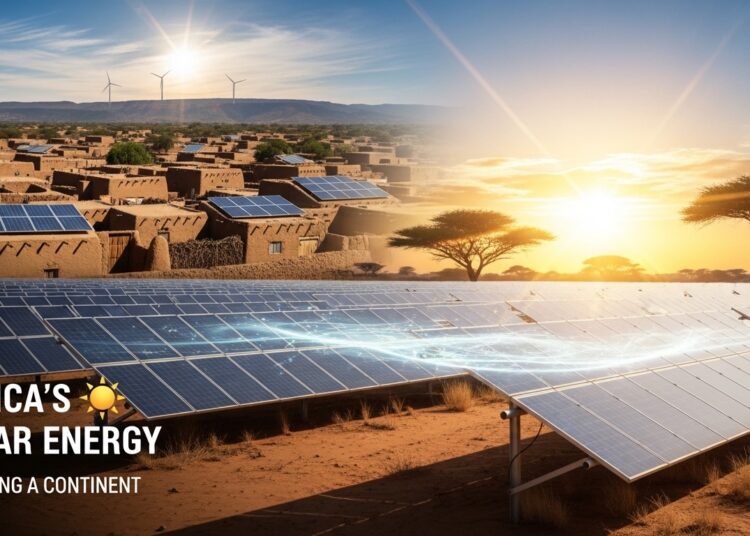
Africa’s solar energy market recorded its strongest growth in 2025, led by South Africa and Nigeria, as new capacity additions, policy reforms and private investment accelerate across the continent.
New data released by the Global Solar Council (GSC) shows that expanding capacity, improved policy frameworks and rising private-sector investment are rapidly reshaping Africa’s power landscape, with both large and emerging markets contributing to the momentum.
The findings are contained in the Africa Market Outlook for Solar PV: 2026–2029 report, released on Tuesday, which highlights how solar power has moved from a niche solution to a central pillar of Africa’s energy strategy.
“In 2025, the top 10 solar markets accounted for around 90% of new solar capacity additions,” the GSC noted, with South Africa leading the pack after adding 1.6 gigawatts of new capacity.
Nigeria followed closely with 803 megawatts, while Egypt and Algeria added 500 megawatts and 400 megawatts respectively. These gains underline the scale at which solar deployment has accelerated in countries with clearer regulatory frameworks and growing investor confidence.
At the same time, the report points to a widening base of solar adoption across the continent. Several mid-sized and emerging markets recorded meaningful capacity additions, signalling a shift away from concentration in just a handful of countries.
Broader Market Participation Across the Continent

Beyond the largest markets, the GSC highlighted the growing contribution of countries such as Morocco, Zambia, Tunisia, Botswana, Ghana and Chad.
Each of these countries added between 86 megawatts and 204 megawatts of new capacity in 2025, reinforcing what the report describes as “a trend toward broader market participation.”
This diversification is further reflected in the number of countries crossing key capacity thresholds. “In 2025, close to eight countries have installed 100MW or above, against four last year, essentially doubling the number of countries,” the report stated, noting that Ghana and Chad were also closing in on that benchmark.
The expansion suggests that solar energy is no longer limited to a few frontrunners but is becoming a viable option across a wide range of African economies.
Policy Commitments Drive Solar Expansion
The strong growth recorded in 2025 is closely linked to ambitious government commitments at both national and continental levels. African governments have pledged to significantly scale up renewable energy, including a continental target of 300 gigawatts by 2030.
According to the GSC, initiatives such as Mission 300, which aims to connect 300 million people to electricity, place solar energy “at the core of this trajectory,” positioning it as both a solution to energy access challenges and a driver of economic competitiveness and resilience.
These commitments have helped improve investor confidence, unlock financing and accelerate project development across multiple markets.
While utility-scale projects have historically dominated Africa’s solar landscape, the report indicates a significant shift toward distributed generation.
Although utility-scale installations accounted for 56 per cent of installed capacity in 2025, the GSC cautioned that distributed capacity, which made up the remaining 44 per cent, is likely underestimated due to tracking challenges.
“Africa’s solar market is entering a new phase,” the report noted, explaining that growth is increasingly being driven by on-site generation across commercial, industrial, residential, mini-grid and off-grid segments.
This momentum is being fuelled by falling module costs, improving battery economics and the emergence of local manufacturing ecosystems, particularly in countries such as South Africa and Nigeria.
Rising Demand and Trade Data Signal Shift

Rising electricity demand, unreliable grids and higher tariffs are pushing households and businesses to invest in their own power generation.
This trend is clearly reflected in trade data. Africa imported a record 15 gigawatts of solar panels in the year to mid-2025, a volume far exceeding what utility-scale projects alone could absorb.
The GSC observed that utility-scale projects typically account for only about 15 per cent of these imports, pointing to “rapid and less accurately reported growth in distributed, commercial, and rooftop solar.”
This surge underscores how captive and behind-the-meter installations are becoming a critical part of Africa’s energy mix.
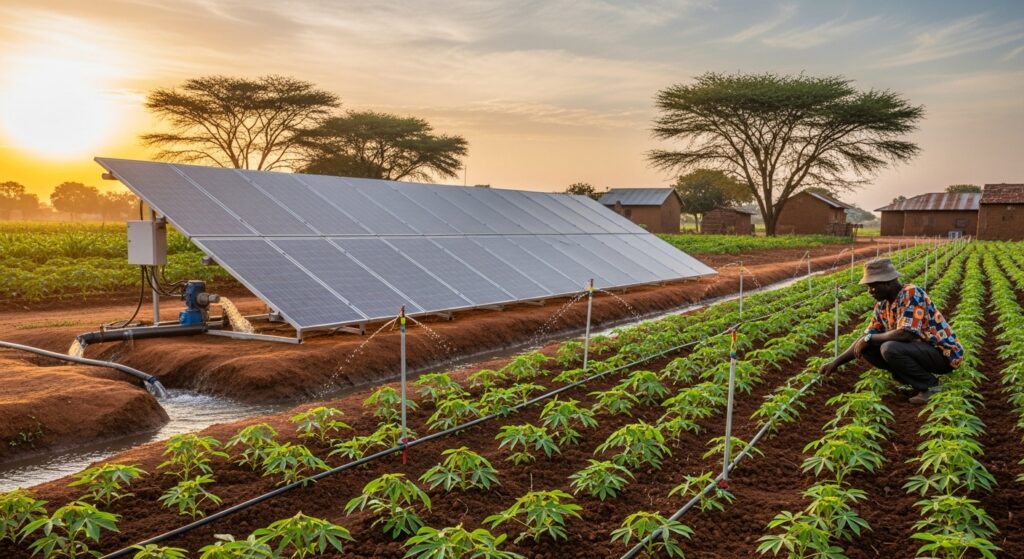
Beyond electricity access, distributed solar is increasingly supporting productive economic activities. According to the report, solar systems are enabling uses ranging from irrigation and agro-processing to refrigeration, small-scale manufacturing and e-mobility charging.
Corporate decarbonisation efforts, particularly in response to the European Union’s Carbon Border Adjustment Mechanism, are also accelerating adoption as exporters seek cleaner and more cost-effective power.
The GSC highlighted the growing role of bilateral corporate power purchase agreements, micro-generation subsidies and national electrification strategies in improving bankability.
Mini-Grids Expand Access in Rural Areas
The report also emphasised the growing importance of mini-grids and off-grid solar solutions in rural and underserved communities.
These systems are increasingly seen as the fastest and most affordable way to expand electricity access while reducing dependence on expensive and polluting diesel generation.
Looking ahead, the GSC’s medium-term outlook suggests that Africa could install more than 31.5 gigawatts of solar capacity by 2029, as both utility-scale and distributed markets continue to expand in parallel.
With policy support strengthening and technology costs falling, Africa’s solar energy sector appears poised to play a transformative role in meeting the continent’s energy and development goals.
READ ALSO: GUTA Demands Fast-Track to Single-Digit Lending Rates