
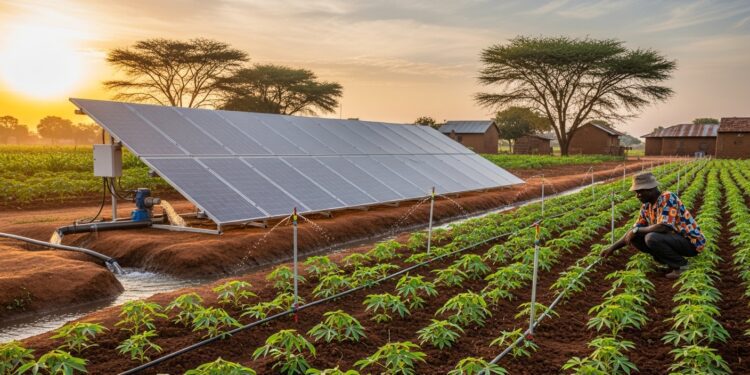
Ghana is deepening its green transition agenda by linking renewable energy deployment with agricultural productivity, as government rolls out pilot solar-powered irrigation projects aimed at boosting year-round farming and rural livelihoods.
The Minister for Energy and Green Transition, Dr John Abdulai Jinapor, said the initiative reflects a broader strategy that combines fiscal discipline, targeted reforms, and inter-ministerial collaboration to deliver measurable development outcomes.
“Through strategic reforms, fiscal discipline, and a firm commitment to our green transition, we are also making a lot of progress.
“The Ministry of Energy is working closely with the Ministry of Food and Agriculture to integrate clean energy into Ghana’s agricultural policy framework.”
Dr John Abdulai Jinapor, Minister for Energy and Green Transition
At the heart of the initiative is a renewed focus on solar-powered irrigation as a solution to Ghana’s long-standing dependence on rain-fed agriculture.
“We’ve started two pilot projects where we’ve installed huge solar pumps along river communities so that we can use solar to pump water for irrigation.”
Dr John Abdulai Jinapor, Minister for Energy and Green Transition
The approach is designed to address seasonal production gaps, particularly during the dry season, when many farming communities experience reduced activity due to limited access to water.
Ending Seasonal Inactivity in Northern Communities
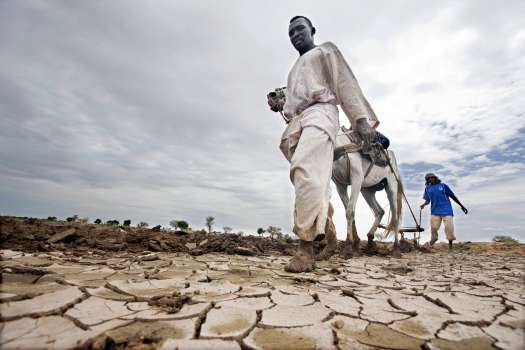
Dr Jinapor emphasised that the impact of the projects would be most strongly felt in northern Ghana, where farming activity often slows for nearly half the year.
“In the dry season, particularly those in the north, they will not be idle,” he said, referring to farmers who traditionally struggle to maintain production outside the rainy season.
He explained that many rural communities face prolonged periods of inactivity, lasting five to six months annually, due to the absence of reliable irrigation infrastructure.
Dr Jinapor stressed that solar-powered irrigation offers a practical way to keep farmers productive throughout the year.
The Energy Minister described the solar pump initiative as a development multiplier that delivers benefits beyond clean energy adoption.
By enabling continuous farming, the projects are expected to increase crop yields, stabilise incomes, and improve food availability in both rural and urban markets.
“Whoever can put a lot of these pumps and the resources showing real incremental progress,” Dr Jinapor said, suggesting that scaling up the initiative could transform agricultural output if supported with the right investment and policy backing.
Analysts note that solar-powered irrigation systems also reduce farmers’ dependence on diesel-powered pumps, lowering production costs while cutting greenhouse gas emissions and air pollution.
Integrating Energy and Agriculture Policy

Dr Jinapor said the initiative illustrates how the green transition can be aligned with broader national development objectives rather than treated as a standalone environmental goal.
“Then it means not only the using green energy, but we contributing to our agriculture policy using the Ministry of Energy.”
Dr John Abdulai Jinapor, Minister for Energy and Green Transition
By embedding renewable energy solutions into agricultural planning, government aims to strengthen food security, reduce poverty, and build climate resilience across farming communities.
Officials believe the collaboration between the Energy Ministry and the Agriculture Ministry signals a shift toward more coordinated policymaking, where energy infrastructure directly supports productive sectors of the economy.
The solar irrigation projects form part of a wider reform agenda that prioritises efficiency, sustainability, and value for money. According to Dr Jinapor, fiscal discipline has been key in ensuring that green transition initiatives are practical and scalable rather than symbolic.
Government sources say the pilot projects are being closely monitored to assess performance, cost-effectiveness, and community impact, with lessons expected to inform a national rollout if results are positive.
Climate and Economic Benefits

Beyond boosting agricultural productivity, the solar pump initiative supports Ghana’s climate commitments by reducing reliance on fossil fuels and lowering emissions associated with farming activities.
Renewable-powered irrigation also enhances resilience to climate variability, a growing concern as rainfall patterns become increasingly unpredictable.
Energy and agriculture experts say such integrated solutions are essential for countries like Ghana, where climate change poses a direct threat to food systems and rural livelihoods.
Dr Jinapor indicated that the pilot phase represents only the beginning of a broader effort to mainstream renewable energy across key sectors of the economy.
As government evaluates the results, there are expectations that similar projects could be extended to other regions and linked with complementary interventions such as storage, processing, and market access.
For farming communities, the promise of reliable, clean energy-powered irrigation offers hope of steady incomes and improved living standards. For policymakers, it demonstrates that the green transition can deliver tangible economic and social dividends.
As Ghana continues to pursue sustainable development, the solar-powered irrigation initiative stands as a clear example of how clean energy, when strategically deployed, can drive inclusive growth while protecting the environment.
READ ALSO: BoG Policy Rate Seen Falling to 14.5%