Ghana’s economic expansion lost momentum in November 2025 as provisional data from the Ghana Statistical Service revealed a slower pace of growth compared to the same period last year.
The Monthly Indicator of Economic Growth showed that overall production of goods and services grew by 4.2 percent in November 2025, down from 7.1 percent recorded in November 2024.
The latest figures reflect a moderation in economic activity across key sectors of the economy. While growth remains positive, the pace of expansion has weakened significantly, raising fresh concerns about the sustainability of the recovery momentum that had been building in 2024.
According to the Government Statistician, Dr. Alhassan Iddrisu, the slowdown was largely driven by weaker performance in the industrial sector, particularly mining and quarrying activities.
Agriculture Demonstrates Steady Expansion
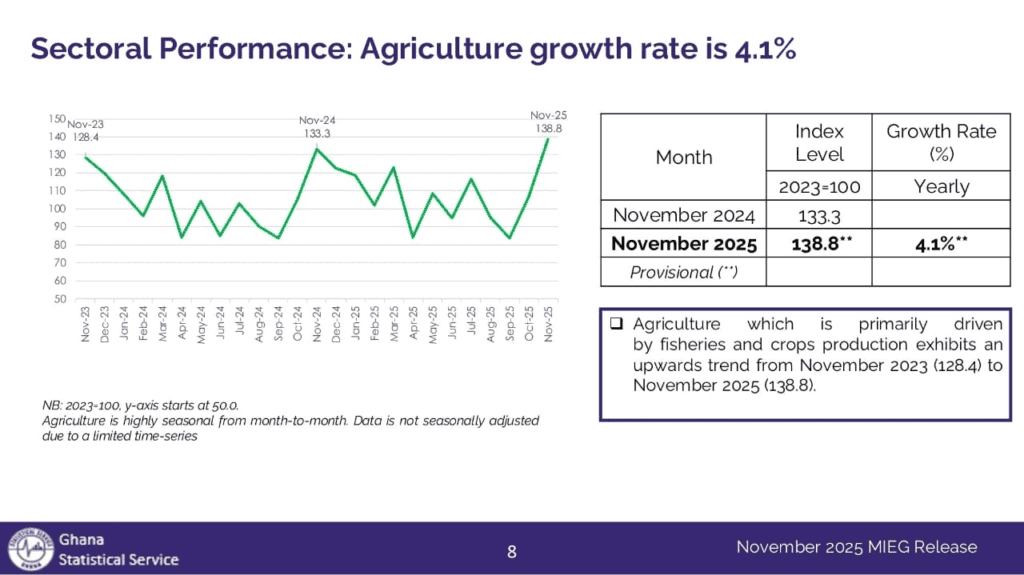
The agriculture sector showed resilience despite the broader slowdown in economic growth. The sector recorded a growth rate of 4.1 percent in November 2025, slightly higher than the 3.8 percent recorded in November 2024.
Dr. Iddrisu explained that the modest improvement in agriculture was “driven primarily by fisheries and crop production.” The steady performance highlights the sector’s continued importance to Ghana’s economy, especially at a time when other sectors are experiencing fluctuations.
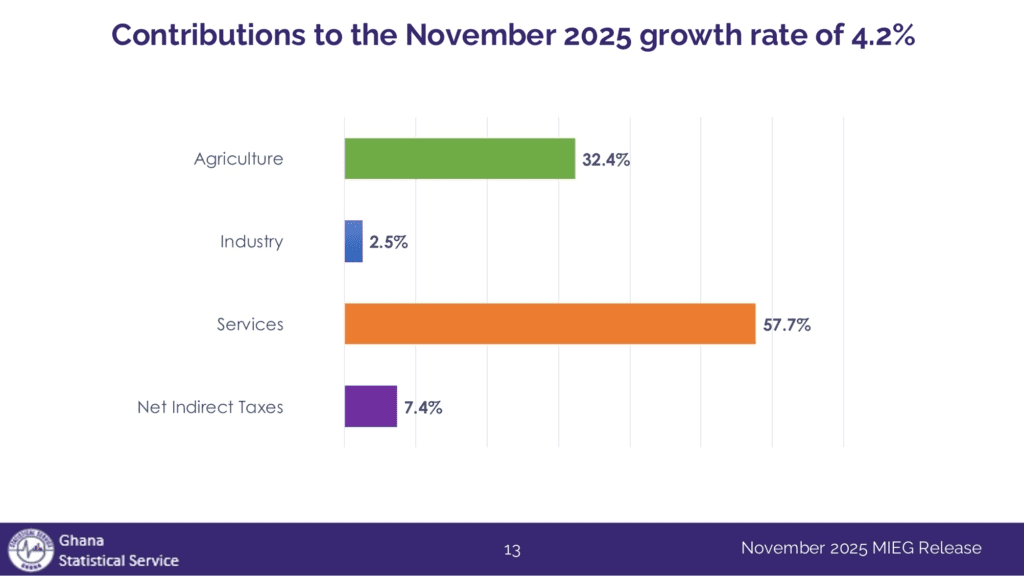
Agriculture contributed 32.4 percent to the overall growth of 4.2 percent recorded in November 2025. This significant contribution underscores the sector’s stabilizing role in the economy. Increased resilience within agricultural activities signals sustained output in food production and fisheries, which remain critical for food security, employment and rural incomes.
The steady growth also suggests that ongoing efforts to support agricultural productivity may be yielding gradual results, even though the pace of expansion remains moderate.
Industry Records Sharp Slowdown
In contrast to agriculture, the industrial sector experienced a pronounced deceleration. Industry recorded a growth rate of just 0.4 percent in November 2025, a sharp drop from the 6.2 percent growth recorded in November 2024.
The sector contributed only 2.5 percent to the overall 4.2 percent growth in the Monthly Indicator of Economic Growth. This subdued performance reflects a slowdown in mining and quarrying activities compared to the same period last year.
Despite a strong showing from gold production in 2024, the latest data indicates a downturn in extractive activities. Dr. Iddrisu noted that the decline “is an indication of a slowdown in mining and quarrying activities, especially the oil and gas sectors, largely on the back of a contraction in the upstream petroleum sector.”
The contraction in upstream petroleum activities has had a significant impact on industrial output. Given the strategic role of oil and gas in Ghana’s industrial landscape, any slowdown within this subsector tends to weigh heavily on overall industrial performance.
The weaker industrial growth has therefore been a major factor behind the broader moderation in economic expansion.
Services Remain Largest Contributor
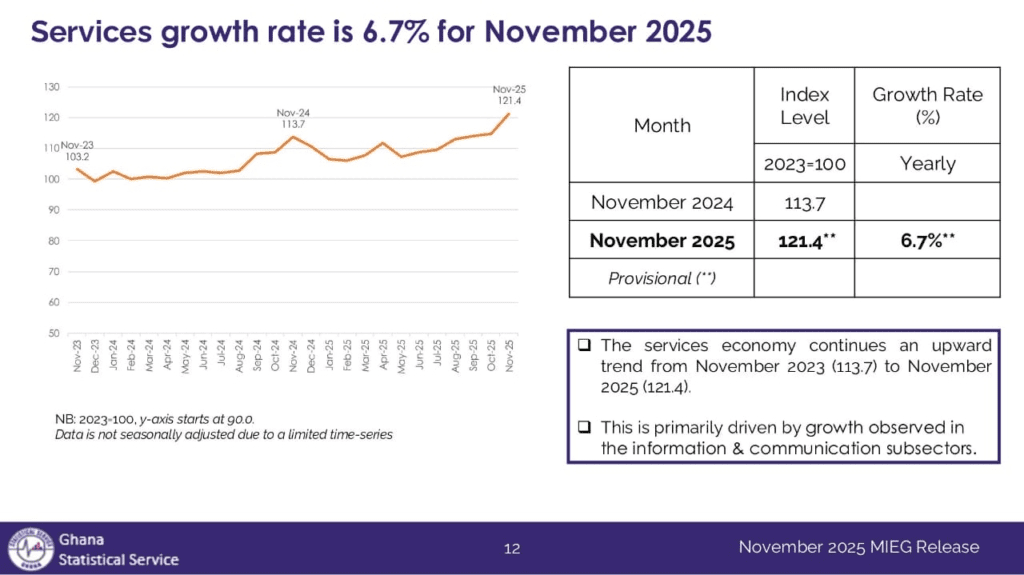
The services sector continued to be the largest contributor to aggregate production of goods and services in November 2025. The sector expanded by 6.7 percent, although this was slower than the 10.2 percent growth recorded in November 2024.
While growth in services remains relatively strong compared to other sectors, the deceleration signals a cooling in activity. The Monthly Indicator of Economic Growth shows that although the sector continued to expand, the pace of growth slowed significantly compared to the same period last year.
Services accounted for 57.7 percent of the overall 4.2 percent growth in November 2025, making it the dominant driver of economic activity. The sector’s continued expansion reflects sustained performance in areas such as trade, information and communication, financial services and other service-related activities.
However, the moderation suggests that consumer demand and business activity may be adjusting amid broader economic conditions.
Implications for the Economy
The slowdown from 7.1 percent growth in November 2024 to 4.2 percent in November 2025 signals a loss of momentum in Ghana’s economic expansion. While positive growth indicates that the economy is still expanding, the sharp deceleration in industry and the slower pace in services raise questions about the outlook for the coming months.
Agriculture’s resilience provides a measure of stability, but it may not be sufficient to offset persistent weaknesses in the industrial sector, particularly if challenges in oil and gas production continue.
The data highlights the need for renewed focus on strengthening industrial productivity, supporting extractive sector stability and sustaining momentum in services. Policymakers may also need to deepen efforts to diversify growth sources to reduce vulnerability to sector-specific shocks.
For now, the November figures paint a picture of an economy that continues to grow, but at a noticeably slower pace than a year ago.