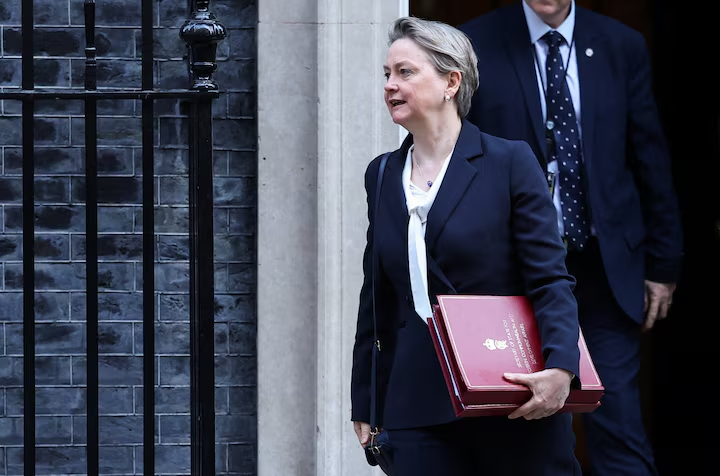
UK’s Foreign Secretary Yvette Cooper has backed the government’s decision to make its own foreign policy decisions based on national interest rather than simply aligning with allies.
She emphasized the government’s responsibility to act independently in international matters.
“It is our job as the UK government to decide what’s in the UK national interest, and that doesn’t mean simply agreeing with other countries or outsourcing our foreign policy to other countries.”
Yvette Cooper
Her remarks come at a time of heightened geopolitical tensions following the conflict involving the United States, Israel and Iran.
Questions have emerged over the extent to which the United Kingdom should support American military operations particularly after criticism from the US President Donald Trump, who argued that UK should have offered stronger backing during the early stages of the confrontation.
The UK government, led by Prime Minister Keir Starmer, defended its cautious approach, insisting that decisions on military involvement must be guided by the broader national interest.

Cooper indicated that it is right for the Prime Minister to “stand up for British interest,” adding that “its for the US President to decide what he thinks is in the US national interest.”
UK – USA Relations Under Pressure
This disagreement tests the strength and future direction of the UK–US relationship, spotlighting the tension between alliance solidarity and national autonomy.
The UK and the US have traditionally described their partnership as a “special relationship.” This idea of a ‘special relationship’ between the UK and the USA dates back to the end of the Second World War and the early Cold War period. Winston Churchill popularized the term in a famous 1946 speech, calling for unity against the growing threat of the USSR, and it has since been adopted by successive governments keen to emphasize Anglo-American relations.
However, the phrase “special relationship’” is not unique to the UK and the US. Other countries, such as Israel, the United States, and Canada, have also used this term to describe their bilateral partnerships.
The UK’s close relationship with the US is not just based on relationships between presidents and prime ministers, but on deep intelligence, defence, and security working relationships. It centers particularly on the US’s commitment, made in the aftermath of the war, to remain a guarantor of peace in Europe.
Nevertheless, the latest crisis has revealed that, despite their alliance, the two governments take distinctly different approaches to military intervention.
On 28 February 2026, the US initiated military action against Iran alongside Israel, killing Iran’s Supreme Leader as well as other senior leadership and launching strikes across the country.
In contrast to the US and Israel’s action, the UK did not join the initial strikes on Iran, but subsequently permitted the US to use British bases to conduct defensive strikes.
This position taken by the UK government sparked a lot of criticism. Notably, former UK Prime Minister Tony Blair advised that the UK should have backed the strikes from the beginning. He said the US was an “indispensable cornerstone” of the UK’s security, and that allies should ‘show up’ regardless of who the current President is.
The Foreign Secretary in response, stressed that the UK should neither automatically agree with nor systematically oppose the US, but instead act based on what is right for the country.
Meanwhile, US President, Donald Trump mentioned in a post that, the UK was considering sending aircraft carriers to the Middle East but appeared dismissive of the move.
“The United Kingdom, our once Great Ally, may be the Greatest of them all, is finally giving serious thought to sending two aircraft carriers to the Middle East. That’s OK, Prime Minister Starmer, we don’t need them any longer but we will remember. We don’t need people who join wars after we’ve already won!”
Donald Trump
Following the US President’s comment, the UK’s Foreign Secretary reiterated the government’s stance of not necessarily agreeing with the US President on every issue.
Middle East Tensions And The Risk Of Wider Escalation
Recent military strikes and retaliatory attacks involving Iran, Israel and US have increased instability across the region. Several Gulf states have reported security alerts following missile and drone launches linked to the ongoing confrontation.
The situation has also heightened fears about global energy markets and international shipping routes, particularly around the Strait of Hormuz, one of the world’s most critical maritime choke-points for oil transportation.
The explosions that illuminated the skies above Tehran after the Israel Defense Forces targeted fuel facilities equally point to the increasing danger that the ongoing violence could spark a broader regional conflict.
READ ALSO: US To Continue Military Offensive In Iran