• About
  • Advertise
  • Privacy Policy
  • Contact
Friday, May 15, 2026
  • Login
The Vaultz News
  • Top Stories
  • News
    • General News
    • Education
    • Health
    • Opinions
  • Economics
    • Economy
    • Finance
      • Banking
      • Insurance
      • Pension
    • Securities/Markets
  • Business
    • Agribusiness
    • Vaultz Business
    • Extractives/Energy
    • Real Estate
  • World
    • Africa
    • America
    • Europe
    • UK
    • USA
    • Asia
    • Around the Globe
  • Innovation
    • Technology
    • Wheels
  • Entertainment
  • 20MOBPL2DNew
  • Jobs & Scholarships
    • Job Vacancies
    • Scholarships
No Result
View All Result
The Vaultz News
  • Top Stories
  • News
    • General News
    • Education
    • Health
    • Opinions
  • Economics
    • Economy
    • Finance
      • Banking
      • Insurance
      • Pension
    • Securities/Markets
  • Business
    • Agribusiness
    • Vaultz Business
    • Extractives/Energy
    • Real Estate
  • World
    • Africa
    • America
    • Europe
    • UK
    • USA
    • Asia
    • Around the Globe
  • Innovation
    • Technology
    • Wheels
  • Entertainment
  • 20MOBPL2DNew
  • Jobs & Scholarships
    • Job Vacancies
    • Scholarships
No Result
View All Result
The Vaultz News
No Result
View All Result
in UK

UK Bars Far-Right Agitators as Starmer Vows Zero Tolerance

Emmanuel Nuamahby Emmanuel Nuamah
May 15, 2026
Reading Time: 4 mins read
UK Prime Minister, Keir Starmer

UK Prime Minister, Keir Starmer

UK government has barred 11 foreign far-right activists from entering the country ahead of a weekend of major demonstrations in London, as Prime Minister Sir Keir Starmer pledged to use the full force of the law against anyone seeking to spread hatred or intimidate communities.

Thousands of people are expected to gather in the capital on Saturday for a march organised by Unite the Kingdom, alongside a large pro-Palestinian demonstration that will also include anti-racism campaigners from Stand Up to Racism. The scale of the events is expected to make this one of the busiest policing operations London has seen in years.

Speaking after visiting the Metropolitan Police’s Command and Control Special Operations Room, the Prime Minister emphasised that the country was facing a defining challenge.

“We’re in a fight for the soul of this country, and the Unite the Kingdom march this weekend is a stark reminder of exactly what we are up against. Its organisers are peddling hatred and division, plain and simple.

“We will block those coming into the UK who seek to incite hatred and violence. For anyone who sets out to wreak havoc on our streets, to intimidate or threaten anyone, you can expect to face the full force of the law.

Keir Starmer

The Prime Minister further indicated that, “My government will always champion peaceful protest but will act decisively against hatred,” adding, “We all have a responsibility to speak out against those spouting vile, divisive views wherever we see it.”

ADVERTISEMENT

“We are a country built on decency, fairness and respect, at our best when people from different backgrounds come together in common purpose. That is what we must fight for.”

Keir Starmer

Starmer stressed that he recognises most of those expected to take part are law-abiding citizens exercising their right to protest peacefully, and he urged all participants to conduct themselves with decency and respect.

Among those denied entry is US-based extremist Valentina Gomez, who has drawn widespread criticism for inflammatory and dehumanising remarks about Muslim communities.

According to the government, the decision to block her and 10 others reflects a broader determination to prevent foreign agitators from importing extremist rhetoric and fuelling tensions in Britain.

These actions form part of a wider effort to safeguard public order while protecting the right to peaceful protest. They stressed that Britain remains open to lawful expression, but not to individuals whose intention is to incite violence, hatred or intimidation.

The Prime Minister warned that any minority intent on whipping up hatred and threatening communities during the weekend’s marches would face swift and decisive action.

Britain Tightens Security Ahead of Major London Protests
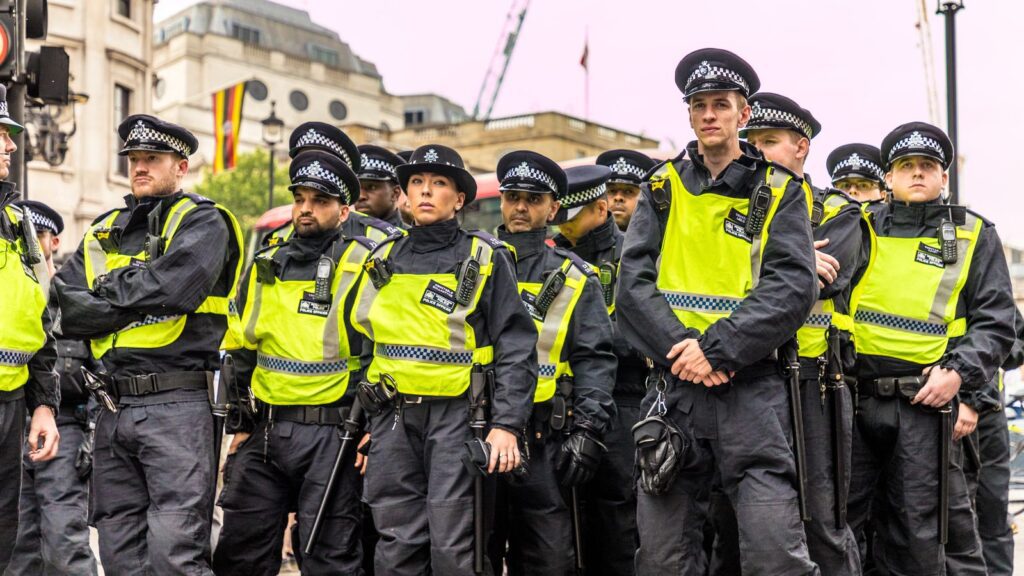
UK police
Metropolitan Police Officers

Moreover, Britain has launched an extensive security operation ahead of major demonstrations in London, as the government seeks to ensure that peaceful protest is protected while any attempts to spread hatred or incite violence are dealt with swiftly.

Prime Minister Keir Starmer met senior police chiefs and acknowledged that the overwhelming majority of those expected to attend the protests are law-abiding citizens exercising their democratic rights.

Thousands of police officers will be deployed across the capital over the weekend, backed by live facial recognition technology, helicopters, drones, mounted units, police dogs and armoured vehicles.

 According to a government communiqué, the operation is intended to respond rapidly to any outbreaks of disorder and to reassure communities that may feel vulnerable.

ADVERTISEMENT

The Metropolitan Police has warned that officers will arrest individuals who incite hatred, including those using chants such as “globalise the intifada,” where the context suggests unlawful incitement.

In a further show of resolve, the government has announced £18 million in emergency funding for the Metropolitan Police to bolster security arrangements and provide reassurance to Britain’s Jewish community, which has experienced a rise in antisemitic incidents in recent months.

The justice system has also been placed on heightened alert. Prosecutors will work closely with police to speed up charging decisions, while additional courts will sit for extended hours to ensure that suspects are brought before judges without delay.

According to government officials, these measures reflect concern that a small number of violent extremists could exploit otherwise peaceful demonstrations to inflame tensions.

They insist the response is not intended to restrict legitimate protest, but to draw a firm line against hate speech, intimidation and violence.

With tensions high and public scrutiny intense, the government highlighted that its objective is clear: to safeguard peaceful protest while taking decisive action against anyone who threatens to spread division or fear.

READ ALSO: National House of Chiefs President Calls for Mineral Revenue Overhaul

Sign Up to Our Newsletter

Fresh updates, Straight to your inbox

Tags: Keir StarmerMetropolitan Police’s Command and Control Special Operations RoomStand Up to RacismUnite the Kingdom MarchUnited Kingdom
Share3Tweet2ShareSendSend
Please login to join discussion
Previous Post

Fidelity Demands Africa Own Its Digital Future

Next Post

GES Assures Placement for All Qualified BECE Candidates

Related Posts

Skills Minister Jacqui Smith
UK

Education Barriers Lifted as Adults Gain Study Opportunities Across UK

May 15, 2026
Andy Burnham, Mayor of Greater Manchester
UK

Burnham Plots Westminster Comeback Amid Deepening Starmer Crisis

May 15, 2026
Wes Streeting, Health Secretary
UK

Wes Streeting Resigns as Health Secretary, Deepening Starmer Leadership Crisis

May 14, 2026
Angela Rayner
UK

Angela Rayner Exonerated in Tax Probe as Labour Leadership Battle Intensifies

May 14, 2026

Sign Up to Our Newsletter

Fresh updates, Straight to your inbox

Recent News

GettyImages 1855339841

36 Countries, EU Approve Agreement To Establish Special Tribunal For Ukraine

May 15, 2026
Professor Ernest Kofi Davis, Acting Director-General, Ghana Education Service

GES Assures Placement for All Qualified BECE Candidates

May 15, 2026
UK Prime Minister, Keir Starmer

UK Bars Far-Right Agitators as Starmer Vows Zero Tolerance

May 15, 2026
Fidelity Demands Africa Own Its Digital Future At a time when Africa’s digital economy is accelerating at an unprecedented pace, Fidelity Bank Ghana has delivered one of the strongest messages yet on the continent’s technological future. The bank made a bold and urgent case for Africa to stop depending on foreign controlled digital systems and begin building its own infrastructure capable of retaining value, strengthening currencies, and driving long term economic sovereignty. As one of the key sponsors of the 3i Africa summit, Fidelity Bank did not just show up to participate. It arrived with a message that resonated deeply across conference halls and policy discussions. Fidelity Bank emerged as one of the loudest voices championing a future where African nations control the very digital rails that power their economies. Digital Infrastructure Is The New Economic Power One of the defining moments of the summit came during a high level panel discussion on digital public infrastructure, where Adeline Aryee delivered a statement that immediately captured the attention of participants. She declared that if Africa builds its own digital rails, it naturally retains the value created by those systems. Her message was clear and uncompromising. In previous decades, national infrastructure was measured by roads, bridges, ports, and airports. Today, the true engines of economic power are payment platforms, identity systems, financial technology ecosystems, and digital marketplaces. According to Aryee, digital public infrastructure is no longer a luxury. It is now a strategic national asset. Her remarks struck at the heart of one of Africa’s most pressing economic concerns. Despite growing digital adoption, many transactions across the continent still pass through foreign payment systems, resulting in value leakage and continued pressure on local currencies. Ghana’s Success Story Becomes A Continental Blueprint Aryee highlighted Ghana’s progress in financial inclusion, mobile payments, and digital banking, describing the country as an emerging model for other African economies. Over the years, Ghana has invested heavily in domestic payment systems such as GhIPSS and its flagship platform, Gh-link. These systems have significantly expanded access to financial services while promoting digital transactions across urban and rural communities. Yet Aryee argued that inclusion alone is no longer enough. The next chapter for Africa, she insisted, must focus on ownership. She questioned why local transactions continue to depend on foreign rails when domestic infrastructure already exists. According to her, such dependence creates unnecessary external exposure and limits the continent’s ability to fully capture the economic benefits of its growing digital market. Her comments triggered intense debate among summit participants, many of whom acknowledged the urgent need for policy reforms and infrastructure investments. Market Driven Innovation Takes Center Stage Beyond infrastructure, Fidelity Bank also made a strong case for innovation that begins with real market needs. During the Ecosystem Roundtable on platforms, talent, and digital markets, Prince Osei Hyeaman-Addai shared insights from the bank’s years of digital financial innovation. He stressed that successful digital products are not built in boardrooms or based on assumptions. Instead, they are created by listening carefully to the market and understanding customer pain points. According to him, the market itself reveals the problems that need solving, the type of platform required, and the path toward scalable growth. His comments reflected a growing shift in African fintech circles, where customer centered design is becoming essential for product adoption and long term relevance. Trust And Credibility Remain The Real Currency Prince also emphasized that technology alone does not guarantee success. In his view, trust, credibility, and strong operational structures remain the real foundations of successful innovation. He noted that while investor interest in African fintech continues to rise, startups must prove they can deliver sustainable solutions, maintain transparency, and build products that respond to local realities. This perspective reflects Fidelity Bank’s own journey in digital transformation. Over the years, the bank has built strategic collaborations with leading fintech players, including IT Consortium, helping pioneer wallet to bank integrations and mobile financial solutions in Ghana. These partnerships have helped position Fidelity as one of Ghana’s most innovation driven financial institutions. A Defining Moment For Africa’s Digital Future Fidelity Bank’s participation at the 3i Africa Summit 2026 was more than a corporate appearance. It was a strategic declaration. At a time when Africa is racing to build competitive digital economies, the bank’s message was impossible to ignore. Africa cannot simply consume technology created elsewhere. It must own the infrastructure, shape the platforms, and capture the value generated by its digital future. As conversations from the summit continue to ripple across financial and policy circles, one thing is becoming increasingly clear. Africa’s next economic revolution may not be built on oil, gold, or minerals. It may be built on digital rails designed, owned, and powered by Africans. READ ALSO: IMF Ghana Review Ends in Dramatic Cliffhanger Fidelity Demands Africa Own Its Digital Future At a time when Africa’s digital economy is accelerating at an unprecedented pace, Fidelity Bank Ghana has delivered one of the strongest messages yet on the continent’s technological future. The bank made a bold and urgent case for Africa to stop depending on foreign controlled digital systems and begin building its own infrastructure capable of retaining value, strengthening currencies, and driving long term economic sovereignty. As one of the key sponsors of the 3i Africa summit, Fidelity Bank did not just show up to participate. It arrived with a message that resonated deeply across conference halls and policy discussions. Fidelity Bank emerged as one of the loudest voices championing a future where African nations control the very digital rails that power their economies. Digital Infrastructure Is The New Economic Power One of the defining moments of the summit came during a high level panel discussion on digital public infrastructure, where Adeline Aryee delivered a statement that immediately captured the attention of participants. She declared that if Africa builds its own digital rails, it naturally retains the value created by those systems. Her message was clear and uncompromising. In previous decades, national infrastructure was measured by roads, bridges, ports, and airports. Today, the true engines of economic power are payment platforms, identity systems, financial technology ecosystems, and digital marketplaces. According to Aryee, digital public infrastructure is no longer a luxury. It is now a strategic national asset. Her remarks struck at the heart of one of Africa’s most pressing economic concerns. Despite growing digital adoption, many transactions across the continent still pass through foreign payment systems, resulting in value leakage and continued pressure on local currencies. Ghana’s Success Story Becomes A Continental Blueprint Aryee highlighted Ghana’s progress in financial inclusion, mobile payments, and digital banking, describing the country as an emerging model for other African economies. Over the years, Ghana has invested heavily in domestic payment systems such as GhIPSS and its flagship platform, Gh-link. These systems have significantly expanded access to financial services while promoting digital transactions across urban and rural communities. Yet Aryee argued that inclusion alone is no longer enough. The next chapter for Africa, she insisted, must focus on ownership. She questioned why local transactions continue to depend on foreign rails when domestic infrastructure already exists. According to her, such dependence creates unnecessary external exposure and limits the continent’s ability to fully capture the economic benefits of its growing digital market. Her comments triggered intense debate among summit participants, many of whom acknowledged the urgent need for policy reforms and infrastructure investments. Market Driven Innovation Takes Center Stage Beyond infrastructure, Fidelity Bank also made a strong case for innovation that begins with real market needs. During the Ecosystem Roundtable on platforms, talent, and digital markets, Prince Osei Hyeaman-Addai shared insights from the bank’s years of digital financial innovation. He stressed that successful digital products are not built in boardrooms or based on assumptions. Instead, they are created by listening carefully to the market and understanding customer pain points. According to him, the market itself reveals the problems that need solving, the type of platform required, and the path toward scalable growth. His comments reflected a growing shift in African fintech circles, where customer centered design is becoming essential for product adoption and long term relevance. Trust And Credibility Remain The Real Currency Prince also emphasized that technology alone does not guarantee success. In his view, trust, credibility, and strong operational structures remain the real foundations of successful innovation. He noted that while investor interest in African fintech continues to rise, startups must prove they can deliver sustainable solutions, maintain transparency, and build products that respond to local realities. This perspective reflects Fidelity Bank’s own journey in digital transformation. Over the years, the bank has built strategic collaborations with leading fintech players, including IT Consortium, helping pioneer wallet to bank integrations and mobile financial solutions in Ghana. These partnerships have helped position Fidelity as one of Ghana’s most innovation driven financial institutions. A Defining Moment For Africa’s Digital Future Fidelity Bank’s participation at the 3i Africa Summit 2026 was more than a corporate appearance. It was a strategic declaration. At a time when Africa is racing to build competitive digital economies, the bank’s message was impossible to ignore. Africa cannot simply consume technology created elsewhere. It must own the infrastructure, shape the platforms, and capture the value generated by its digital future. As conversations from the summit continue to ripple across financial and policy circles, one thing is becoming increasingly clear. Africa’s next economic revolution may not be built on oil, gold, or minerals. It may be built on digital rails designed, owned, and powered by Africans. READ ALSO: IMF Ghana Review Ends in Dramatic Cliffhanger Fidelity Demands Africa Own Its Digital Future

Fidelity Demands Africa Own Its Digital Future

May 15, 2026
Bruno Fernandes has won Manchester United's Player of the Year award twice in succession

Fernandes Crowned Manchester United Player of the Year Again After Remarkable Season

May 15, 2026
Next Post
Professor Ernest Kofi Davis, Acting Director-General, Ghana Education Service

GES Assures Placement for All Qualified BECE Candidates

The Vaultz News

Copyright © 2025 The Vaultz News. All rights reserved.

Navigate Site

  • About
  • Advertise
  • Privacy Policy
  • Contact

Follow Us

Welcome Back!

Login to your account below

Forgotten Password?

Retrieve your password

Please enter your username or email address to reset your password.

Log In
No Result
View All Result
  • Top Stories
  • News
    • General News
    • Education
    • Health
    • Opinions
  • Economics
    • Economy
    • Finance
      • Banking
      • Insurance
      • Pension
    • Securities/Markets
  • Business
    • Agribusiness
    • Vaultz Business
    • Extractives/Energy
    • Real Estate
  • World
    • Africa
    • America
    • Europe
    • UK
    • USA
    • Asia
    • Around the Globe
  • Innovation
    • Technology
    • Wheels
  • Entertainment
  • 20MOBPL2D
  • Jobs & Scholarships
    • Job Vacancies
    • Scholarships

Copyright © 2025 The Vaultz News. All rights reserved.

This website uses cookies. By continuing to use this website you are giving consent to cookies being used. Visit our Privacy and Cookie Policy.

Discover the Details behind the story

Get an in-depth analysis of the news from our top editors

Enter your email address