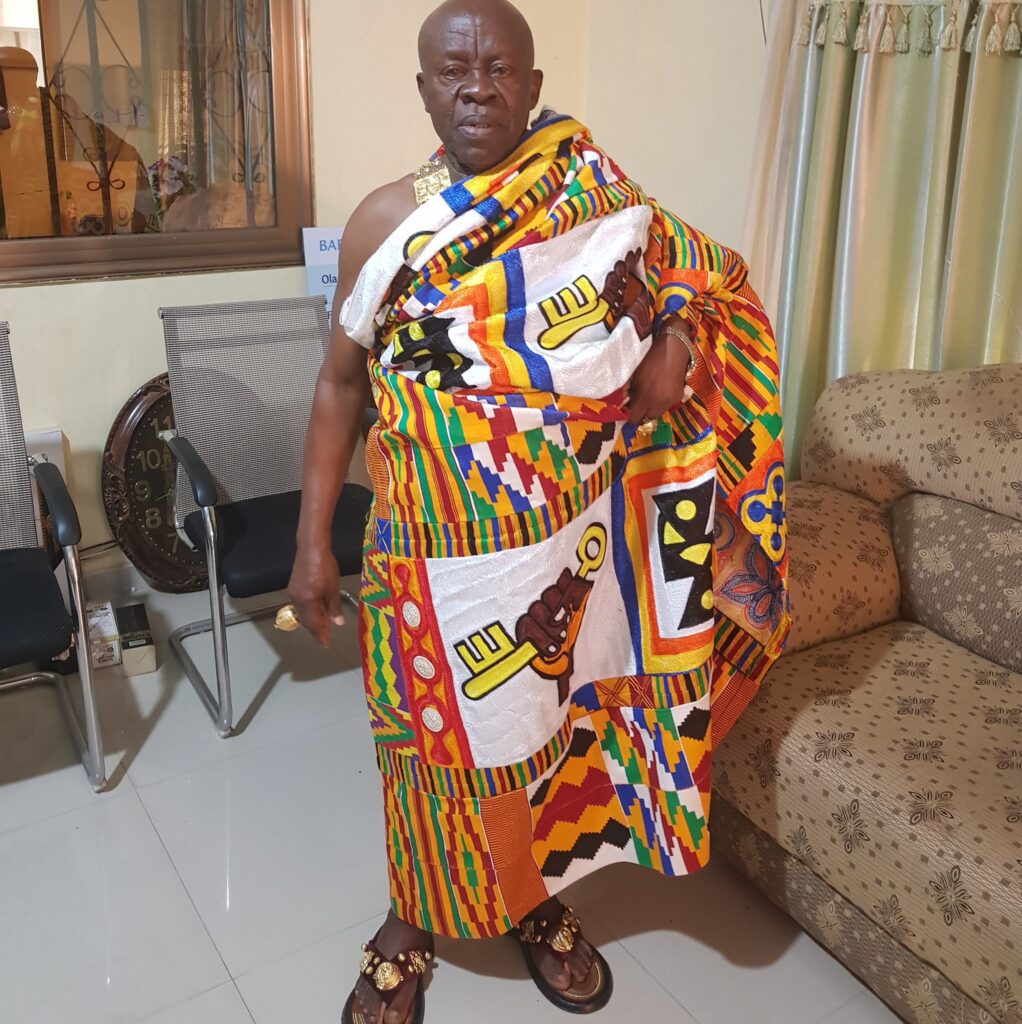
Ogyeahohoo Yaw Gyebi II, the President of the National House of Chiefs and Paramount Chief of the Sefwi Anhwiaso Traditional Area, is demanding a radical restructuring of Ghana’s mineral revenue disbursement framework to address the chronic underdevelopment of mining enclaves.
The traditional leader argues that the current statutory formulas for sharing royalties are fundamentally flawed, leaving host communities with negligible financial benefits despite the massive scale of extraction occurring on their ancestral lands.
During a high-level meeting with the Parliamentary Select Committee on Chieftaincy and Religious Affairs, the Chief highlighted the paradox of plenty, where areas rich in gold and other minerals remain impoverished while the central government retains the lion’s share of the wealth generated.
“I draw your attention to royalties; if any gold mine pays $1 billion in a quarter, government takes $900,000 and we are left with $100,000. Of this, the municipal assembly is allocated 55%, leaving only about $40,500 for the community and its traditional leadership. We need a radical review because if you are unlucky to have resources in your area, it becomes a case.”
Ogyeahohoo Yaw Gyebi II
This advocacy for reform comes at a time when the Sefwi Anhwiaso area hosts four major mining companies, some of which have been operational for over eight decades.

Despite nearly a century of industrial activity, the Chief pointed out that there is little visible developmental evidence to justify the environmental and social costs borne by his people.
The grievance centers on the bureaucratic process where mineral royalties are first funneled into the Consolidated Fund before being trickled back to local authorities and traditional councils.
This centralized “resource curse” mechanism, according to the Paramount Chief, results in a lack of transparency and a significant dilution of funds, often leaving traditional areas in the dark regarding the actual quantum of revenue they are entitled to receive.
The Arithmetic of Disparity: How the Current System Fails Communities
Under the existing legal framework governing mineral revenue in Ghana, specifically the Mineral Development Fund (MDF) Act, the distribution of royalties follows a top-down approach that systematically disadvantages the primary stakeholders the host communities.
When mining companies pay royalties, which are typically a percentage of their total revenue, the vast majority is retained by the central government for national budgetary support.
Only a small fraction is earmarked for the MDF, from which further deductions are made for the Office of the Administrator of Stool Lands (OASL).
The “resource case” described by Ogyeahohoo Yaw Gyebi II highlights a mathematical reality where, after the central government and the OASL take their portions, the remaining funds are split between District Assemblies and Traditional Authorities.
In the Chief’s cited example, the $1 billion hypothetical royalty payment is eroded through various statutory tiers until only a minute fraction reaches the local level.
This dilution is worsened when a mining concession spans multiple traditional jurisdictions, forcing chiefs to subdivide an already meager sum.
Consequently, the funds available for local infrastructure, scholarships, or environmental reclamation are insufficient to meet the pressing needs of the populace.
Institutional Bottlenecks and the Lack of Transparency
A primary point of contention raised by the Sefwi Anhwiaso Paramountcy is the requirement for these funds to be paid into the Consolidated Fund before being disbursed.
This process creates a “black hole” effect where local leaders are “not even informed” about the timing or the exact amount of payments being made by the companies operating on their land.

The Chief noted that “when they go there, we know what happens to them,” suggesting that administrative delays and potential diversions at the national level further starve the grassroots of necessary capital.
The lack of direct access to mineral wealth means that communities remain observers of their own resources.
The Chief emphasized that although the people have “access to land and a place,” they have received virtually nothing in return for the decades of exploitation.
This disconnect between the wealth extracted and the poverty of the host community fuels local resentment and undermines the social license of mining firms to operate.
By calling for a “radical overhaul,” the traditional leader is seeking a system where a greater percentage of royalties is retained at the source or at least disbursed with greater transparency and speed.
A Call for Direct Community Reinvestment
The call for a radical review is not merely about increasing the dollar amount but about redefining the relationship between the state, the miner, and the host.
The current structure, which Ogyeahohoo Yaw Gyebi II characterizes as a “resource case,” suggests that being resource-rich has become a developmental burden rather than a blessing.

To reverse this, he proposes that the mineral revenue sharing system must be reimagined to prioritize the immediate needs of those who live in the shadow of the mines.
The President of the National House of Chiefs is advocating for a mechanism where traditional areas and municipal assemblies are treated as primary partners in the extractive value chain.
Without such a shift, the “small traditional areas” like Sefwi Anhwiaso, Tapa, and Bompata will continue to suffer from the environmental degradation of mining without the financial capacity to mitigate its effects.
The appeal to the Parliamentary Select Committee serves as a formal notice that the status quo is no longer tenable for Ghana’s mining heartlands.
READ ALSO: “Let Africa Go” Conference Targets Ethical Anchor In Trade Growth