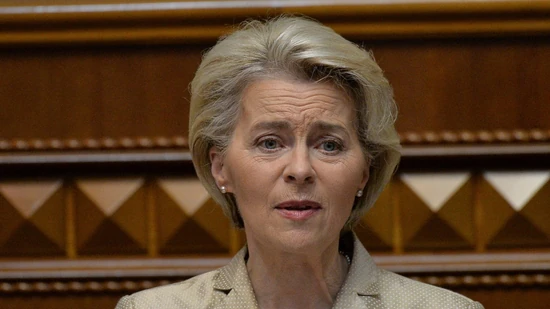
Ursula von der Leyen, the head of the European Commission has asserted that the EU needs to intensify the shift to “homegrown” and “reliable” renewable and nuclear energy, after the war in the Middle East added €22bn to its energy-import bill.
Speaking to reporters in Brussels, von der Leyen focused most of her remarks on the EU’s internal agenda in response to soaring energy prices. Von der Leyen said that during 44 days of turmoil in the Middle East, the EU’s import bill for fossil fuels had increased by more than €22bn, with “not a single molecule of energy in addition.”
She said that the EU was paying “a high price for our over-dependency on fossil fuels” but went on to say that Europe had assets.
“We have the electricity that is produced in Europe, from renewables and from nuclear. And therefore our strategy to decarbonise has not only been confirmed in the last years, but is growing in importance day by day. And our objective is very clear. We need to scale up the homegrown, affordable, reliable energy.”
Ursula von der Leyen
Also, the European Commission Head promised a strategy next Wednesday outlining how the EU could contain the economic fallout from 44 days of turmoil in the Middle East, which began when the US and Israel launched strikes on Iran in late February.



Reflecting the uncertainty after the weekend’s inconclusive talks between the US and Iran, and Donald Trump’s subsequent social media posts, von der Leyen observed that “negotiations have been stalled now and we have to say how things go.”
Any agreement, she said, would have to address concerns raised by Iran’s nuclear and ballistic missile programme and the strait of Hormuz.
“The ongoing closure of the Strait of Hormuz is greatly damaging, and the restoration of the freedom of navigation is of paramount importance for us.”
Ursula von der Leyen
She said that the EU’s 27 member states need to coordinate on gas storage filling and releasing oil stocks. The European Commission would consult countries on greater flexibility in state aid, rules governing subsidies and other support. She urged faster progress to agree on an EU draft law on grids that would help the shift to renewable energy, while also promising an electrification strategy and calling for governments to implement more energy-saving measures.
EU Leaders Concerned About Israel’s Attacks On Lebanon
EU leaders remain concerned about Israel’s attacks on Lebanon and she called on “all parties” to respect Lebanon’s sovereignty and to implement a complete cessation of hostilities
“We are also worried that the continued strikes on Lebanon threaten to derail the entire process. We are mobilising ReliefEU stocks to provide immediate aid to the Lebanese people, but no amount of aid can replace the safety of a permanent peace. A key lesson of the past weeks is that security is indivisible. You cannot have stability in the Middle East or the Gulf while Lebanon is in flames. So we call on all parties to respect the sovereignty of Lebanon and to implement a complete cessation of hostilities.”
Ursula von der Leyen
Separately, Lebanon’s President, Joseph Aoun called for ceasefire ahead of Washington meeting, saying that he hopes a meeting in Washington between Lebanese, US and Israeli representatives will lead to a ceasefire.

In remarks to Italy’s Foreign Minister Antonio Tajani, the Lebanese presidency said on X that Lebanon wants “an agreement … with the aim of initiating direct negotiations between Lebanon and Israel” to end hostilities and stabilise the south.
He said that there is “an available opportunity to reach a sustainable solution”, but stressed that it “cannot be one-sided” and that Israel must respond to calls “to stop its aggressions … and commence negotiations.”
“Israel’s destruction of Lebanese areas is not the solution and will not achieve any result, because diplomatic solutions have always been the best for armed conflicts.”
Joseph Aoun
He welcomed Italy’s offer to host talks and said negotiations would be handled “by the Lebanese state and no other party.”
He also said that Lebanon has stepped up security measures at Rafic Hariri International Airport and border crossings to prevent arms smuggling.