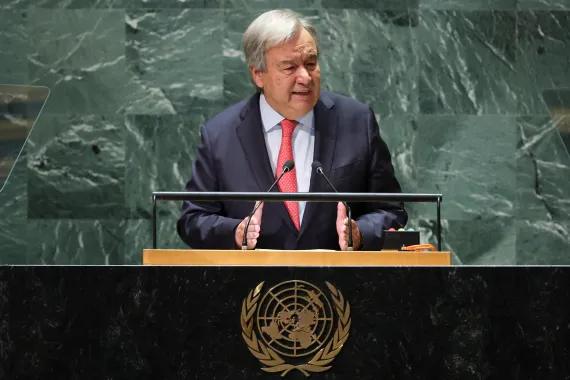
UN Secretary-General, Antonio Guterres has called for restraint, warning that “without it, instability spreads, mistrust deepens, and conflicts spiral out of control” – a situation that applies everywhere, but urgently to the conflict in the Middle East.
He repeated his position that there is no military solution to the crisis, adding that peace agreements require persistent engagement and political will. He stressed that serious negotiations must resume, while international navigational rights and freedoms – including in the Strait of Hormuz – must be respected by all parties.
“It is time for restraint and responsibility. It is time for diplomacy over escalation. It is time for a renewed commitment to international law.”
Antonio Guterres
The crisis has caused death and devastation across the region, blocked shipping through the Strait of Hormuz –crucial for global trade in fuel, fertilizer and gas, and left thousands of workers stranded in vessels on the high seas.
He also said that it is “highly probable” that talks between the US and Iran will restart, and described ongoing discussions between Israel and Lebanon as “very important” for improving the situation on the ground. “The truth is that Hezbollah and Israel have always helped each other to destabilize the government of Lebanon,” he added.

The Secretary-General lowered expectations, saying that no one expects the talks to resolve all outstanding issues, but expressed hope that they could “create the conditions to a change in the way the actors have been developing their activities.”
Yesterday, Stephane Dujarric, Guterres’ Spokesman, said in a statement that while no agreement was reached at the talks hosted by Pakistan between the United States and Iran in Islamabad, the discussions themselves underscored the seriousness of their engagement and constituted a positive and meaningful step toward renewed dialogue.
He said that given the deeply rooted differences, an agreement cannot be reached overnight, and “the Secretary-General calls on the talks to continue constructively for an agreement to be reached.”
“After weeks of destruction and distress, it is clear that there is no military solution to the current conflict. At the same time, the ceasefire must absolutely be preserved. All violations must cease.”
Stephane Dujarric
He noted that disruptions in the maritime trade through the Strait of Hormuz have already had a direct effect well beyond the immediate region, with increased global economic fragility and insecurity in many sectors.
He said that the disruption of fertilizer and its inputs further exacerbates food insecurity for millions of vulnerable people around the world, adding to the rising cost of living due to impacts from fuel, transportation and supply chain disruptions.
Guterres Warns International Law Eroding Fast
Moreover, the UN Secretary-General warned that respect for international law is eroding globally, particularly in the Middle East.
Guterres added that “rules governing the use of force and the conduct of hostilities are ignored.”
Addressing journalists at UN Headquarters in New York outside the Security Council, Guterres said that humanitarian and other legal obligations are being disregarded in the Middle East and elsewhere, breeding chaos, suffering and destruction. He said that the theme of upholding international law would be a central theme of his visit this week to the UN’s highest tribunal in the Hague – the International Court of Justice, amid hopes for renewed talks between Iran and the United States.
“Justice is meant to be blind. But today, too many are choosing to turn a blind eye to justice itself. Around the world – and starkly in the Middle East – respect for international law is being trampled. This is not the moment to retreat from international law. It is the moment to reaffirm it.”
Antonio Guterres
The ICJ, also known as the World Court, marks its 80th anniversary this week. The UN’s principal judicial organ is a pillar of the international legal order and it “has fulfilled that role with distinction” over this period. However, Guterres asserted that the visit “is not simply about commemorating an anniversary” but about “sending an unmistakable message.”
“A message that the United Nations stands firmly behind the institutions and principles designed to protect peace, justice, sovereignty and human dignity. A message that international law applies to all States, without exception, and that respect for its rules is not optional. A message that in a world moving toward greater fragmentation and sharper power competition, international law is indispensable.”
Antonio Guterres
READ ALSO: Health Minister Calls Agenda 111 A Deliberate Political Trap