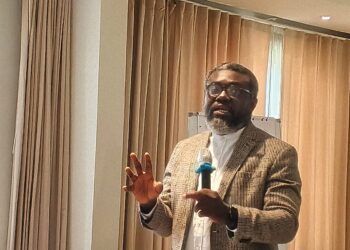

The Deputy Director General in charge of Operations at the National Service Authority, Major Moses Dok Nach Kpeungu, has disclosed that the institution has reduced its payroll budget from about GHS 1.6 billion to approximately GHS 700 million following a comprehensive cleanup of ghost names.
According to him, the significant reduction was achieved within a year after the introduction of stricter verification and monitoring processes. He explained that when the current management assumed office, they prioritized addressing irregularities within the payroll system, particularly the presence of non-existent personnel receiving allowances.
He noted that despite maintaining similar enrollment figures, the cost to the state has dropped sharply, signaling what he described as a major improvement in financial efficiency.
No Reduction in Service Personnel Numbers
Major Kpeungu clarified that the reduction in payroll expenditure was not due to a decrease in the number of National Service personnel. He emphasized that participation in the programme is mandatory for graduates, making it impossible for the Authority to arbitrarily reduce enrollment figures.

He explained that the government would not permit any attempt to limit the number of graduates undertaking national service, as it remains a statutory requirement. Instead, he said the focus was placed on ensuring that only genuine personnel are captured on the payroll.
He indicated that recent enrollment figures have remained consistent, with about 99,000 personnel enrolled last year compared to roughly 96,000 in the previous year.
The Deputy Director General attributed the previous high payroll figures to the existence of ghost names, which he described as fictitious personnel who were receiving allowances despite not being deployed.
He explained that earlier systems allowed for inflated numbers to be recorded, leading to payments being made to individuals who did not exist within the service structure. “They were non-existent personnel,” he said, stressing that these ghost entries were responsible for the inflated expenditure.
According to him, the introduction of rigorous verification procedures has eliminated such anomalies. He noted that personnel must now go through strict validation processes before being added to the payroll, ensuring that only legitimate service members receive payments.
Understanding the Cost Difference
Major Kpeungu provided further insight into how the discrepancy in payroll figures occurred. He explained that under the current system, if approximately 99,000 personnel are deployed and each receives the standard monthly allowance, the total annual cost aligns with the current figure of about GHS 700 million.
However, he indicated that in previous years, payroll figures suggested that far more personnel were being paid than were actually deployed. He described a scenario where numbers could have been inflated to nearly double the actual count, resulting in payments being made to ghost beneficiaries.

He emphasized that the difference between the actual number of personnel and the inflated figures represented funds lost to ghost names within the system.
The Deputy Director General stated that the cleanup exercise forms part of broader efforts to enhance transparency and accountability within the National Service Authority. He noted that the reforms are aimed at ensuring that public funds are used appropriately and that leakages are minimized.
He explained that the new system requires personnel to meet specific criteria and complete verification procedures before receiving allowances. This, he said, has significantly reduced the possibility of fraudulent entries.
He added that the Authority remains committed to maintaining these standards to prevent a recurrence of the problem.
Implications for Public Finance
The reduction in payroll expenditure is expected to have a positive impact on government finances. By eliminating ghost names, the Authority has freed up substantial resources that can be redirected to other development priorities.
Major Kpeungu indicated that the savings demonstrate the importance of strong institutional controls in managing public funds. He stressed that similar reforms across other sectors could yield significant financial benefits for the state.

Looking ahead, the Deputy Director General expressed confidence that the reforms will sustain long term efficiency within the National Service Authority. He emphasized that maintaining accurate records and strict oversight will be key to preserving the gains achieved.
He also noted that the Authority will continue to improve its systems to ensure that the programme operates effectively and transparently. According to him, the goal is to build a system that reflects the true number of personnel and ensures fair and timely payment of allowances.
He concluded that the elimination of ghost names marks a turning point in the management of the National Service Scheme, setting a precedent for accountability within public institutions.