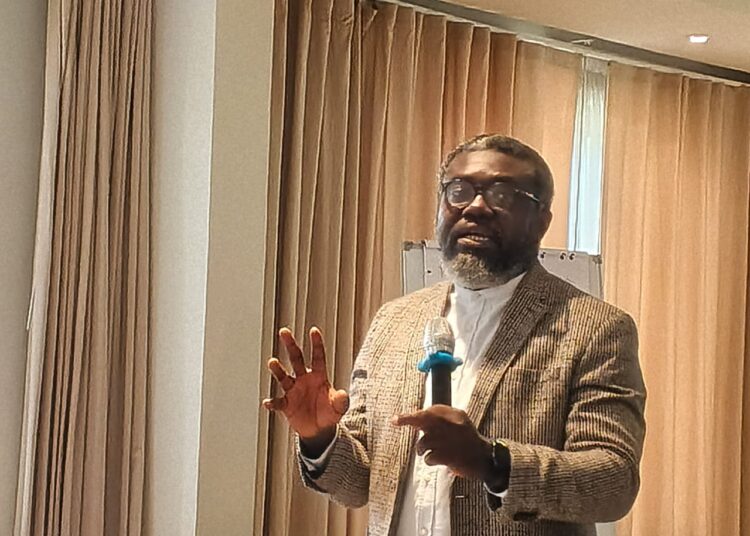
Private legal practitioner and Secretary to the Constitutional Review and Implementation Committee, Osagyefo Oliver Barker-Vomawor, has questioned inconsistencies surrounding the arrest and detention of Salomey Awiti Bafoh in the Ghana Jollof case. His intervention centres on whether constitutional safeguards are being applied consistently during police investigations.
Mr Barker-Vomawor pointed to reports that Ms Bafoh was arrested on September 13, while subsequent communication referred to September 17. He argued that such discrepancies matter because the Constitution limits how long an arrested person can be held before court.
The legal practitioner also challenged the treatment of constitutional rights during investigations. He recalled his own experience of having devices seized after his arrest and challenging a police application seeking access to them.
He argued that courts must remain vigilant when law enforcement seeks access to private information held on electronic devices. In his view, investigative convenience should not weaken constitutional privacy protections.
“When a person is presented before a court, we do not treat the violation of constitutional rights as unnecessary and continue to engage,” he stressed. Mr Barker-Vomawor indicated that rights protection should must be central even where authorities believe serious offences may have occurred.
The Lawyer distinguished between legitimate police investigations and the manner in which investigative powers are exercised. He acknowledged that authorities could have a valid interest in examining conduct associated with the Ghana Jollof account, particularly material that allegedly suggested a coup.
However, he argued that other content involving insults or offensive commentary should be assessed against the specific legal threshold for criminal conduct. The legal practitioner noted that distasteful speech does not automatically become criminal because it is objectionable.

Mr Barker-Vomawor further questioned the identification of alleged financial sponsors by investigators. He argued that evidence of money transfers alone does not establish that funds were provided to finance an alleged criminal publication.
He therefore questioned why individuals whose names have reportedly emerged in connection with the alleged funding have not been arrested if investigators have established a criminal link. Mr Barker-Vomawor stressed that public allegations require sufficient evidentiary grounding.
Police Powers Ought To Be Consistent Under Every Government
The legal practitioner, Mr Barker-Vomawor, also cautioned against defending the use of police powers simply because the political administration in office has changed. He argued that conduct criticised under one government should not become acceptable when similar methods are deployed by another administration.
He stressed that, “if those actions were wrong then, they cannot be right now just because the government has changed.” The Lawyer explained that his position should not be interpreted as support for the substance of statements published by the Ghana Jollof account.
Dr Barker-Vomawor said some of the online material is offensive and content he personally does not support. However, he argued that opposition to such speech is separate from the question of whether law enforcement is exercising its powers proportionately and within the law.
The legal practitioner also criticised the police communication declaring Barbara Asantewaa Kodua wanted. He questioned the decision to describe her as hiding when investigators had already established that she was living in the United Kingdom.
“In my view, when we publish content like that, it does not show professional police work,” he remarked. Mr Barker-Vomawor argued that such communication can create an impression that security institutions are acting to serve political interests.

Mr Barker-Vomawor therefore called for greater consistency in the application of state power. He argued that protecting free expression does not require anyone to endorse abusive speech, but it does require authorities to apply the law according to clear and defensible standards.
In the case of Salomey Awiti Bafoh, a 40-year-old senior nursing officer from Techiman, she has been remanded for two weeks after being charged with abetment of crime, specifically the alleged publication of false news.
The prosecution alleges that she assisted Barbara Asantewaa Kodua, popularly known as “Ghana Jollof”, in disseminating videos through social media by recruiting others to redistribute the content. Ms Bafoh has pleaded not guilty and is expected to reappear before the Adentan Circuit Court on September 30, 2026.
The police have also identified Ms Kodua, who is believed to be in the United Kingdom, as the operator of the Ghana Jollof account and have declared her wanted. Investigators allege that financial transactions linked Ms Bafoh and Ms Kodua to the activities, while the police says further investigations are ongoing to identify other people allegedly involved in circulating the content or providing financial support.
READ ALSO: GSE Rebounds Sharply On Final Weekday Despite Weekly Market Losses