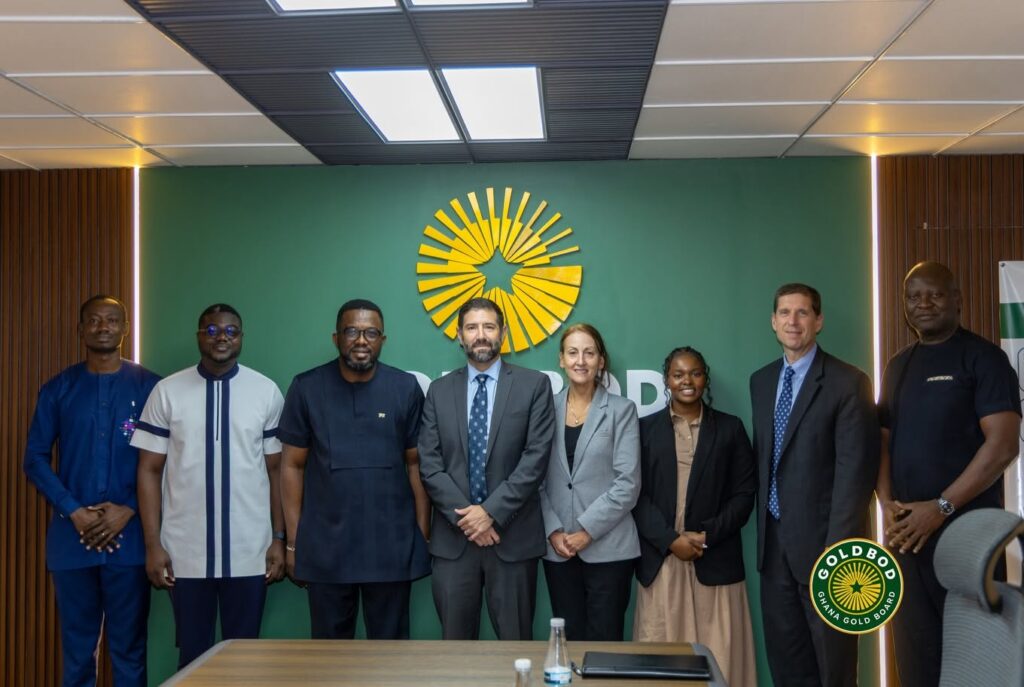
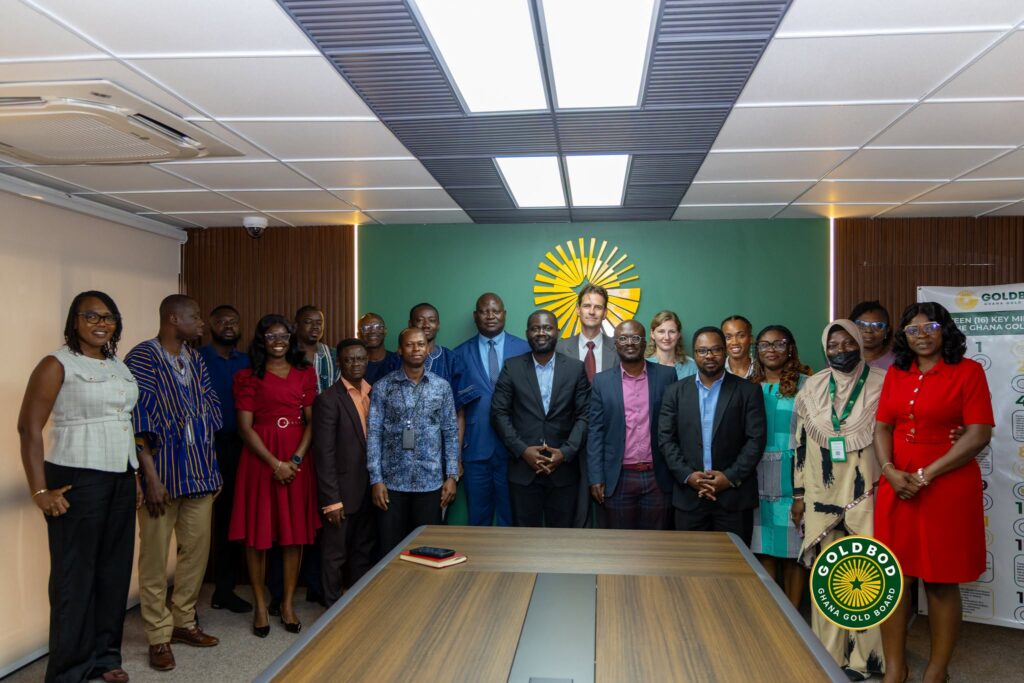
A delegation from the United States Department of Treasury, accompanied by officials of the Economic Section of the U.S. Embassy in Accra, visited the Ghana Gold Board (GoldBod) to engage on critical strategies for mineral value addition and resource governance.
The high-level bilateral session focused on aligning international trade expectations with Ghana’s ambitious economic agenda to maximize domestic benefits from its rich gold deposits.
“The Deputy CEO took the delegation through GoldBod’s mandate under the Ghana Gold Board Act, 2025 (Act 1140), and the Board’s role in the implementation of the Ghana Accelerated National Reserve Accumulation Programme (GANRAP).”
GoldBod
The U.S. delegation was received by the Deputy Chief Executive Officer of GoldBod, Richard Nunekpeku, Esq., alongside the Director of Responsible Mining, Prof. Ishmael Quaicoe, and the Deputy Director of Mining Operations, James German.
During the engagement, Mr. Nunekpeku provided a comprehensive overview of GoldBod’s mandate under the Ghana Gold Board Act, 2025 (Act 1140).
He detailed the Board’s central role in driving the Ghana Accelerated National Reserve Accumulation Programme (GANRAP), an initiative aimed at strengthening national financial resilience through aggressive, gold-backed reserve building.
Furthermore, the discussions highlighted key interventions, including promoting local gold refining, reforming the national assay regime, building nationwide end-to-end traceablity systems, offering bankable geological assessments, formalising artisanal and small-scale mining (ASM), reclaiming degraded landscapes, and advancing sustainable value-chain reforms.
Institutional Mandate And Regulatory Reforms
The establishment of the Ghana Gold Board under Act 1140 represents a decisive structural pivot in Ghana’s extractive sector governance.
For decades, the nation struggled with uncoordinated exports, under-reported production figures, and severe revenue leakage due to informal trading channels in artisanal and small-scale mining.
By designating GoldBod as the primary anchor for purchasing, assaying, and certifying gold exports, the legislation establishes a unified supervisory framework that brings regulatory discipline to the sector.
This institutional overhaul directly underpins the implementation of GANRAP, which seeks to systematically accumulate gold reserves to shore up foreign exchange stability and insulate the domestic economy against global market shocks.
Reforming the national assay regime ensures that every ounce of gold mined within Ghana’s borders is accurately valued and tracked prior to export.
In-text disclosures from GoldBod officials confirmed that setting up robust, nationwide gold traceability solutions will prove instrumental in meeting international conflict-free mineral standards and enhancing direct trade partnerships with global financial powerhouses like the United States.
Formalisation, Traceability, And Environmental Restoration
Addressing the vulnerabilities within the artisanal and small-scale mining (ASM) space remains central to GoldBod’s operational mandate.
Historically, informal ASM operations have contributed significantly to national gold output, yet they have simultaneously suffered from systemic illicit financial flows, exploitation by informal off-takers, and catastrophic environmental degradation.
By extending bankable geological data to small-scale miners, GoldBod is shifting the sector away from speculative, highly destructive digging toward targeted, commercially viable, and eco-friendly extraction practices.
Run-in quotes from sector experts present during the delegation visit emphasized that formalising ASM operators through streamlined licensing and guaranteed off-take routes provides the state with direct access to local gold production for national reserve building.
Simultaneously, the Board’s dedicated focus on land reclamation and forest restoration directly counters the ecological damages caused by illegal mining activities, offering a sustainable blueprint where extractive economic gains do not come at the expense of environmental integrity.
Global Strategic Alignment And Need For Value Creation
The necessity for Ghana to engage global stakeholders like the U.S. Treasury stems from a historic economic paradox: despite being one of Africa’s top gold producers, the country has traditionally exported raw, unrefined bullion, thereby missing out on downstream value capture.
Raw gold exports leave the nation vulnerable to price volatility while offshore refineries capture the financial premium associated with processed minerals and jewel-grade refining.
Engaging foreign diplomatic and financial partners allows Ghana to attract international investment into local refining infrastructure, ensuring that high-value gold processing occurs within the country.
Furthermore, as international supply chain transparency regulations tighten under Western framework standards, establishing an internationally recognized traceability and responsible mining regime is no longer optional.
Ghana’s strategic dialogue with the U.S. Department of Treasury secures key economic alignment, bolsters investor confidence, and positions the nation as a transparent, high-integrity hub for ethical mineral trade across the West African sub-region.
READ ALSO: GSE Rebounds Sharply On Final Weekday Despite Weekly Market Losses