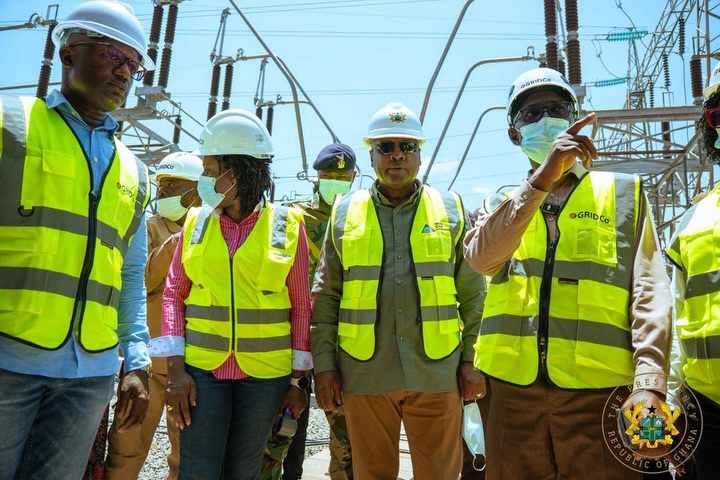
President John Dramani Mahama has lauded the technical expertise and dedication of the Volta River Authority (VRA) staff following a recent fire outbreak at the Akosombo substation control room, describing the organization as a beacon of state-run excellence.
During a high-level assessment visit to the scene of the incident, the President emphasized that the swift response of the technical team to “ameliorate” the crisis underscores the superior quality of Ghana’s human resource within the energy sector.
“But it’s not surprising because VRA has been one of the best-organised state-run enterprises. So I’m not surprised that you have the kind of quality of human resource to be able to ameliorate what happened. Because now that this adversity has happened, it makes sense. It gives us an opportunity to replace it with a more modern control room that will serve.”
President John Dramani Mahama

He noted that while the disruption was significant, the caliber of personnel managed by the VRA provides a guarantee of recovery that remains unparalleled in the country.
The visit comes in the wake of a blaze that decimated the facility’s primary control center, an infrastructure component that has been in continuous operation since 1964.
President Mahama highlighted that the age of the equipment contributed to the vulnerability, yet he framed the disaster as a pivotal turning point for the nation’s energy strategy.
He indicated that the “act of God” provides a clear mandate to transition from legacy systems to a digitized energy landscape.
By replacing the 60-year-old control room with a state-of-the-art facility, the government aims to consolidate the resilience of the Ghana Grid Company (GRIDCo) and the VRA, ensuring that the Akosombo generating complex remains the backbone of the national grid.

Engineering Resilience and the Human Factor
The President’s commendation of the VRA as “one of the best-organised state-run enterprises” reflects a deep-seated confidence in the institutional memory and technical discipline of the authority.
He remarked that he was “not surprised” by the speed at which the engineers moved to restore stability, stating, “I know VRA has some of the best personnel you’ll ever get anywhere in the country.”
This human-centric resilience is what the President believes will bridge the gap between the current adversity and the restoration of full power capacity.
The “sacrifice” of the technical teams on the ground has prevented what could have been a total systemic collapse, proving that even as hardware fails, the human resource remains quality and steadfast.
From Legacy Systems to Digital Sovereignty
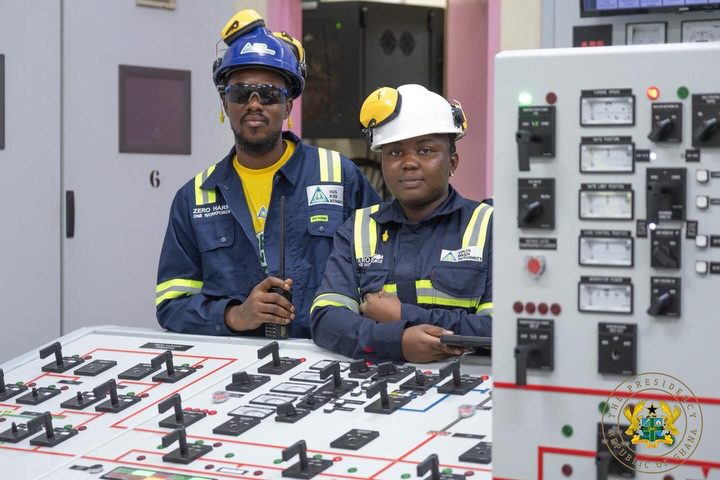
A thorough technical analysis suggests that the proposed shift to a “more modern control room” will do more than just restore power; it will revolutionize the efficiency of the Akosombo hydro plant.
Modernized control rooms utilize Supervisory Control and Data Acquisition (SCADA) systems and AI-driven predictive maintenance tools that allow operators to detect thermal anomalies before they escalate into fire outbreak.
By replacing 1960s-era analog dials and manual switchovers with digital twins and automated load-balancing software, the VRA can significantly reduce “adversity” by minimizing transmission losses and improving the speed of grid synchronization.
This modernization is essential for the green transition, as digital grids are better equipped to handle the variable loads associated with integrating renewable energy sources into the existing hydro-base.
Turning Adversity into Energy Opportunity
President Mahama concluded that “adversity is opportunity,” signaling a commitment to a comprehensive infrastructure upgrade that extends beyond mere repair.

The new control architecture is expected to feature fire-suppression technologies and modular designs that were unavailable in 1964, effectively future-proofing the plant for the next half-century.
As the VRA works to “find a way of bringing it back,” the focus is shifting toward an energy-secure future where modern infrastructure mitigates the risks of aging equipment.
This strategic pivot ensures that the Akosombo substation will not only return to its former capacity but will serve as a sophisticated hub for a more stable and technologically advanced Ghanaian power sector.
READ ALSO: PIAC Technical Manager Flags Low Data as Hurdle to Petroleum Investment Drive