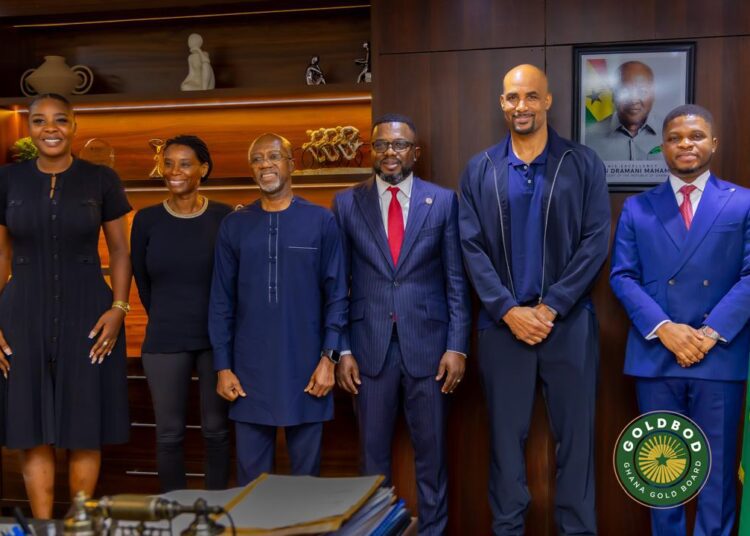
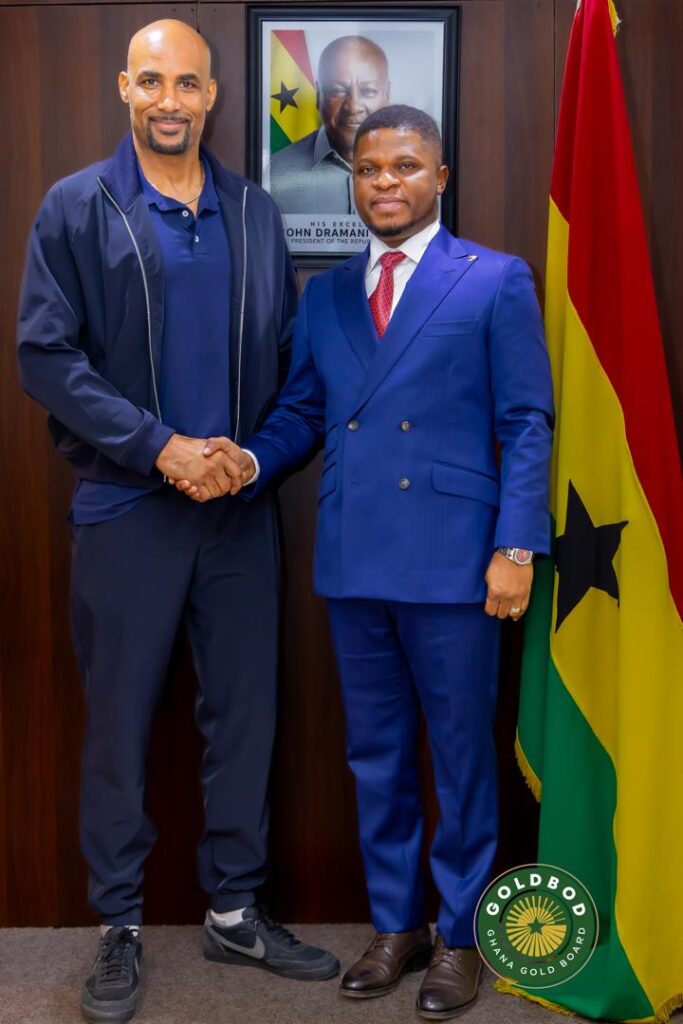
Ghana Gold Board (GoldBod) through its Chief Executive Officer, Sammy Gyamfi, Esq., has hosted Austrian-German actor and business mogul Boris Kodjoe for a high-level strategic engagement focused on advancing value addition within Ghana’s gold sector.
The visit aimed to explore collaborative pathways for strengthening the refining, branding, and global positioning of the nation’s mineral wealth, marking a shift toward more sophisticated resource management.
By integrating Kodjoe’s international influence with the board’s regulatory oversight, the partnership seeks to ensure that Ghana derives maximum economic benefit from its gold deposits rather than remaining tethered to the traditional export of raw ores.
“During the meeting, both parties emphasized the importance of moving beyond the traditional model of exporting gold in raw form and instead prioritizing local beneficiation through refining and downstream development. They noted that such an approach would not only increase national revenue but also create jobs, stimulate industrial growth, and strengthen Ghana’s position in the global gold market.”
Ghana Gold Board (GoldBod)

The engagement provided a platform to discuss how international networks and private sector investments can be leveraged to modernize the local gold trade and enhance downstream development.
Both parties highlighted the necessity of local beneficiation as a catalyst for industrial growth, noting that shifting the focus to processing and refining will significantly increase national revenue and stimulate job creation.
This strategic move is designed to strengthen Ghana’s position in the global market, allowing the country to transition from a primary producer to a sophisticated player in the international bullion and jewelry trade.
Strengthening the Value Chain through International Synergy
The collaboration between the Ghana Gold Board and Boris Kodjoe represents a bridge between local industrial policy and the “global platform” required to elevate the nation’s mineral brand.
By involving a partner with an international profile spanning entertainment and philanthropy, Ghana Gold Board is positioning Ghana’s gold sector to attract diverse private sector investments that are often out of reach for traditional state institutions.
This “strategic partner” approach is expected to enhance the global visibility of Ghanaian refineries, ensuring that the country’s gold meets the highest international standards for branding and marketability.
Furthermore, the involvement of global figures helps validate Ghana’s efforts in “responsible sourcing and value addition,” making the sector more attractive to ethical investors.
As GoldBod pushes for more transparency and modern trade reforms, these international synergies provide the necessary credibility to compete with established gold hubs.
The ultimate goal is to move the industry toward a model where “innovation and investment” drive the economy, allowing Ghana to retain a larger share of the value generated by its natural resources.
Local Beneficiation as a Catalyst for Industrialization
A primary focus of the discussion was the urgent departure from the “traditional model of exporting gold in raw form,” which has historically limited the economic impact of the mining sector.
Sammy Gyamfi reiterated that the board’s mandate is now heavily weighted toward “local beneficiation,” a process that involves refining gold to investment-grade purity within Ghanaian borders.
By doing so, the country can capture the margins typically lost to offshore refineries, thereby “strengthening the local participation” of indigenous firms in the extractive value chain.

The shift toward a “gold economy” is expected to have a transformative effect on the national grid of industrialization.
When gold is refined locally, it provides a steady stream of high-quality raw material for the domestic jewelry and fabrication industries, creating a “secondary market” for Ghanaian artisans.
This approach not only keeps “foreign exchange retention” within the country but also builds a specialized workforce capable of handling complex mineral processing tasks, thus diversifying the skill set of the Ghanaian labor force.
Strategic Branding and Global Market Access
The transition from being a bulk exporter to a value-added producer requires a sophisticated approach to “strategic branding,” which was a key pillar of the talks between GoldBod and Kodjoe.
For Ghana to compete with international gold brands, it must ensure its products are recognized for their quality, ethical origin, and consistency.

This engagement is expected to open the door for future collaborations centered on market access, allowing Ghanaian-processed gold to penetrate high-end markets in the West and East through “international networks.”
As GoldBod continues to push reforms across the value chain, partnerships of this nature reinforce the board’s broader mission of “ensuring that Ghana’s gold works for its people.”
By focusing on innovation and technological upgrades in refining, the board is laying the groundwork for a future where the mining sector is a cornerstone of sustainable development.
The success of this initiative will ultimately be measured by its ability to create a “stronger local economy” that is resilient to global market fluctuations and capable of supporting the nation’s long-term prosperity.
READ ALSO: Zaragoza Goalkeeper Slapped With 13-Match Ban After Derby Altercation