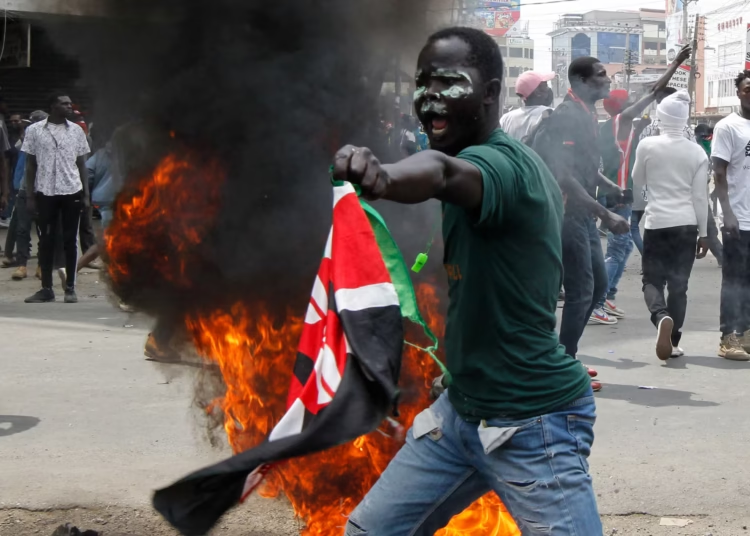
Kenya is facing a renewed wave of politically linked violence that is raising alarm ahead of the next general election, after a high-profile attack on a senator highlighted the growing influence of organised gangs in the country’s political arena.
The recent assault on some politicians, including Senator Godfrey Osotsi in Kisumu, has intensified fears that the country could be sliding back toward the kind of election-related unrest that has previously destabilised the nation.
According to a report from a media outlet, Osotsi was attacked in broad daylight by a group of hooded individuals shortly after leaving a barber shop, in an incident captured on CCTV and widely circulated. He was beaten, robbed, and left injured. While police are still investigating, the senator has alleged the attack was politically motivated, claiming the assailants questioned his stance on President William Ruto’s re-election bid.
This incident triggered a strong public backlash, prompting parliament to summon senior security officials. For many Kenyans, the attack was not an isolated incident but part of a broader pattern of intimidation linked to political rivalries, particularly as the country edges closer to another high-stakes election cycle.
Kenya’s history of political violence is deeply rooted. Since the reintroduction of multiparty politics in the 1990s, politicians have often mobilised unemployed youths into gangs used to intimidate opponents and influence voters.
These networks played a central role in the disputed 2007 election, when around 1,500 people were killed, leaving a lasting scar on the country’s democracy.
Recent developments suggest that these dynamics are resurfacing in a more organised and entrenched form. Interior Minister Kipchumba Murkomen has acknowledged that authorities are struggling to contain more than 100 active criminal gangs, many allegedly linked to political figures. He described them as “decentralised and sophisticated networks,” warning that irresponsible political leadership poses a direct threat to national security.
Police also reported that at least 300 suspects have been arrested in an ongoing crackdown, with weapons and communication devices recovered during operations. However, the absence of any politicians among those detained has drawn criticism from opposition leaders and civil society groups, who argue that those financing and directing the violence remain untouched.
Tensions are being further fuelled by shifting alliances and internal political rivalries. The fallout from the impeachment of former deputy president Rigathi Gachagua and divisions within major parties have heightened competition.
The death of veteran opposition leader Raila Odinga has also reshaped the political landscape, triggering splits that have, in some cases, led to clashes at rallies and public events.
With elections due by August next year, reports of violence at political gatherings, churches and by-elections are becoming more frequent. Opposition groups have accused police of failing to act or, in some instances, standing by as violence unfolds, claims the government denies.
Organised Gangs and Political Rivalries Drive Escalation
The recent attacks have brought into sharper focus the evolving role of organised gangs in Kenya’s political system, where violence is increasingly used as a tool of influence. What distinguishes the current trend is the level of coordination and persistence, with groups operating in ways that suggest planning and backing beyond spontaneous street violence.
Security officials indicated that, many of these gangs have developed clear structures, enabling them to mobilise quickly and operate across multiple regions. Once loosely organised, they now function as networks capable of carrying out targeted attacks on political figures and supporters alike.
The broader political environment is amplifying the risk. Rigathi Gachagua, who is preparing a presidential bid after his removal from office, has also reported multiple attacks on his supporters, including incidents at churches. He and his allies allege these are part of a coordinated effort to undermine his political ambitions, though such claims remain disputed.
Violence has also spread to other arenas. In Kakamega, a political aspirant aligned with the ruling coalition was forcibly removed from a church service earlier this year, highlighting how even non-political spaces are being drawn into it.
Meanwhile, by-elections in several regions have been marred by clashes between rival groups, attacks on polling agents, and police interventions involving tear gas.
Authorities insist they are taking action. Inspector General of Police Douglas Kanja has said security agencies have identified those behind the violence and are working to dismantle the networks. However, critics argue that without addressing the alleged political sponsorship of these groups, efforts to curb violence will fall short.
Moreover, analysts also indicate that the persistence of such networks reflects deeper structural issues, including unemployment and political patronage.
As the election approaches, the accumulation of incidents is fuelling concern that Kenya could once again face widespread unrest if decisive action is not taken.
READ ALSO : ACEP Boss Calls for Infrastructural Upgrade at Power Stations to Ensure Energy Resilience